


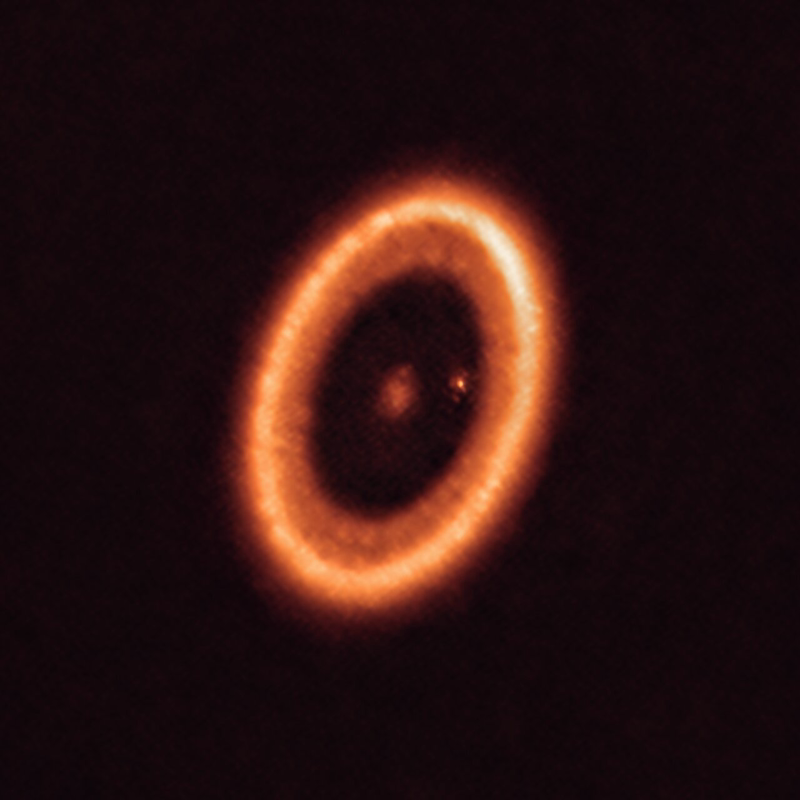
The two planets still growing inside the disk of PDS 70 have been some of the most photographed protoplanets in astronomy since the European Southern Observatory’s Very Large Telescope first imaged them in 2018 and 2019. Now the same system is offering up a second story, one that may explain where the water inside that disk came from. A team led by Aline Novais, a post-doctoral researcher in the Department of Physics at Lund University, reports in Nature Communications that PDS 70 shows variable sodium-line absorption matching the spectroscopic fingerprint of icy bodies sublimating as they swing past their star. The result, the authors say, makes PDS 70 the youngest known system in which exocomet activity has been proposed, and the first such case around a star whose temperature is close to the Sun’s. The story has been picked up by Universe Today and The Brighter Side of News.
PDS 70 sits about 370 light-years away in the constellation Centaurus. It is a K7 T Tauri star, slightly cooler and less massive than the Sun, and at roughly 5.4 million years old it has not yet settled onto the main sequence. Its surrounding protoplanetary disk is split by a wide gap, and inside that gap two gas giants, PDS 70 b at about 20.6 astronomical units and PDS 70 c at about 34.5 astronomical units, are still accreting material. The two planets were the first protoplanets ever directly imaged, and they have become a benchmark for what planet formation looks like while it is still happening. The ALMA image of the system, reproduced below, shows the bright orange dust ring and the dark gap carved out by the two forming gas giants (see the ESO image page for full credit and dimensions; the ESO artist animation shows the system in motion). The novelty in the new paper is not about the planets themselves but about what may be moving through the system alongside them, and what those moving bodies might be carrying inward.
The argument hinges on archival spectra. Novais and her co-author Alexandra Stockwell Murphy, also at Lund, went back to 52 high-resolution spectra of PDS 70 taken with the High Accuracy Radial velocity Planet Searcher (HARPS) on ESO’s 3.6-metre telescope at La Silla in Chile. The observations span 22 nights spread across 2018, 2019, and 2020. Most of the action is in 2018, when HARPS collected 18 epochs of data. Across those 18 nights, the team identified 43 variable neutral-sodium (Na I) absorption components moving at radial velocities from roughly minus 25 to minus 115 kilometres per second relative to the star. The lines were clumpy rather than uniform, sometimes covering only a fraction of the stellar disk, and they changed amplitude, number, and velocity from one night to the next. None of those properties fits a stable, smooth disk wind. All of them fit a stream of small bodies releasing sodium-bearing gas as they swing past the star and heat up.
That spectroscopic pattern is the same one astronomers have been cataloguing for decades around Beta Pictoris, the well-known A-type star surrounded by a debris disk where thousands of exocomet transits have been inferred from variable absorption lines. Beta Pictoris is hot, several times more massive than the Sun, and old enough that its inner system has long since been cleared. PDS 70 is young, cool, and still embedded in a gas-rich disk. The new result extends the exocomet phenomenon to a regime where the surrounding architecture is still being built.
The authors are careful about the word “evidence.” The variable Na I lines are consistent with sublimating planetesimals on highly eccentric orbits, but PDS 70 is also known to drive disk winds, and a sufficiently clumpy wind could in principle produce similar absorption. Novais and her colleagues ran a simple wind model and found that the sodium mass in the lines was substantially higher than the wind model predicted, that the velocity changes from night to night were too rapid for a steady outflow, and that the partial-disk coverage required a spatially confined source. The wind scenario could not be ruled out completely, because the star’s mass-loss rate and accretion properties are not well known. The exocomet scenario remains the preferred interpretation but is not yet confirmed. The authors also note that new observations taken in 2026 with the Ultraviolet and Visual Echelle Spectrograph (UVES, programme ID 0116.C-0329, PI A. Novais) show the activity is continuing, and a detailed analysis of that follow-up dataset is in preparation.
If exocomets are the right explanation, the second question is whether they can physically reach the inner disk at the rate the data implies. To test that, the team ran N-body simulations of planetesimals interacting gravitationally with the two known gas giants, and with a hypothetical third planet in a more distant orbit. In the two-planet case, on average 0.47 percent of the test particles crossed the planetary gap into the inner disk per million years; in the three-planet case, the figure rose to 2.9 percent. Translated into a flux, the simulations suggest that for every 10 Earth masses of planetesimals stored beyond the planets, between about 0.047 and 0.29 Earth masses of icy material could be crossing the gap per million years under the assumed configurations. That is a small fraction, but the inner disk has had millions of years to accumulate it.
The water question is what gives the result its broader reach. JWST’s Mid-Infrared Instrument (MIRI) had previously detected spectroscopic emission from gaseous water close to the star, inside the planetary gap. The origin of that water was not clear. Pure gas-phase synthesis in the disk is possible but slow, and the disk is also cool enough in its outer regions for water ice to be abundant on small bodies. The exocomet scenario links the two: comets perturbed inward by the giant planets sublimate as they pass through the inner disk, releasing water and other volatiles. “Our study suggests that comets may be responsible for transporting water to the inner parts of the planetary system, where planets can form, in the same way as in the early Solar System,” Novais said in a press release accompanying the paper. “It is reminiscent of a possible process in the early Solar System, in which comets may have helped to deliver water to the young Earth,” added Stockwell Murphy.
The comparison to the early Solar System is the point that resonates beyond this one system. The leading explanations for Earth’s water include late accretion of water-bearing asteroids, contributions from icy comets, and outgassing from the planet’s interior. None of those channels is easy to observe in action, because they happened more than four billion years ago. PDS 70 is young enough that the same channels may be operating now, and the planets are still growing, so the inner disk’s water reservoir is still being filled. If a Sun-like star can build a wet inner disk by shepherding icy bodies inward, the same process could have operated around the young Sun, and the question of where Earth’s water came from shifts from “which bodies delivered it” to “how much of it was cometary in the first place.”
The authors are clear that the next step is confirmation. The UVES follow-up is one avenue. Another is the ESO Extremely Large Telescope, now under construction in Chile, which will be able to image structures in the PDS 70 disk at much higher spatial resolution and look for individual transiting comets directly. If those observations find the same sodium clouds on the same highly eccentric trajectories, the exocomet interpretation will harden into a detection. For now, the result is a working hypothesis with strong circumstantial support: variable sodium in HARPS, an inner-disk water reservoir seen by JWST, and a dynamical simulation that says yes, the icy bodies in the outer disk can get there. PDS 70 may not be a complete answer to where Earth’s water came from, but it is the first place astronomers have caught the process plausibly underway in a system that looks, in temperature and architecture, uncomfortably like a very young copy of our own.
 Subscribe to our RSS feed









There are no comments.
Add A Comment