


In a basement lab at Ben-Gurion University of the Negev, a cloud of about 20,000 rubidium atoms has just answered a question physicists have been asking for nearly a century. Cooled to a few nanokelvin above absolute zero and held still by microscopic wires on a fingernail-sized chip, the atoms were nudged into a quantum superposition in which one half of the cloud rose a few micrometres and fell back under gravity while the other half stayed put. When the two halves were brought back together, the interference pattern between them showed a clean phase shift, and that phase shift matched Einstein’s prediction to within 2.5 percent.
The result, published in Science Advances on 2 September 2026 by Dobkowski, Folman, Penrose, Vedral, Schleich and a dozen other collaborators, is the first direct measurement of the quantum phase accumulated by a freely falling particle. It is also a fresh check on Einstein’s equivalence principle, the assumption that gravity disappears for an observer in free fall. The principle works fine for billiard balls and spacecraft. Until now, no one had checked whether it still works when the falling object is in a quantum superposition of two places at once, which is what the Ben-Gurion group, along with partners at Oxford and Ulm, set out to do. That the check matters at all is because general relativity and quantum mechanics describe the universe with completely different mathematical machinery, and they have resisted every attempt to combine them for almost a century. Most attempts to unify the two assume, implicitly, that the equivalence principle still applies at quantum scales, and this result is the first empirical reason to believe that assumption is correct.
Building the right kind of interferometer took the Folman group years. Ordinary atom interferometers, which have existed since the early 1990s, can compare two paths that both involve motion, one slightly higher than the other or one slightly accelerated with respect to the other. What they cannot do is compare a path that is genuinely free of forces against a path that is held artificially still, which is exactly the situation an equivalence-principle test requires, as Ars Technica reported on 11 September 2026. The team called the new device the Quantum Galileo Interferometer, or QGI, in honour of Galileo’s original observations of free fall, and the underlying method is laid out in detail on arXiv.
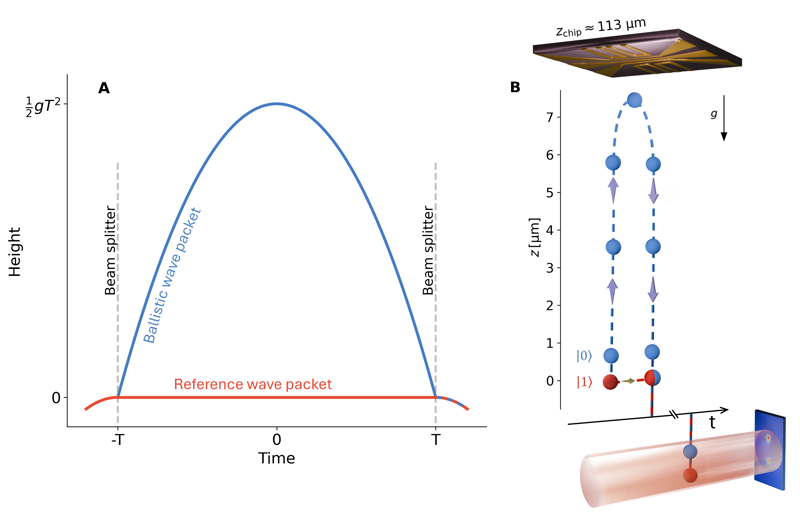
Inside a glass cell held under vacuum, a few micrograms of rubidium-87 gas is cooled into a Bose-Einstein condensate, a quantum state in which all the atoms share a single wave function. The condensate floats about 113 micrometres beneath an atom chip, a flat substrate etched with microscopic current-carrying wires that paint the surrounding space with carefully shaped magnetic fields. The chip itself is mounted upside down, with the wires facing the atoms, so the magnetic gradient can levitate the condensate in place. The whole apparatus is small enough to fit on a desk, which is part of why a single lab group could afford to spend years getting it to work, but the measurement it produces has implications for the largest questions in fundamental physics.
The reason it took so long is that interference, the property the experiment depends on, is fragile. Interference only appears when there is no way, even in principle, to tell which path a particle took; any measurement that distinguishes the two paths destroys the quantum superposition and forces the particle to behave like a localised classical object. Wave packets that have fallen under gravity are moving fast, while stationary wave packets are not, and that difference in speed is itself information about the path, so a naive setup would never produce an interference pattern at all. Folman and his colleagues had to design a sequence of pulses that cancels the path information without cancelling the phase information they actually wanted to measure.
Once the atoms are ready, the experiment unfolds in four microwave and magnetic pulses, summarised in Figure 1 of the arXiv preprint. The first pulse puts every atom into a superposition of two spin states: one that feels the magnetic field and one that does not. A magnetic pulse then kicks the magnetically sensitive state upward, launching it on a ballistic arc, while the insensitive state stays put. A second microwave pulse swaps the roles: the rising atom becomes magnetically insensitive and falls freely under gravity, while the stationary atom becomes magnetically sensitive and is held hovering by a field tuned to exactly cancel its weight. A final magnetic pulse acts as a parachute, gently braking the falling atom so it lands back where it started, where the two halves of each atom can interfere. At their farthest apart, the two trajectories were about 7.5 micrometres apart and the longest free-fall time was about two milliseconds. The interference pattern at the end of each run depends on the phase that the falling path accumulated during its trip. The longer the fall, the more phase, and the chirp in those oscillations is the signature the theory predicts. As the team lengthened the fall duration, the measured phase grew in proportion to gT squared, exactly as general relativity predicts for a classical trajectory and as the equivalence principle predicts for a quantum one.
The interpretation is the part that makes the result satisfying rather than just technical. From the perspective of the falling atom, there is no gravity at all: it is in free fall, the way an astronaut is in orbit, and its wave should pick up no extra phase. From the perspective of the laboratory, the same atom is being pulled downward at 9.81 metres per second squared, and its wave should accumulate a phase proportional to gT squared. The two views should agree, and Einstein’s equivalence principle says they do. The QGI measures the lab-frame phase directly and shows that, to within the experiment’s precision, the falling quantum wave accumulates exactly the phase that gravity predicts. As The Brighter Side reported, the measurement is a checkpoint on the boundary between two theories that physicists are still trying to merge. The result does not say which, if either, will eventually have to give way, but it sets a baseline that future versions of the experiment will sharpen.
A first upgrade is already under construction at Ben-Gurion. The next-generation QGI is being designed to put nanodiamonds, particles roughly ten orders of magnitude heavier than rubidium atoms, into the same kind of superposition. Nanodiamonds sit in a mass range where several competing quantum-gravity models and collapse theories make different, falsifiable predictions, and putting a nanodiamond in superposition for any usable time has not yet been achieved. Folman told Ars Technica that his lab is already working on a design that he hopes will let the heavier experiment run within the next four or five years, though he was clear that it is “a very, very challenging project.” If it works, the team would have a direct laboratory test of the boundary between quantum mechanics and gravity in a regime where competing theories actually disagree.
In the meantime, the September result establishes something that has been assumed but not shown. When an atom falls, the quantum phase it picks up is the phase that gravity, applied classically, would predict. The equivalence principle, written down by Einstein in 1907 and tested for classical masses by Galileo, Newton, Bessel and Eötvös, has now been demonstrated, in a single careful experiment, for a particle that is in two places at once. The result does not resolve the long-standing tension between general relativity and quantum mechanics, but it removes one of the most reasonable doubts about how the two might eventually be unified: that the equivalence principle, which is foundational to general relativity, might quietly break at quantum scales. It does not appear to.
 Subscribe to our RSS feed









There are no comments.
Add A Comment