


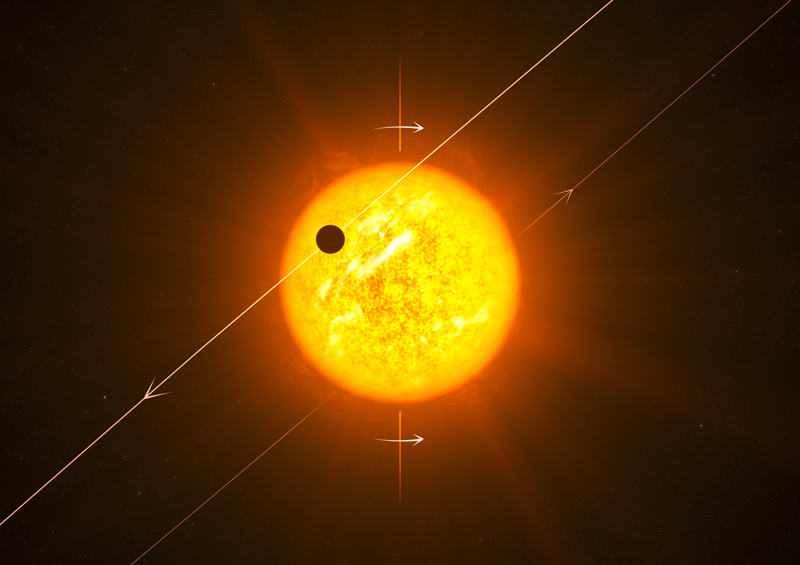
For most of the history of exoplanet science, planets that orbit their host stars in the wrong direction were curiosities reserved for the rare hot-Jupiter systems where gravitational chaos had clearly been at work. A team led by doctoral student Yann Carteret at the University of Geneva has now reported the first retrograde planet ever found around a small, cool red dwarf star, and the result has no obvious explanation. The planet, GJ 3090 b, is a sub-Neptune 73 light-years away in the southern constellation Phoenix, and it traces an orbit that runs opposite to the rotation of its host. For an M-dwarf system, that is new ground.
Why this matters comes down to a single number. The angle between a planet’s orbital plane and the equator of its star, called Psi by the people who measure these things, sits at roughly 136 degrees for GJ 3090 b. Anything over 90 degrees counts as retrograde. In our own Solar System, that angle is between three and seven degrees for every planet, and Mercury nudges a little higher but stays comfortably prograde. The handful of other misaligned systems spotted over the last fifteen years each had a massive companion on hand, another giant planet or a stellar partner whose gravity could tilt or flip a smaller neighbor’s orbit after the fact. GJ 3090 does not. The second planet in the system is too small to do that kind of work, and there is no sign of a stellar companion. Whatever put this world on its current path had to do so without the usual accomplices, which means the textbook explanations of misaligned hot Jupiters do not apply. The find, published in Astronomy & Astrophysics, forces the field to consider mechanisms that would otherwise be filed under unlikely.
The story begins with TESS, NASA’s Transiting Exoplanet Survey Satellite, which flagged GJ 3090 b’s shadow back in one of its southern-sector campaigns. A transit is the easy part. The hard part is figuring out which way the planet is moving when it crosses the star, because that is what tells you whether the orbit is prograde or retrograde. The team watched five separate transits with the NIRPS infrared spectrograph, an instrument built in Geneva and installed on ESO’s 3.6-metre telescope at La Silla Observatory in Chile. NIRPS is tuned to the near-infrared, which is exactly the part of the spectrum where a cool, dim red dwarf like GJ 3090 puts out most of its light, and where telluric absorption from Earth’s own atmosphere is least annoying.
What the team was after is a phenomenon called the Rossiter-McLaughlin effect. As a star rotates, the hemisphere spinning toward Earth is slightly blueshifted, and the hemisphere spinning away is slightly redshifted, from the regular Doppler motion of the stellar surface. When a planet transits, it blocks a small patch of that rotating surface. If the planet moves across the star in the same direction as the star’s spin, the planet first covers a blue patch and the star appears briefly redder, then it covers a red patch and the star appears bluer, leaving a characteristic bump-dip pattern in the radial-velocity curve during the transit. For GJ 3090 b, the team saw the order reversed on every one of the five transits, with the red patch covered first. The orbital obliquity they derived is 136 degrees, in line with the inverted transit shape, and consistent across nights. There is no ambiguity left in the geometry, and that is what makes the result clean.
The science and engineering of the result sit at the same intersection that has made red dwarfs the most-studied stellar hosts over the past decade. M dwarfs are smaller and cooler than the Sun, so a sub-Neptune-sized planet produces a deeper transit signal and a larger radial-velocity wobble per unit mass than the same planet would around a Sun-like star, but the wobble from a 2.2-Earth-radius, 4.5-Earth-mass world with a 2.9-day period is still small and the transit still short. NIRPS’s design wavelength range of roughly 0.95 to 1.8 micrometres lines up with the infrared peak of a cool red dwarf, and its stability across a single transit, and across five transits taken on different nights, is what allowed the team to distinguish a genuine 136-degree obliquity from a smaller angle buried in noise. Carteret and his co-authors, including Léna Parc and Vincent Bourrier at UNIGE, point out that GJ 3090 b is now the smallest exoplanet to have its orbital obliquity mapped around any M dwarf. The technical milestone is as important as the discovery itself, because it means the technique works on the kinds of planets that are most common in the galaxy.
What remains genuinely puzzling is the missing companion. In every previously known misaligned multiplanet system, the configuration can be traced to gravitational interactions with a much larger body, either a second giant planet in the same system or a binary star whose orbital plane pulled things off course over hundreds of millions of years. GJ 3090 has a second planet, but it is not massive enough to do that kind of work, and there is no sign of a stellar companion. The team’s favoured hypothesis is a primordial disk flip, the idea that after the original protoplanetary disk dissipated, a second, misaligned disk of gas and dust fell onto the star from the surrounding interstellar medium. If that second disk arrived at the right angle, the planets that formed inside it would inherit its orientation rather than the star’s. There is precedent in so-called Peter Pan disks, which survive far longer than standard disk-evolution models predict, around other young stars. GJ 3090 b might be a snapshot of what happens when one of those long-lived disks finally does form planets, and the planets turn out to be running around the wrong way, in the wrong direction.
The takeaway is that this is the kind of measurement that quietly resets how a discovery category gets built. Until now, retrograde exoplanets were a hot-Jupiter phenomenon with a tidy dynamical explanation. Now there is a sub-Neptune on a 2.9-day orbit around a small red dwarf, and the dynamical explanation has fallen away. NIRPS will keep taking data, and the same technique can be applied to any of the dozens of transiting M-dwarf planets already on the books. Carteret’s team plans to extend the survey, and at least one follow-up is already in the queue. Whether GJ 3090 b turns out to be a one-off oddity or the first example of a new population of backwards travelers around small stars is the question that the next year or two of observations will answer.
 Subscribe to our RSS feed









There are no comments.
Add A Comment