


A white dwarf 145 light-years from Earth has just given astronomers a problem they did not know they had. The star, catalogued as HS 0209+0832, was observed by Hubble in 1999 as part of a snapshot survey of stellar remnants. Twenty-six years later, a doctoral candidate at the University of Warwick pulled the same archival spectra out of the Hubble archive, ran roughly a hundred previously unidentified lines against an updated atomic database, and found that most of them were niobium, the element used in jewelry alloys and MRI superconducting magnets. The team’s conclusion, published Monday in Nature Astronomy, is that HS 0209+0832 may be hosting a planet that was not born with the star, but assembled afterwards from the chemically enriched debris the star itself shed when it died. Earth is a first-generation planet, made from the same disk of gas and dust that formed the Sun. The candidate around HS 0209+0832 would be something rarer: a second-generation world.
The NASA Hubble press release on the discovery frames the find as the first credible evidence that the white-dwarf stage of a star’s life is not an epilogue but a chapter that can produce new worlds, a result Phys.org reported on the same day. Lead author Jamie Williams put it more concretely: rather than the white-dwarf stage being a kind of final epilogue, the team’s result implies that what we have observed in old planetary systems so far is only the opening chapter of a much longer story, with new worlds potentially showing up to continue it. The conventional view of what happens after a Sun-like star loses its envelope has been that any close-in planets get engulfed during the red-giant phase, and any survivors settle into wider orbits as the white dwarf cools. Whether a fresh planet can condense out of the gas the dying star leaves behind has been mostly theoretical.
That theoretical picture has weight because the universe does not waste matter. A Sun-like star ends its life by inflating into a red giant, then blowing off its outer layers as a planetary nebula. The exposed core, made mostly of carbon and oxygen, is the white dwarf. The ejected envelope is rich in everything the star made during its lifetime, including elements heavier than iron. To find niobium in a white dwarf’s atmosphere in the quantities the Hubble data show requires that the white dwarf recently accreted material that was processed inside an evolved stellar interior, exactly the kind of material that would also be sitting in a debris disk around the white dwarf and available to form planets.
Williams and her co-authors, including Boris Gänsicke at Warwick and Nicholas Stone at the University of Wisconsin–Madison, did not start with a planet hypothesis. They started with a mystery spectrum. Hubble’s Cosmic Origins Spectrograph had been pointed at HS 0209+0832 in 1999, and the recorded spectrum contained roughly one hundred narrow absorption lines that did not match any known atomic transitions at the time. Williams ran the unidentified lines against modern atomic line lists and found that the largest single chunk were niobium transitions missing from the original reduction. The data were not new; the database was. The abundance implied by the absorption depth is several orders of magnitude above what the Sun’s photosphere shows, and niobium had not been reported in any other white dwarf analyzed to date. The most natural source is a body rich in heavy elements in a close orbit, shedding material that is being pulled onto the white dwarf.
Confirmation came from two independent places. The Far Ultraviolet Spectroscopic Explorer (FUSE), a NASA mission that operated from 1999 to 2007, also observed HS 0209+0832 and recorded strong niobium lines in its own bandpass. NASA’s Transiting Exoplanet Survey Satellite (TESS) spent four months staring at the white dwarf and detected a periodic brightness variation consistent with a planet orbiting at roughly 6 million kilometers, much closer to the white dwarf than Mercury is to the Sun. Putting the timing and the chemistry together, the team estimates the candidate is a gas giant roughly the size of Jupiter, on a tight orbit, currently being stripped of its outer atmosphere by the white dwarf’s intense radiation. The planet’s evaporating envelope should be feeding a comet-like tail of gas that spirals back onto the white dwarf.
The geometry matters. White dwarfs are small, about the size of Earth, with masses packed into a volume a million times smaller than the Sun. Anything that gets close enough to be tidally disrupted enters the Roche limit and is shredded into a disk. The HS 0209+0832 system appears to have exactly that configuration: a gas giant that has migrated close enough to lose mass, a debris disk of heavy-element-rich gas spiraling inward, and a white dwarf whose atmosphere records the chemistry of what is being added. Niobium at the observed level is not a chondritic signature. It points to material that has been processed inside an evolved star and then recondensed.
The team is careful with the claim. The TESS photometry is consistent with a planet, but a single four-month light curve does not exclude other explanations: rotating star spots can produce periodic brightness variations at the few-percent level. The Hubble spectrum is more robust. The niobium is there, in a quantity that requires an external source. The working hypothesis is that the source is a second-generation gas giant losing atmosphere onto a disk, and the team plans to keep monitoring HS 0209+0832 with Hubble and other facilities to nail down the orbit, the mass, and the composition of whatever is feeding the white dwarf. If the candidate holds up, it is the first direct evidence that planets can form from the debris of a dead star, opening a new population of objects to look for around the white dwarfs in the local galactic neighborhood.
Why this matters is that the universe has a long way to go after a Sun-like star dies. Roughly 97 percent of all stars in the Milky Way will end up as white dwarfs, and the galaxy is currently littered with several billion of them. At least a quarter show evidence of being polluted by surrounding debris, most of it attributed to the tidal disruption of rocky asteroids and the occasional comet. If even a small fraction of the polluted white dwarfs turn out to host second-generation planets, the number of objects in the galaxy that are technically “planets” goes up by an order of magnitude. Some of those planets will sit in the habitable zones of their white dwarfs, in stable thermal environments for billions of years, long after main-sequence stars like the Sun have gone through their red-giant phases. White-dwarf planets are an observational target with a candidate list that started, this week, with exactly one entry.
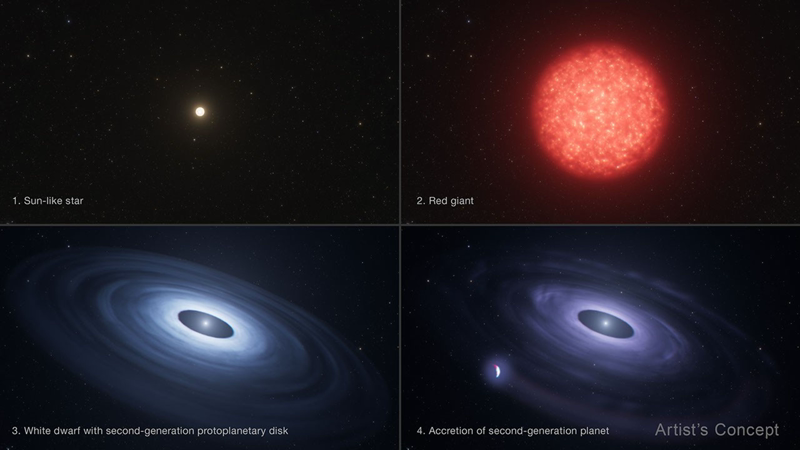
The Hubble Space Telescope has been operating for more than three decades, and the HS 0209+0832 result is a reminder that decades-old data still has surprises in it. The 1999 spectrum was not wrong; it was just unreadable at the time. The four-quadrant illustration NASA released with the paper walks through the four stages a Sun-like star has to go through to make a system like this: main-sequence, red giant, white dwarf with a second-generation protoplanetary disk, and finally the accretion of a second-generation planet. Each stage was known. Putting them in sequence, with a real system at the end of the chain, is the part that was missing.
The next paper from the team is likely to be a follow-up spectroscopic campaign on HS 0209+0832, looking for variability in the niobium line strength as the putative planet orbits and sheds mass in chunks. A measurable phase dependence, with niobium absorption deepening when the planet is between the white dwarf and the observer and shallowing when the planet is behind, would be the cleanest confirmation of the picture. Failing that, a direct imaging campaign with the James Webb Space Telescope at infrared wavelengths could pick up the thermal emission of the disk and the planet itself. Earth formed out of the leftover gas from the Sun’s birth. The next planet the field confirms, if the Williams result holds, will be the first that formed out of the leftover gas from a star’s death. The difference is a new population of worlds, sitting in plain sight in the Hubble archive, waiting to be read.
 Subscribe to our RSS feed









There are no comments.
Add A Comment