


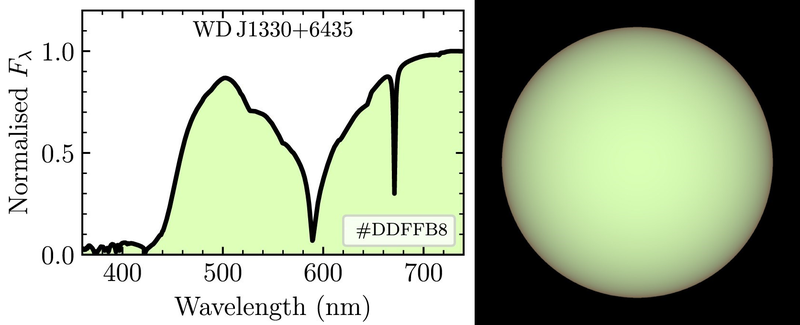
A star that would look green if you stood on a planet beneath it sounds like the kind of object that should not exist. The colours a star shows in the night sky are set almost entirely by temperature. Cool stars glow red, stars like our Sun glow white, hot stars glow blue, and the hottest of all glow a faint violet at the edge of vision. Green sits in the middle of the visible spectrum, but stellar blackbody curves tend to slide through it on the way from orange to blue without ever pausing there. For more than a century, the quiet compact rule “stars are red, orange, white, or blue, and that is the list” has been a piece of astronomy no one had to defend, because no counterexample ever showed up.
On 15 October 2026, Mark Hollands at the University of Warwick and three collaborators broke the rule. In a paper titled “Any colour you like: the diverse chromaticities of white dwarfs,” Hollands and his co-authors report the first known star that would actually look green to a human standing underneath it, and at the same time identify what is probably the reddest star on record, a deep salmon-pink white dwarf only 48 light years from Earth that pushes the chromatic boundary in the other direction. A preprint of the paper has been on arXiv since the same day. The work turns on a method that sounds obvious in hindsight but had not been done at scale before: take a high-quality stellar spectrum, feed it through a model of human colour vision, and see what comes out.
The green object is a cool white dwarf called WD J1330+6435, sitting roughly 280 light years away in the constellation Draco. It is about 4,000 degrees Celsius at the surface, which on its own would make it look orange. Instead, in the team’s modelling, it glows a ghostly chartreuse. The reason is chemistry rather than physics in the usual sense. The atmosphere of a cool white dwarf can reach a density close to one gram per cubic centimetre, comparable to water and millions of times denser than the Sun’s photosphere. Under those conditions, trace metals behave very differently than they do in ordinary stellar atmospheres. Sodium, calcium and lithium pulled in from a long-disrupted planetary system absorb light across a much wider range of wavelengths than they would at lower densities. In WD J1330+6435, sodium draws a broad V-shaped valley centred near 600 nanometres that swallows yellow, orange and red. Calcium adds a deep notch at 400 nanometres that takes out some of the blue. Lithium adds a thin gap near 670 nanometres. What survives between those three absorptions is mostly green. Hollands told a University of Warwick press release that the experience of standing beneath such a star would feel like “something out of science fiction,” and that no other star, living or dead, has been credibly reported as green before.
To put that result on a solid footing, the team did not stop at one object. A white dwarf is the exposed core of a Sun-like star that has shed its outer layers. There is no fusion happening any more; the object is a cooling cinder, dense as a planet, slowly dimming over billions of years. The earliest examples astronomers found were the brightest and hottest of the population, glowing white or pale blue, and that is how the whole class got its name. Cooler white dwarfs are dimmer and harder to spot, so for most of the history of the field they have been undercounted. Hollands and his co-authors, Boris Gänsicke and Pier-Emmanuel Tremblay at Warwick plus Detlev Koester, set out to ask a simple question that turned out to have a complicated answer: what colours would white dwarfs actually show if we could see them up close? For the 151 white dwarfs within 20 parsecs, or roughly 65 light years, of the Sun, the team measured a median correlated colour temperature of about 6,800 Kelvin, which is exactly the white of a standard computer display. Most stars, Hollands noted, behave like “perfect radiators,” so their colour is set almost entirely by temperature, and the local sample of white dwarfs obeys that rule on average. The textbook picture that white dwarfs look bluish is, the team argues, a selection effect. Surveys that pick up the faintest sources in the sky are biased toward the hotter, brighter white dwarfs that can be seen from far away. The local sample is dominated by cooler, dimmer ones, and those look, on average, plain white.
Roughly five out of those 151, around three percent, looked nothing like a blackbody. Two glowed yellow and three glowed pink. When the team broadened the search to known white dwarfs across the rest of the sky, the outliers became more vivid. WD J1330+6435 is the chartreuse green star described above. A second star, WD J1011+2845, only 48 light years from Earth in Leo, is the reddest star ever recorded. Its atmosphere has a deep convection zone that has reached the helium-dominated core, lifted carbon up to the surface, and let it form C2 molecules. Those molecules absorb blue, green and yellow so heavily that almost everything that leaves the star is squeezed into wavelengths longer than 600 nanometres, the deep salmon end of the visible spectrum. A third star, WD J2356-2054, looks vivid blue even though its surface temperature is only about 4,000 Kelvin. The mechanism there is different again, hydrogen molecules colliding with helium atoms in the dense atmosphere, and the team flags it as one of the bluest cool stars known. The pattern that emerges is that white dwarfs split into a few colour families tied to what is in their atmospheres: carbon-rich ones lean pink or purple; stars that have swallowed rocky debris from old planetary systems lean yellow, orange or green depending on which metals dominate; mixed hydrogen-helium atmospheres with their own peculiar chemistry tend toward cyan or pale blue. The reason this matters for the rest of astronomy is that the colour is a reading of what the star has eaten. White dwarfs that show metal absorption lines in their atmospheres are, by definition, white dwarfs that have been pulling in the rocky leftovers of their former planetary systems. Polishing the colour, this new paper shows, can pinpoint which elements they have been consuming and how recently. WD J1330+6435 is a fossil of a planetary system that has been mostly devoured, and the green glow is the colour of those remnants, briefly visible in the atmosphere of the star that ate them. The same approach can in principle be extended to the cooler white dwarfs being catalogued by Gaia, which should turn up more coloured outliers in the years ahead. Across the Milky Way’s full census of several billion white dwarfs, the team’s estimate of one unusually coloured star in thirty is a small fraction per object but a very large absolute number. The day Gaia’s pipeline finishes classifying the nearest few hundred cool white dwarfs, several dozen more greens, pinks and blues are likely to come out of the noise. Standing on a planet in the WD J1330+6435 system, looking up at a green sun, would not be science fiction at all. It would simply be Tuesday.
 Subscribe to our RSS feed









There are no comments.
Add A Comment