


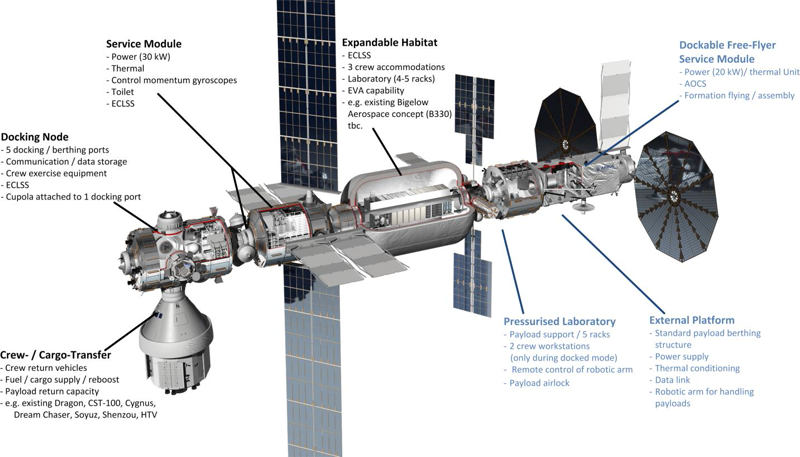
The drawing is the concept schematic from Jahnke et al., taken from the open-access manuscript held in DLR’s electronic library.
On 15 December, ministers from ESA’s member states will gather in Rome to settle how Europe stays in low Earth orbit once the International Space Station is retired. NASA’s part of that timetable is fixed rather than debated: the agency has committed to operating the station through 2030 and has already picked SpaceX to build the vehicle that brings the whole structure down in a controlled manner afterwards, under a contract with a potential value of $843 million (NASA on the US Deorbit Vehicle selection). What is still open is whether Europe buys seats on someone else’s station or builds hardware of its own.
Eight years ago the German Aerospace Center had already drawn that station. The Orbital Hub concept, published in 2018 by Jahnke and colleagues in the system analysis group at DLR’s Institute of Space Systems in Bremen, describes a small modular outpost made of two elements: a base platform holding a permanent crew of three, and a laboratory that flies free of the crew for months at a time (Jahnke et al., Orbital Hub, CEAS Space Journal). The timing makes it more than a museum piece. The paper notes that moving between two crewed orbital platforms has historically taken 10 to 15 years, so a direction chosen in December 2026 is already late for hardware aimed at the 2030s.
ESA put three scenarios to its member states ahead of the November 2025 ministerial. The first leans on commercial stations flown by others, the second buys a limited amount of European hardware for use on those stations, and the third proposes a European-led outpost that accepts contributions from partners outside Europe. In September 2026, ministers meeting at the International Space Summit in Paris endorsed a call to boost European space exploration, naming three priorities: keeping European access to low orbit after the station, a stronger presence on and around the Moon, and using both as staging posts for eventual Mars missions. The argument for the third scenario is that Europe stops being an occasional passenger in someone else’s vehicle and starts owning it and keeping the keys.
Cargo is the unglamorous half of the answer, and it is already under contract. At the same Paris summit, ESA signed a service deal with The Exploration Company worth €760 million for its Nyx capsule, with €310 million set aside for a demonstration flight to the ISS and two optional service missions worth €450 million still to be confirmed. The company covered 40 percent of the demonstration through private investors, with ESA taking the remaining 60 percent under the ALADDIN programme, whose name spells out autonomous docking to an ISS node (ESA on the ALADDIN contract). ESA framed the award as the first and largest capsule transport contract it has handed to a European company, and the agency is now preparing options for ministers to weigh in Rome (ESA media invitation for the December ministerial).
How the DLR concept was built matters as much as what it proposed. The system analysis group started from the science community rather than from hardware, running a workshop to collect research requirements and defining strawman payloads from the result. Those fed concurrent engineering studies in which industry engineers and flown astronauts sat alongside the analysts, refining a first draft design day by day until the requirement set and the layout were consistent. The character of the station comes straight out of that requirement list. One entry states that no spacewalk should be needed for assembly or operation, with EVA reserved for contingency cases alone. Another caps the free-flying element at under 5 metres in diameter, 15 metres long, and below 19,000 kg at launch, the mass a single Ariane 6 flight was assumed to lift.
The base platform carries the people: a service module supplying 30 kW of electrical power, a docking node with five ports, and an expandable habitat built on Bigelow Aerospace’s BA-330 for three crew. The second element, the Free Flyer, holds the more interesting decisions. It is a pressurised laboratory wrapped around an external platform, roughly the size of a Kibo module with its exposed facility, and it flies on its own for about three months before returning to dock for a fortnight of servicing and payload exchange. That separation is the point of the whole design. Crew activity generates vibration and air currents, and a laboratory that leaves the crew behind can hold microgravity quality near one millionth of a g while remaining serviceable by the same people who visit the station. The heritage behind it is deliberate and named in the paper: the pressurised section is based on Columbus with a shortened length, the rendezvous sensors and the reaction control thrusters come from the European ATV cargo ship, and the external truss borrows from Kibo and the ISS structure. A seven degree-of-freedom robotic arm with roots in DLR’s DEOS programme rides a circular rail around that truss to move payloads out of the airlock and onto the platform.
The engineering numbers are where the cost argument hides. Mass across all of the parts came to roughly 60,000 kg, launchable in three flights, with the base platform itself weighing 65 tonnes at 30 kW of power, a little over 15 percent of the station’s in-orbit mass and about a quarter of its electrical budget. The authors compare that to the ISS in 2000, when Zarya, Unity, Zvezda and the first truss element together reached about 60 tonnes with 17 kW, and argue the comparison holds for the functions that matter: crew living, life support, power, attitude control and docking. Propulsion is where the Free Flyer is both clever and awkward. It carries four 400 newton chemical engines and 24 thrusters of 220 newtons each for agility, with tanks for about 760 kg of bipropellant, enough for one complete free-flying phase including rendezvous and docking. The electric system uses RIT ion thrusters in the 10 to 130 millinewton range, and the paper estimates that 660 kg of xenon would cover the vehicle’s 15-year life. Refuelling those high-pressure tanks in orbit is not a solved problem, and the authors say so, offering exchangeable tanks handled by the robotic arm, on-orbit servicing, or shorter free-flying periods as the ways out.
The cost estimate came by analogy first, borrowing the ISS figure of 80 million dollars per tonne and landing on 5.1 billion dollars for the base platform, dropping to 3.5 billion if the habitat module is bought rather than developed. A bottom-up estimate for the first flight hardware put base platform development at about 2,220 million euros and the Free Flyer at 530 million euros, roughly 2.8 billion euros for the pair. The authors then draw the uncomfortable conclusion: that total is more than half of ESA’s entire budget for 2017, which is why they argue the concept cannot be built by Europe alone.
That is the question now in front of ministers. ESA selected Airbus Defence and Space and OHB in late September to run parallel feasibility studies on the third scenario, with six additional industrial and institutional partners the agency did not name (European Spaceflight on the study awards). ESA has asked both consortia to draw on European hardware heritage, including the Columbus module and the European Service Module built for Orion, and to deliver a minimum viable product rather than a full station. A SpaceNews report puts the ceiling at €1 billion for each three-year block of development funding, with development limited to two such periods. Whether the Orbital Hub drawing ever becomes hardware is doubtful: its three-launch layout predates the commercial stations now in the pipeline, and its price tag was set in 2016 euros. What survives is the requirement set it produced, and those are the requirements the current studies keep restating: a small crew, autonomous systems doing the servicing, no routine spacewalks, and hardware that separates crew time from payload quality. Europe has to pick between buying seats and owning a vehicle on 15 December. The blueprint for the vehicle has been sitting on a shelf for eight years.
 Subscribe to our RSS feed









There are no comments.
Add A Comment