


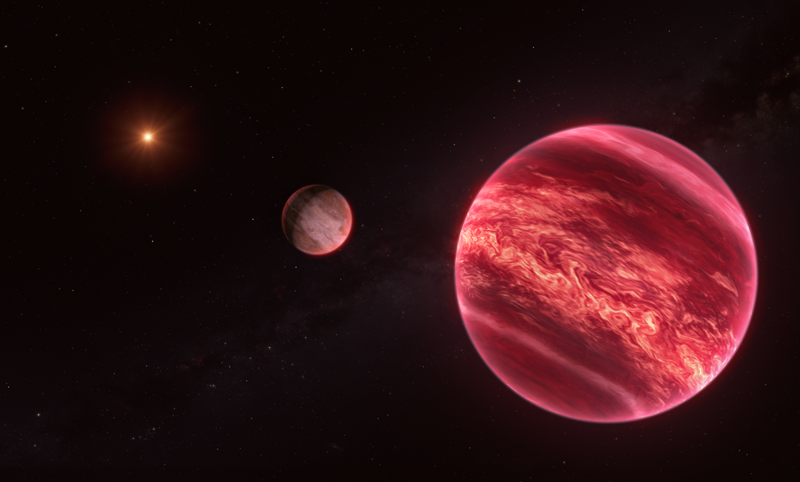
A moon usually has a simple job description: it goes around a planet. The candidate announced this week in the CD-35 2722 system breaks that shortcut. It appears to orbit a brown dwarf, while the brown dwarf itself circles a small star. The outer object has at least the mass of Jupiter. The middle object is about 37 times as massive as Jupiter, too heavy to fit the usual planet category but too light to sustain hydrogen fusion like a star, according to the European Southern Observatory’s release.
That makes the system a three-level orbiting arrangement, but “exomoon” is not quite the right label. The authors of the Nature study call it a planetary-mass exosatellite and describe the result as evidence, not a final, uncontested discovery. That caution matters. The object was not photographed as a separate dot. Researchers inferred its pull from the motion of its brown-dwarf host.
Artist’s impression of CD-35 2722. The star is at left, the brown dwarf is in the foreground, and the newly found object is near the centre. Credit: ESO/M. Kornmesser. ESO image page.
Astronomers have found more than 6,000 exoplanets, but no moon orbiting one of those planets has been confirmed without serious dispute. A planet’s moon is smaller and fainter than the planet, and the planet is already lost in the glare of its star. The geometry makes the signal hard to isolate. In CD-35 2722, the host is a brown dwarf, which is dimmer than an ordinary star and can be observed directly with instruments built for high-contrast infrared work. That changes the observing problem, even if it does not make the interpretation easy.
The result also tests how useful familiar categories are. A moon-like object is defined by the body it orbits, while a planet is often defined by its mass, formation history, or the way it dominates its orbit. Those definitions work tolerably well in the Solar System. They become awkward when a Jupiter-mass body circles a brown dwarf. Calling it a moon describes its orbit. Calling it a planet describes its scale. Calling it an exosatellite avoids pretending that one word settles the physics.
There is a practical reason to care about the label debate. If this detection holds up, it gives observers a new class of target. They can search for satellites around directly imaged brown dwarfs, where the host’s spectrum is accessible and the companion’s gravitational effect may be measurable. The sample will be small, but the method is concrete enough to test.
CD-35 2722 is a star roughly half the Sun’s mass, located about 73 light-years away in the constellation Columba. Its companion, CD-35 2722 B, was directly imaged years ago and is a brown dwarf. The ESO team describes the brown dwarf as orbiting the star on a timescale of about 5,000 years, which means that the star and brown dwarf barely move across a human observing campaign. The newly reported object is the fast-moving part of the system: it circles the brown dwarf.
The researchers used the Very Large Telescope’s CRIRES+ instrument, a high-resolution infrared spectrograph. The observing programme monitored the brown dwarf from October 2023 through January 2025, according to the open version of the paper. The aim was to measure tiny changes in the brown dwarf’s radial velocity, the component of its motion toward or away from Earth.
A satellite changes that velocity because the brown dwarf does not sit perfectly still. Both bodies orbit their common centre of mass. If the satellite is on one side of that balance point, the brown dwarf moves slightly toward us; half an orbit later it moves slightly away. The resulting pattern is periodic. In principle, it is the same basic idea used to discover the first exoplanets around Sun-like stars, applied one level down to a brown dwarf and its companion.
The analysis found a periodic signal consistent with at least one planetary-mass body orbiting CD-35 2722 B. The Nature paper reports a Jupiter-mass exosatellite candidate. “Candidate” is doing real work here. A radial-velocity curve can be distorted by instrumental systematics, activity in the brown dwarf’s atmosphere, or an incomplete model of the system. The team therefore presents the finding as strong evidence rather than an official first exomoon announcement.
The system’s arrangement is unusual even before the terminology begins. The star is the largest body. The brown dwarf is a companion that formed or evolved in a regime between planets and stars. The outer body has the mass of a gas giant but occupies the satellite role. In our Solar System, Jupiter’s moons are far less massive than Jupiter. Here, the supposed moon may be a substantial fraction of its host’s mass, so the two-body orbit is better understood as a binary pair nested inside a wider stellar orbit.
Follow-up observations will have to answer several questions. Does the signal repeat with the same period? Can independent instruments recover it? Does the inferred mass remain stable when the orbit and brown-dwarf properties are fitted together? And can the system’s long-term dynamics keep the outer body bound while the brown dwarf travels around the star? A few clean observing seasons could do more for the claim than a louder headline would.
Radial velocity does not measure an object’s mass directly. It measures the line-of-sight speed of the body being observed. The mass estimate comes from fitting an orbit to the velocity curve and combining that fit with the host mass and orbital geometry. If the orbit is viewed nearly face-on, the true companion mass can be larger than the minimum value inferred from the measured wobble. That is one reason the paper uses language such as “at least as massive as Jupiter.”
CRIRES+ helps by spreading infrared light into a detailed spectrum. Molecules in the brown dwarf’s atmosphere absorb particular wavelengths. As the dwarf moves, those absorption lines shift through the Doppler effect. The instrument tracks the shifts against a wavelength reference, while the analysis separates the brown dwarf’s motion from the Earth’s motion and from the instrument’s behaviour. The expected signal is small, so many individual spectral lines can be combined to improve the velocity estimate.
The nested orbit adds another layer. The brown dwarf’s broad, slow motion around the star is nearly constant over the observing window, while the satellite’s motion should be much faster. A useful model must account for both. It must also distinguish orbital motion from changing atmospheric patterns. Brown dwarfs are not quiet, featureless balls of gas: clouds and temperature variations can alter their spectra. A signal that survives those tests is much more persuasive than a visually pleasing curve.
Stability is a separate engineering-style constraint. The satellite must remain inside the brown dwarf’s gravitational sphere of influence, often approximated by its Hill sphere, while avoiding an orbit so close that tides or disruption become dominant. The star’s distant pull sets the outer boundary. A long-lived configuration needs room between those limits. The reported architecture remains useful even if the object is eventually reclassified: it gives dynamical modelers a real system to stress-test.
The CD-35 2722 result is best read as a careful detection claim, not as the end of the exomoon hunt. Researchers have found a periodic radial-velocity signal in the directly imaged brown dwarf CD-35 2722 B, and the signal is consistent with a companion at least as massive as Jupiter. That is enough to make the system worth following. It is not enough to erase every alternative explanation.
The interesting part is the mismatch between orbit and category. The object behaves like a moon because it circles a brown dwarf. Its mass makes it look like a planet. The brown dwarf itself occupies the middle ground between planet and star. Nature has supplied a system that forces the vocabulary to catch up with the observations.
For now, “planetary-mass exosatellite” is the honest name. More observations will decide whether it becomes the first broadly accepted exomoon-like detection, or a well-measured example of how messy planetary systems can be.
 Subscribe to our RSS feed









There are no comments.
Add A Comment