


In a star cluster about a thousand light years away, the James Webb Space Telescope has found brown dwarfs that weigh about as much as two Jupiters apiece. That is one fifth of one percent of the Sun’s mass, a figure that used to live exclusively in the planetary regime. The objects sit at the floor of how small a star-formation process is willing to go, and their spectra carry a chemical fingerprint no one had seen outside the solar system before. Researchers are now arguing they deserve their own spectral class.
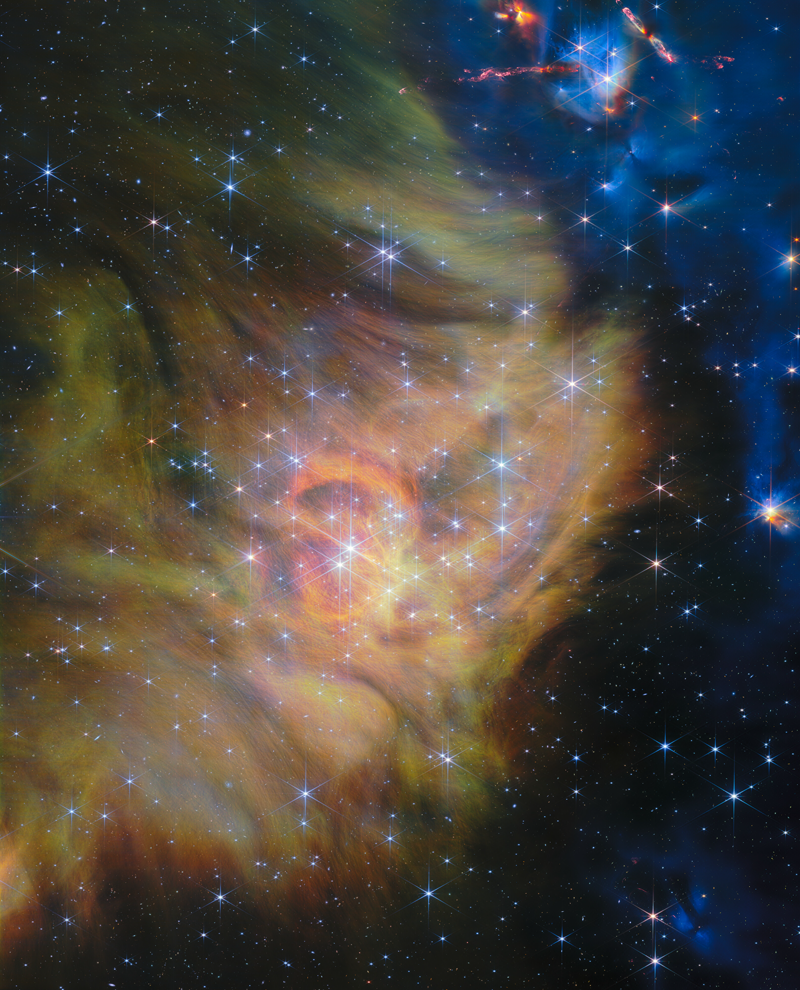
The story comes from a paper by Kevin Luhman of Penn State and Catarina Alves de Oliveira of ESA, published in The Astrophysical Journal Letters and paired with a NASA/ESA/CSA Webb press release on 15 September 2026. The target is IC 348, a star-forming region in the constellation Perseus, sitting inside the larger Perseus Molecular Cloud about 1,000 light years from Earth. IC 348 is a familiar target for brown dwarf hunters; it has been productive for two decades because it is close enough that its lowest-mass members are bright, and young enough that its brown dwarfs are still warm and easy to detect. The cluster contains roughly 400 stars aged between two and five million years, surrounded by wisps of gas and dust lit up by the embedded young stars.
Why does the bottom of the mass spectrum matter? Stars form when cold clouds of molecular hydrogen collapse under their own gravity. The collapse squeezes the protostellar core until the center gets hot enough to fuse hydrogen into helium, and that nuclear ignition is what defines a star. Below about 8 percent of the Sun’s mass, the core never gets hot enough for sustained hydrogen fusion. Those objects are brown dwarfs, sometimes called “failed stars,” even though most of them briefly fuse deuterium early in their lives. The upper end of the brown dwarf range is reasonably well-defined, in the 60 to 75 Jupiter-mass zone. The lower end is not. Observationally, the population thins out and the objects fade, and the boundary where star formation simply stops producing bound objects is hard to pin down. Webb is well suited to the hunt because brown dwarfs are brightest in the infrared, and Webb is the most sensitive infrared telescope ever flown.
In 2022, Luhman and Alves de Oliveira used Webb to identify three new brown dwarfs in IC 348, with the faintest weighing only three to four Jupiter masses. The new paper pushes deeper. Using Webb’s Near-Infrared Camera (NIRCam) in 2024, the team imaged a wider field in IC 348 and identified thirty-nine new brown dwarf candidates based on color and brightness. They then turned to Webb’s Near-Infrared Spectrograph (NIRSpec) in 2025 to confirm which candidates were genuinely sub-stellar. Nine of the fifteen candidates they followed up spectroscopically turned out to be sub-stellar members of the cluster. The faintest two weigh only about 2 Jupiter masses each, or roughly 0.19 percent of the Sun. That is the lowest mass at which a brown dwarf has been confirmed by spectroscopy, and it shrinks the mass range of confirmed brown dwarfs by a factor of roughly seven.
One of those 2-Jupiter-mass objects also shows excess emission from a circumstellar disk, which is the standard signature of raw material for planet formation. If a brown dwarf near the planetary mass limit has its own protoplanetary disk, the eventual system would be hard to describe with familiar vocabulary. The “star” at the center would weigh only twice as much as Jupiter, and the planets would weigh less than that. The team’s framing in the paper is straightforward: a planetary system whose central object is only twice the mass of Jupiter is within reach of current data, even if the terminology is awkward.
The second headline result is the chemical one. Two of the three brown dwarfs from the 2022 study already showed an unidentified absorption at 3.4 micrometers in their spectra. The new data turned up the same feature in more brown dwarfs, for a total of eleven across the cluster. The team attributes the feature to an aliphatic hydrocarbon, a molecule built only from hydrogen and carbon, and notes that it has not been seen in any atmosphere outside the solar system. Methane, the signature hydrocarbon of cool brown dwarfs and gas-giant planets, is conspicuously absent. Because the 3.4 micrometer band grows stronger as the brown dwarfs get fainter, the researchers argue that the carrier is a natural product of the coolest brown dwarf atmospheres rather than some chance contaminant. They propose defining a new spectral class, “H,” keyed to the presence of the 3.4 micrometer fundamental band. If the community adopts the label, it will sit alongside the existing M, L, T, and Y classes as the spectral type for the bottom of the substellar sequence.
The deeper NIRCam imaging that produced this paper’s mosaic is itself a milestone. The IC 348 image, drawn from Webb observing program 4866, is one of the largest single Webb mosaics released to the public and was featured in NASA’s September 2026 image release channel. A phys.org writeup of the same result underscored the parallel between the brown dwarf discovery and the protostellar outflows in the frame: this single Webb pointing produced both the lowest-mass brown dwarfs yet confirmed and a fresh look at the youngest stars still in the process of forming.
The mosaic itself shows a field of orange and yellow nebulosity across most of the frame, scattered stars crowned with Webb’s six-point diffraction pattern, and in the upper-right corner a compact collection of protostars with bright jets and Herbig-Haro objects. The horizontal jet in the upper right is HH 797, which the imaging resolves into two protostars with nearly parallel outflows. The propeller-shaped object just to its right is HH 211, an outflow that shows narrow jets nested inside broader lobes. Those outflow features are not part of the brown dwarf result, but they sit in the same field and help explain why IC 348 keeps yielding surprises: it is still actively making stars.
The next steps are mostly spectroscopic. Luhman and Alves de Oliveira want higher-resolution JWST spectra of the same objects to nail down which specific hydrocarbon molecule is responsible for the 3.4 micrometer band, and they are calling for atmospheric modelers to explain why methane is missing in objects this cool. The remaining brown dwarf candidates from the NIRCam survey, twenty-four of them, still need spectroscopic confirmation, and at least two of them may sit near one Jupiter mass. If those candidate masses hold up, the brown dwarf mass floor would drop further, and the question of whether star formation can produce planetary-mass objects in isolation, with no host star in sight, would become a routine observational target rather than a curiosity.
The broader context is that Webb has been quietly redrawing the mass sequence at both ends for the last three years. The IC 348 result extends the bottom end downward, while complementary surveys of massive quiescent galaxies are pushing the top end of the stellar initial mass function upward. The combination suggests the mass spectrum of objects that come out of gravitational collapse is broader than the textbook categories, and that the boundaries between star, brown dwarf, and planet are matters of definition rather than physics. A 2-Jupiter-mass object with its own protoplanetary disk, glowing with a hydrocarbon feature found only in itself, is a clean illustration of the problem. Call it a brown dwarf or call it a rogue planet host; either way, Webb just put a number on the smallest thing nature seems willing to make by itself.
 Subscribe to our RSS feed









There are no comments.
Add A Comment