


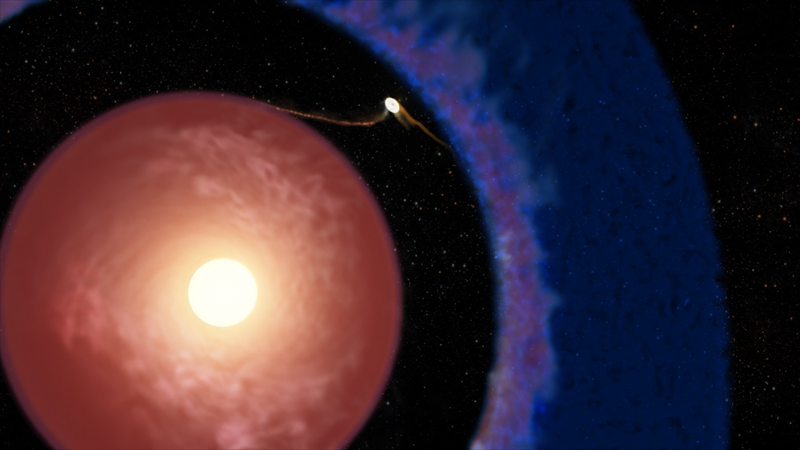
Astronomers using archival data from the W. M. Keck Observatory have confirmed a planet that is younger than one million years, making it the youngest known exoplanet by a wide margin. The object, called Elias 2-24 b, sits 55 times farther from its star than Earth is from the Sun and is already about as massive as Jupiter. It is still pulling gas and dust from a dusty disk around its host star, deep inside a gap it has carved in that disk. NASA’s coverage of the announcement and ScienceDaily’s writeup both carried the same artist concept. Every previous record-holder for the youngest planet, including the two worlds orbiting PDS 70 and the two around WISPIT 2, was older than five million years. Elias 2-24 b undercuts that floor by a factor of more than five, and does so at a distance from its star where planet-formation models did not expect anything that large to have assembled yet. Gizmodo’s coverage of the paper flagged the same gap between observation and prediction.
The confirmation matters because it lands directly on a fault line in giant planet formation. Standard models predict that a Jupiter-mass planet at Jupiter’s distance from its star takes roughly five million years to build through the slow accretion of icy solids and gas. The longer the orbit, the longer the formation time, because the feeding zone of solid material is thinner out there. Elias 2-24 b is more than ten times farther from its star than Jupiter is from the Sun. By the textbook timeline, a Jupiter at 55 AU should still be a swarm of icy boulders with at most a thin gas envelope, not a clean planetary-mass object pulling disk material onto itself. Finding one anyway tells the field that at least one of the formation channels (core accretion, gravitational instability, or some hybrid) is faster than the prevailing models allow.
The story behind the detection is a ten-year relay between three observatories and a NASA-funded archive. Around 2016, the Atacama Large Millimeter/submillimeter Array (ALMA) in Chile imaged a sharp concentric gap in the dusty disk around Elias 2-24, a young star about 450 light-years from Earth in the Ophiuchus molecular cloud. Gaps like that one are a familiar sign that an unseen planet is sweeping up material along its orbit. The European Southern Observatory’s Very Large Telescope then picked up a faint infrared point source sitting in the gap, exactly where a planet should be. The catch was that the object was far enough from the star and buried in enough residual disk material that some astronomers argued it could be a background star or a disk feature, not a planet at all. For nearly a decade the question stayed open. Andrea Bernardi, a doctoral candidate at Universidad Diego Portales in Chile, decided to revisit the problem by searching the Keck Observatory Archive, a NASA-funded partnership between Keck and the NASA Exoplanet Science Institute at Caltech/IPAC, for coronagraphic images of the same field. Bernardi’s team found the point source again in Keck data taken in 2018 and 2020, and by stitching the two epochs together they could measure its motion against the background star field. Anything in the foreground should drift with the host star’s proper motion; anything in the distant background should stay put. The faint source moved with Elias 2-24, which closed the case in favor of a planet.
The lead author’s framing in the resulting paper, published in The Astrophysical Journal Letters on 16 September 2026, is that planet-formation theory is missing a process. Lucas Cieza, a professor at the Instituto de Estudios Astrofísicos in Chile and a co-author, put the gap in plain terms. “Our planet-formation models already struggled to explain the previous record holders for the youngest known planet, a four-way tie between two planets orbiting the star PDS 70 and two planets orbiting the star WISPIT 2, which are all more than 5 million years old,” he said. “Elias 2-24 b shows us that even our best planet-formation models are still missing some important processes.” Bernardi’s read was that the detection itself came from combining facilities rather than from any single instrument. “We usually hear about telescopes working separately, but this confirmation was possible only by using multiple telescopes together,” she said. “Elias 2-24 b is at the limit of what current telescopes can detect, but with new instruments like NASA’s Nancy Grace Roman Space Telescope, such detections should become easier.”
The mechanism at work in the disk around Elias 2-24 is the textbook version of how a giant planet interacts with its birth environment, and it is worth slowing down on it for a moment. A protoplanetary disk is a flat, rotating swarm of gas and dust that orbits a young star for the first few million years of its life. A planet that forms inside the disk does not simply sit there. As it orbits, its gravity pulls disk material toward it, but it also shears the disk on either side of its orbit. That shearing opens a low-density annular gap centered on the planet’s orbital radius, with a local pressure bump at the outer edge of the gap where drifting dust and pebbles pile up. The pressure bump is also where the planet’s gravity can grab more material: it acts as a slow conveyor belt feeding the planet from the outside. The result, on the timescales relevant for the system, is a planet whose mass grows as long as the disk is still there, and a gap whose width and depth encode the planet’s gravitational reach. The fact that ALMA saw a deep, well-defined gap at 55 AU, and that the same VLT imaging picked up a point source inside it, is what made the original Elias 2-24 system a planet-formation candidate in the first place. What the new Keck confirmation adds is that the candidate is now locked in by proper-motion evidence across a six-year baseline, not just by the static “is there a thing in the gap” image.
The numbers in the paper come with a real margin of uncertainty, which is worth being honest about. Mass estimates for young planets inferred from brightness are model-dependent because a planet’s luminosity at a million years is set by how much energy it absorbed while accreting, and that depends on the assumed disk conditions. The reported mass range for Elias 2-24 b, between roughly 1.9 and 4.0 Jupiter masses according to a SpaceDaily writeup of the ApJL paper and The Brighter Side’s reporting, comes from comparing the Keck infrared photometry against the ATMO-NEQ-STRONG 2023 atmospheric and evolutionary models. The age of the host star, which is also model-dependent for a pre-main-sequence object, drives most of that mass range. None of that ambiguity changes the headline. The object is a planet, not a background star, and it is younger than one million years by enough margin to clear the previous record by a factor of five.
The next round of discoveries in this regime is likely to come from Roman, NASA’s Nancy Grace Roman Space Telescope, which launched on 30 August 2026 aboard a Falcon Heavy and is now on its way to a Sun-Earth L2 halo orbit. Roman carries a coronagraph that is much more aggressive at suppressing stellar glare than anything currently flying, and the team’s own argument is that the same archival-style imaging technique applied at Roman’s sensitivity should pick up planets that are older but in tighter, more Jupiter-like orbits. Elias 2-24 b is about ten times farther from its host star than a true Jupiter analog would sit. A Roman-class survey that runs the same gap-and-proper-motion playbook across hundreds of nearby young stars could push the record from a single outlier at 55 AU toward a population of newborn Jupiters at 5 AU, which is where the existing formation models assumed the action was happening in the first place. For now, the youngest known planet is a single data point sitting in an unexpected place, and the open question is how many more like it are waiting in the same archive.
 Subscribe to our RSS feed









There are no comments.
Add A Comment