


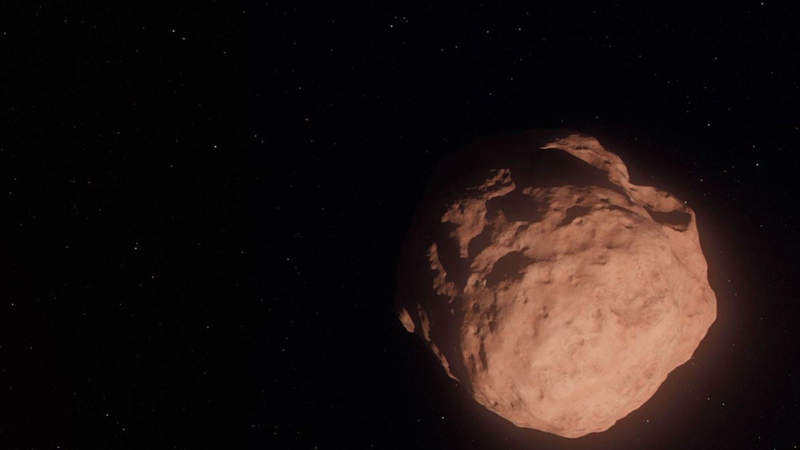
Image credit: NASA, ESA, Leah Hustak (STScI). The illustration is from the official NASA/ESA news materials accompanying the September 2026 announcement of the 27 new TNOs.
The Hubble and James Webb space telescopes have spent most of their careers looking out, at distant galaxies and the early universe. A new survey turned them around to look back home, and in the process turned up 27 new Trans-Neptunian Objects, all of them so small and so distant that they are still bearing the chemistry of the solar system’s earliest planetesimals.
These TNOs are between 6 and 25 miles across, with the smallest only about 6 miles (10 kilometers) in diameter. They sit between the cold classical Kuiper Belt and the dynamically hot Scattered Disk, and the survey is the deepest look yet into the region beyond Neptune. As such, the work is the first census with enough sensitivity to compare the smallest TNOs to their larger siblings, which is the comparison that lets you say something about how the solar system formed.
A TNO is a small icy body that orbits the sun beyond Neptune. The classical ones sit on near-circular orbits level with the ecliptic plane and are dynamically cold, meaning they have not moved much since they formed. The hot ones have been kicked there from closer in, mostly by gravitational resonances with the giant planets while those planets were still growing. They ended up on highly elongated orbits well off the ecliptic. Most of the 27 new objects are classical cold TNOs, with a smaller number from the scattered disk.
How cold are these cold TNOs, exactly? The new survey found them at apparent magnitudes between 24.1 and 29.3, putting them at the very edge of what either telescope can detect. Reaching reliable sizes for objects this faint required combining both observatories’ strengths: Hubble’s deep visible-light imaging to find the candidates, and JWST’s infrared vision to size them, because at infrared wavelengths a body’s brightness reflects its actual size rather than its albedo, the way visible-light brightness does.
The work was led by two PhD candidates, Anastasia Morgan of Northern Arizona University, who led the color and composition analysis, and Marielle Eduardo of the University of Victoria, who led the size distribution. They were part of a larger team that also included David Trilling, also of NAU. The size work was the headline: Eduardo was able to derive the diameters of the 27 TNOs from their infrared brightnesses, and the resulting size distribution was the first surprise.
Models of planetesimal formation predict a steep size distribution: many small objects and a few large ones. When Eduardo plotted the inferred sizes of the 27 TNOs, she found they followed the same shape distribution as larger TNOs. That was not the surprise. The surprise was that the slope of the size distribution was shallower than models predicted at the very smallest sizes, meaning there are fewer really tiny TNOs out there than the models would predict. Either planetesimal formation is more efficient at small sizes than the models say, or the smallest objects get eaten or ejected by something the models don’t include.
Models of how the solar system has churned through 4.5 billion years of collisions predict that small TNOs should be heavily gardened by impacts, their surface composition thoroughly mixed up and homogenized. The 27 objects should look quite different on their surfaces from their larger siblings, the way a heavily cratered asteroid looks different from a freshly fallen meteorite. But the colors of these small TNOs look just as pristine as those of larger ones, the same red-or-gray surface colors they have had since the dawn of the solar system.
Morgan, who led the color and composition analysis, said in a statement that the team’s expectation was that impacts would have erased whatever the objects’ original chemistry was. The fact that the smallest objects still preserve that chemistry is, she said, the kind of result that changes how astronomers think about the history of the outer solar system.
This same chemistry preservation holds even for the dynamically hot TNOs that originated between Uranus and Neptune before being thrown into the scattered disk by resonances with the growing giant planets. Trilling, who led the analysis on the hot-population side, said the data show the hot TNOs retain a chemical signature of where they were born, even though their orbits have been scrambled since then. Whatever preserved the cold TNOs’ surfaces preserved the hot ones’ too.
There are two ways to read this. The simpler one is that there are far fewer collisions out there than the population-density models predict, which would require a real rethink of how dense the outer solar system actually is. The more interesting one is that collisions do happen but somehow don’t tear up the surface of these objects as much as expected, perhaps because the impactors are too small to do real damage, or because the surfaces are unusually cohesive for some reason.
This is not the first time small-body surface chemistry has been unexpectedly hard to perturb. The OSIRIS-REx samples from Bennu, returned to Earth in 2023, showed that rubble-pile asteroids also remember their formation conditions far better than cratering models would predict, suggesting the same pattern holds closer to home as well as at the edge.
The deeper point is that the chemistry of the early solar system is more durable than the textbooks say. Across the size spectrum, from rubble-pile asteroids a few hundred meters across to planetesimals tens of kilometers across, the surfaces are carrying the chemistry they had when they formed 4.5 billion years ago. This makes them uniquely valuable as time capsules.
What the new survey is really telling us is that the small end of the solar system is far less weathered than we thought. The TNOs were supposed to be the battered outer suburbs of the solar system, places where collisions are common and mixing is complete. The opposite is true. They are more like a museum than a battlefield, with each object preserving a record of where and how it was made.
The team plans to expand the survey with additional JWST observations in the next year, both to find more small TNOs and to characterize the larger ones in more detail. The combination of two flagship observatories working together has turned what was once a search at the limits of detectability into a routine observation program, and the next decade is likely to see hundreds more small TNOs characterized this way.
For now, the message is clear: the smallest, most distant objects in the solar system are quietly holding onto chemistry from before the planets finished forming, and they are going to keep doing it for billions of years more.
 Subscribe to our RSS feed









There are no comments.
Add A Comment