


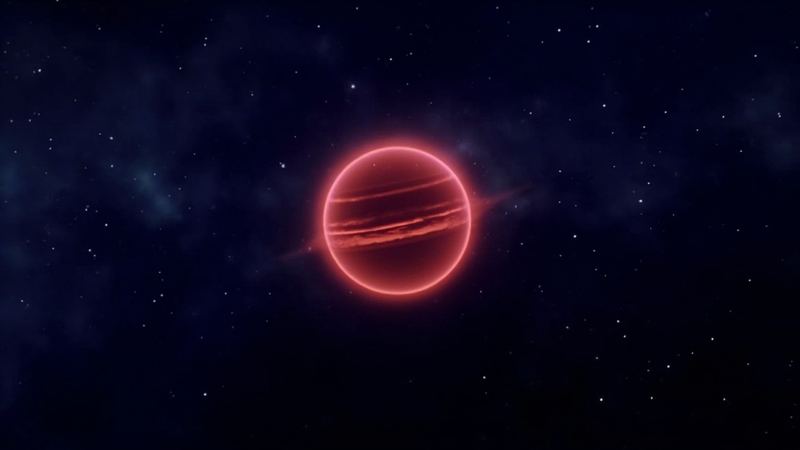
Somewhere in the constellation Hydra, about 7.43 light-years from the Sun, an object slightly larger than Jupiter and roughly twice Jupiter’s mass sits at 265 kelvins and slowly rotates, surrounded by water-ice clouds. It is the coldest known brown dwarf, a failed star with no fusion at its core, and on a single clear orbit of the James Webb Space Telescope, a team led by Brittany Miles of the University of Arizona’s Steward Observatory pointed the Near-Infrared Spectrograph at it for eleven straight hours. The result, announced on 8 October 2026 and accepted for publication in The Astrophysical Journal, is the first direct evidence that water clouds thicken and thin on a body outside the solar system. The air is moving. The weather is real. We can now watch it.
Brown dwarfs have always been a category problem. Too massive to be planets — at least thirteen Jupiter masses is the conventional lower bound — and too small to clear their neighborhoods, they are also too small to ignite steady hydrogen fusion. They glow with the residual heat of their formation, dimming visibly year over year as they radiate it away. A young T-type brown dwarf can sit at 1,500 K and look vaguely like a hot Jupiter. A middle-aged one in the L-T-Y sequence cools through a thousand kelvins and changes chemistry, with silicate and iron clouds raining out of its atmosphere at successive temperature plateaus. By the time an object reaches the Y class, somewhere below 500 K, water has frozen into clouds at the level of the photosphere, and the chemistry has become alien enough that it overlaps with what a cold, isolated gas-giant planet would look like. WISE J085510.83-071442.5, the object that Kevin Luhman first identified in the WISE survey in 2013, sits so far down the cooling track that its own temperature is below the freezing point of water. That is why astronomers care about it. It is the closest analog to a free-floating giant planet that we can see in detail (Luhman 2014, ApJ 786, L18).
The new work leans on that proximity. With a parallax of 439.0 ± 2.4 milliarcseconds measured against background quasars (Luhman & Esplin 2014), WISE 0855 is the fourth-closest stellar system to the Sun, after Alpha Centauri, Barnard’s Star, and Luhman 16. At 2.278 parsecs it is close enough that JWST can collect a medium-resolution spectrum, R ≈ 1,000, with high signal-to-noise in fifteen-minute slices across an entire rotation. The team obtained 32 such spectra, one every fifteen minutes for eleven hours, watching the same atmospheric column long enough to track features as they came in and out of view. The result is not a static spectrum. It is a movie with chemical resolution.
What they saw falls into two distinct layers. In the upper atmosphere, between roughly 1 and 4 bar of pressure, the water-ice cloud opacity oscillates. Some rotation phases show deeper, thicker clouds; others show clearer air, with the underlying gas-phase water absorption features rising into view. Below that, near 70 bar, the abundances of carbon monoxide and, in particular, phosphine (PH₃) vary in a way that does not match a quiet atmosphere. The team interprets the deeper signal as convective dredging: parcels of gas from well below the photosphere are rising, cooling, and being mixed into the visible layers, carrying with them the products of high-pressure chemistry. Phosphine, in particular, is hard to make in a cold, hydrogen-rich atmosphere at equilibrium; seeing it vary is a fingerprint of disequilibrium mixing, the same vertical transport that drives Earth’s weather but in a gas made mostly of molecular hydrogen and helium.
Why this matters is partly a question of what the older instruments could not do. Pre-JWST photometry of WISE 0855 measured the total brightness changes as the object rotated, but photometry collapses everything — clouds, chemistry, temperature — into a single flux number. NIRSpec at R ≈ 1,000 resolves individual molecular lines, so a cloud’s signature can be told apart from a chemistry change by the wavelength dependence. A water-ice cloud dims more in the continuum than in a line core; phosphine varies in a sharp, narrow band near 4.3 μm. That wavelength-resolved time series is what turns “the brightness is changing” into “the air is moving,” and only JWST has the combination of light grasp, wavelength coverage, and stability to make the measurement.
The broader payoff is the bridge the result builds between solar-system science and exoplanet science. Jupiter, the only other place where we can stare at water-ice clouds for a full rotation, has its own meteorology, and the cloud structures are different in kind — banded, with sharp shear zones and lightning-driven convection. The brown-dwarf version is slower, colder, and chemically simpler, but the physics overlaps. Carbon monoxide and phosphine chemistry in hydrogen-rich air follows the same quench kinetics, the same vertical-mixing timescales, the same temperature-dependent pathways. Modeling tools built for Jupiter’s atmosphere can be ported across. As the team puts it, the cloud-thickness modulation they see in WISE 0855 sits at pressures close to the photosphere, while the CO and PH₃ modulation sits much deeper; the two signals decouple, which they would not if a single effect were driving both. The weather is layered, the way weather here is layered.
There is a second, quieter implication. Brown dwarfs are not the only objects at this effective temperature. The directly imaged giant planets around HR 8799, β Pictoris, and a handful of other young A-stars sit at L-to-T spectral types, with brightness temperatures around 1,000 to 1,500 K. The colder, free-floating Y-dwarfs like WISE 0855 are the only objects old enough and cool enough to make the photospheric chemistry fully settled, and that makes them the closest natural laboratory for what an isolated Jupiter-mass planet would look like after it stops glowing from formation heat. The same NIRSpec time-series technique, applied to a young, hot Jupiter, will not work — the contrast against the host star is too steep — but applied to a Y-dwarf, it works because the dwarf is its own light source. If the team can repeat the measurement on a slightly warmer or slightly cooler Y-dwarf, they can map how the cloud layer’s vertical position and the convective mixing depth depend on effective temperature. That is a phase diagram of substellar weather waiting to be filled in.
For the moment, the headline is small and concrete: on one eleven-hour night, JWST watched water clouds form and dissipate on an object only 7.43 light-years away. The first exoplanet weather report, in the strict sense, is in. The next step is repetition across the Y class, where a small population of cold brown dwarfs within 20 parsecs is already known and the JWST time-allocation committee is more than willing to spend hours on them. The fields that should move fastest are the cloud microphysics of water ice in hydrogen-rich gas and the rate at which disequilibrium chemistry can reshuffle carbon and phosphorus through an atmosphere with no stellar irradiation to drive it. Both questions have been waiting, in a sense, for a Webb that could simply sit on one cold dot for half a night and watch. That wait is over.
 Subscribe to our RSS feed









There are no comments.
Add A Comment