


Dragonfly Flies Its First Flight Without Leaving Earth
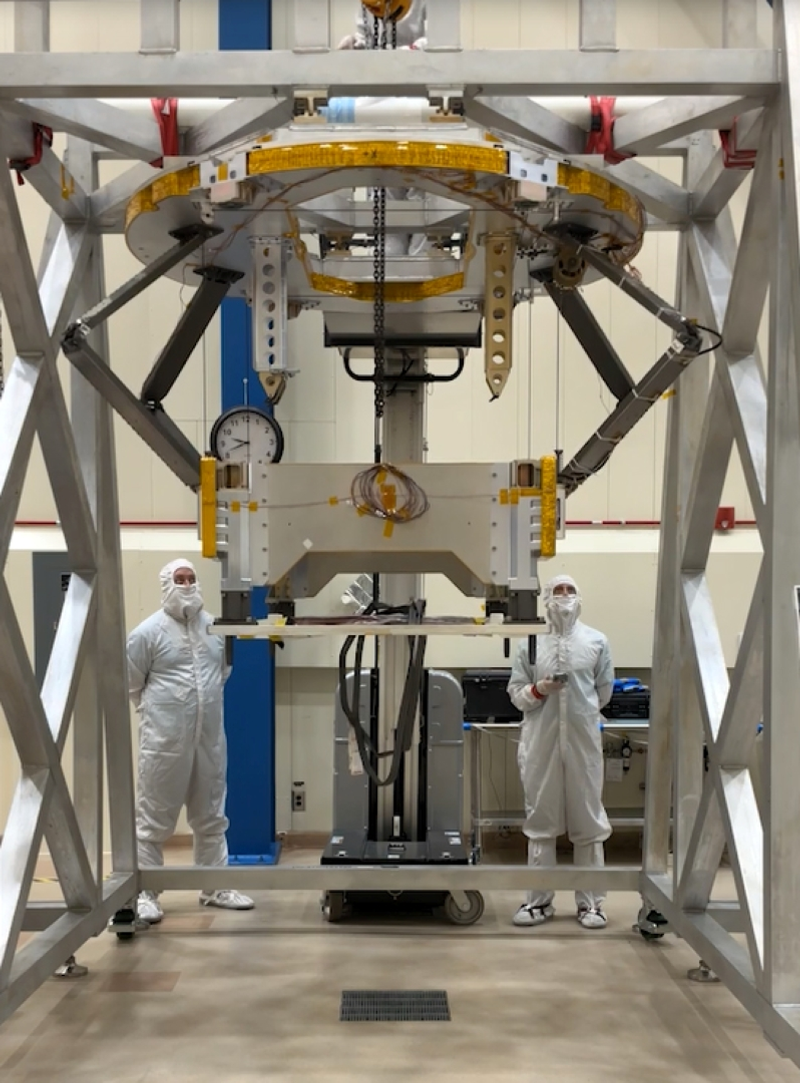
In a testbed at the Johns Hopkins Applied Physics Laboratory in Laurel, Maryland, a rotorcraft that has never left Earth crossed a landscape that does not exist. It accelerated over simulated dunes, scanned the ground beneath it, picked out a flat patch, turned, and settled down. On October 23, 2026, NASA described that run as the most thorough rehearsal yet of the moment Dragonfly lifts off for the first time, on Titan in 2034. The test ran in real time on flight-like avionics, with simulated data fed into the navigation cameras, inertial measurement units and lidar the spacecraft will carry (NASA, Oct. 23, 2026). The software did more than fly the vehicle. It searched for a landing site and chose one, and on Titan that choice belongs to the vehicle alone.
Dragonfly is a nuclear-powered octocopter about the size of a small car: roughly 953 kg, 3.85 m across and 1.75 m tall, with four pairs of coaxial 1.35 m blades, a 147 ampere-hour battery and a Multi-Mission Radioisotope Thermoelectric Generator supplied by the Department of Energy through NASA’s radioisotope power program (NASA Dragonfly fact sheet, Sept. 2026). Its five instruments run from a drill that feeds surface material to a mass spectrometer, to a camera suite, a gamma-ray and neutron spectrometer, and a geophysics and meteorology package. Launch is no earlier than 2028, the cruise takes about six years, and the surface mission runs a little over three years.
The world waiting for it is the reason flying makes sense there. Titan’s surface pressure runs about 60 percent above Earth’s, the air is roughly 95 percent nitrogen and 5 percent methane, and the ground sits near -179 degrees Celsius (NASA Titan facts). Sunlight takes about 80 minutes to arrive and lands roughly 100 times fainter than it does at Earth, so solar panels would be close to useless; the radioisotope generator is what keeps the rotors turning. The moon’s pull is weak, with a surface gravity of 1.35 m/s2, about 0.138 times Earth’s (NASA Glenn, 2022). Thick air and weak gravity are the two conditions that turn a spacecraft into an aircraft.
Everything about the recent test follows from that last point. The team fed the flight software simulated sensor data: imagery from the two navigation cameras installed at APL in August 2026, inertial readings, and lidar returns for terrain height and slope (NASA, Oct. 23, 2026). Lidar was the missing piece. The campaign had grown in steps, from spinning a single rotor to a short repositioning flight to a partial scouting flight, and adding lidar finally made a complete first flight reproducible in simulation. A custom camera emulator rendered each synthetic Titan scene on graphics processors with exposure times of roughly 20 to 70 ms, matching what the real cameras will see in flight. Because the run happened on flight-like hardware, the team could watch information move between processes at the millisecond pace it really moves.
Zach Putnam, the mobility subsystem lead engineer at APL, frames the difficulty plainly: “The cool thing about first flight is that it’s our most challenging flight.” It is the case that “uses every piece of flight sensor hardware on the lander” (NASA, Oct. 23, 2026). Leave out a sensor there and you leave out the ability to make a decision.
The part that cannot be rehearsed in software is the moment of release. Dragonfly arrives inside a backshell hanging under a parachute, and has to lower itself clear of that shell before separation, with its rotors already turning. Engineers at Lockheed Martin in Denver, where the cruise stage and entry, descent and landing hardware are being assembled, have been testing that “pose” mechanism: pushing and pulling on it with representative mass to check the loads it must take, lowering it to see how smoothly and quickly it deploys and whether it locks, and tilting the whole rig to reproduce the swing of a backshell beneath a parachute (NASA, Oct. 23, 2026). The pose structure links the backshell to an aluminum interface attached to the lander, and it has to work once, unrepeatably, about 1.6 billion kilometres from home.
That hardware has already been through a strange battery of ground tests. In May and June 2026, engineers suspended the fuselage a few inches above the floor on long bungee cords and measured how vibration at the rotor mounts travelled through the frame, then lowered the vehicle onto protective padding to see how it would sit on its skids. They also pressurized the assembled structure to hunt for gaps, because most planetary hardware is built for vacuum and Dragonfly will sit in air 60 percent denser than Earth’s (NASA Dragonfly blog, July 9, 2026). A slotted foam high-gain antenna, 87.4 cm across, folds onto a motorized arm before each flight so it cannot resonate against the vehicle.
The physics of the machine is worth doing roughly, because it explains how a tonne of hardware can hover on another world. Hover needs thrust equal to weight, T = m * g, so 953 kg on Titan asks for about 1.29 kN. Spread across eight rotor discs of 1.35 m diameter, the total swept area is roughly 11.4 m2, giving a disk loading near 112 N/m2. With air density around 5.7 kg/m3, worked out from Titan’s pressure and temperature and about 4.6 times the density of air at sea level, the induced velocity v_i = sqrt(σ / (2ρ)) comes out near 3.1 m/s. The same machine in Earth’s air would need about 6.8 m/s, so ideal hover power P = T * v_i falls from roughly 8.7 kW to about 4.0 kW. Dense air is a gift: the rotors push against more mass of gas for the same thrust. Real numbers run higher once profile drag and rotor efficiency are counted, and the electrical budget comes from a generator and a 147 ampere-hour battery, which leaves no room for waste.
None of that saves a vehicle that cannot decide for itself. Signals from Titan take the better part of an hour and a half to reach Earth, which is why NASA’s engineers talk about autonomy as a requirement rather than a feature; the rule Putnam repeats is that “everything we do on Titan has to happen autonomously” (NASA, Oct. 23, 2026). So the next round of tests is as much about failure as about flight. The team will run the first flight on the actual flight system instead of the testbed, fly other profiles, and deliberately inject faults to see whether the vehicle notices and recovers on its own.
Spread across 2026 and 2027, that work is the quiet way a 2034 landing gets decided. Dragonfly will spend its first years on Titan moving between dune fields and impact craters, drilling and analyzing samples for the chemistry that runs ahead of life rather than life itself (NASA Dragonfly fact sheet, Sept. 2026). If the autonomy holds and the pose mechanism behaves in flight, the thing that looked like an oversized drone in a Maryland clean room becomes the first powered aircraft to work on another world, and the missions designed after it will look different for that reason.
 Subscribe to our RSS feed









There are no comments.
Add A Comment