


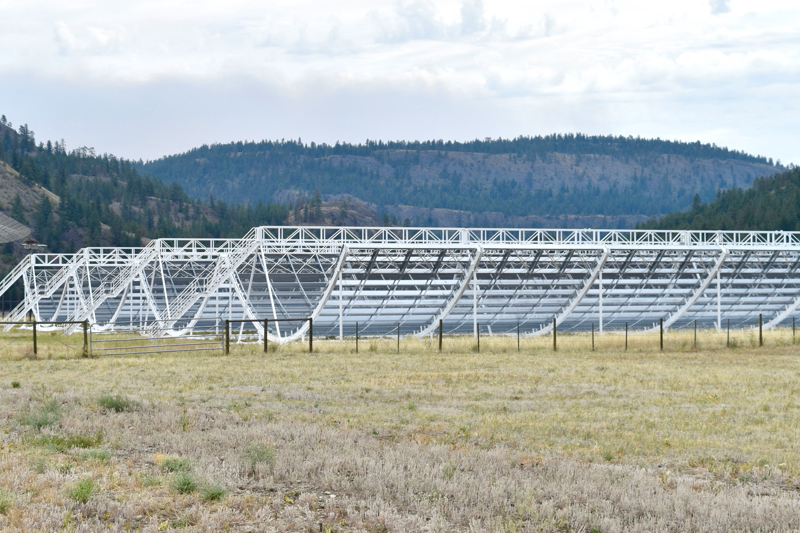
The Canadian Hydrogen Intensity Mapping Experiment, run out of a low-slung cluster of wire-mesh cylinders near Penticton, British Columbia, has just done something the rest of cosmology has been waiting on for the better part of two decades. In a paper published in The Astrophysical Journal on 28 September 2026 and posted to arXiv as 2511.19620, the CHIME Collaboration reports the first standalone detection of the cosmological 21-centimeter signal, the faint radio glow of neutral hydrogen from an era when the universe was roughly five billion years old. The result reached a signal-to-noise ratio of 12.5 across 94 nights of observing, a clean confirmation that intensity mapping can carry cosmological information without leaning on any other telescope.
The detection matters because it removes a crutch that earlier 21cm cosmology work could not do without. To pick a faint hydrogen signal out of the radio sky, every previous CHIME result had to be cross-correlated with an external galaxy or quasar catalog, so that any structure showing up in both maps could be trusted. That technique works, but it ties a hydrogen experiment to the schedule and depth of someone else’s survey. The new measurement is an auto-correlation, meaning the team trusted only CHIME’s own data and still recovered a statistically unambiguous clustering signal. Splitting the 608.2 to 707.8 megahertz frequency window in two yields independent detections at 8.7 and 9.2 sigma. Two independent confirmations in a single dataset is the kind of robustness that turns a hint into a measurement.
The reason this is exciting rather than merely incremental comes down to what intensity mapping is meant to do. Galaxy surveys like DESI, Euclid, and the Vera Rubin Observatory’s LSST build their maps by detecting and counting individual galaxies, a process that consumes enormous telescope time and tends to miss the dim, hydrogen-rich galaxies where most of the universe’s atoms actually live. CHIME does something different. Its four 100-metre cylindrical reflectors look at the whole northern sky every day, with no moving parts, and instead of resolving individual galaxies they sum the faint 21cm emission from millions of unresolved sources inside each patch of sky. The result is a low-resolution three-dimensional map of where the neutral hydrogen is, calibrated by redshift because cosmic expansion has stretched the original 21cm line into longer and longer wavelengths the further back in time one looks.
CHIME’s full operating band runs from 400 to 800 megahertz, which corresponds to redshifts between roughly 2.5 and 0.8, an epoch the collaboration describes as substantially younger than the one surrounding Earth today but old enough to capture the period when dark energy began to dominate the cosmic energy budget. The new paper uses only the cleaner half of that window, between 608.2 and 707.8 megahertz, which corresponds to redshifts of 1.34 down to 1.01, with a mean redshift of 1.16. That is exactly the slice where the universe had finished its early formative fireworks but had not yet been completely taken over by the accelerating expansion driven by dark energy.
Why this matters comes down to what the team can now attempt to do with the rest of the CHIME archive. The instrument has been collecting data continuously since first light in 2017 and the collaboration says it now has nearly seven years of observations in hand, most of which has not yet been analyzed. The Sept 28 paper uses 94 nights from 2019 only. If the new processing pipeline can keep extracting the auto-power spectrum cleanly from older data, CHIME should be able to push the measurement to higher redshifts, into the period when the universe was only about three billion years old, and to lower redshifts, where the dark-energy signal is strongest. That spans almost the entire window during which dark energy transitioned from negligible to dominant. Tracing the universe’s expansion history across that span, with a single instrument and a single tracer, is the prize the collaboration has been working toward since construction finished in 2017.
The first detection was a 2023 paper that cross-correlated CHIME’s hydrogen maps with optical galaxy and quasar catalogs from eBOSS. That cross-correlation approach was scientifically productive but also exposed. The hydrogen experiment needed a second, much larger optical survey to confirm any signal. The new result flips that around: CHIME is now the primary instrument, and any cross-correlation with another survey becomes an optional consistency check rather than a requirement. Co-author Dr. Mark Halpern, a University of British Columbia physicist and CHIME principal investigator, called the result a fundamentally new way of probing the cosmos, built on an instrument conceived, paid for, and operated entirely by Canadian institutions.
The technical work that made this possible is what most readers will not see and what most of the team spent the most time on. The 21cm cosmological signal at these frequencies is buried under several layers of brighter noise. Galactic synchrotron emission from our own Milky Way dominates by orders of magnitude. Distant radio galaxies and active galactic nuclei add another, structured layer on top. Human radio-frequency interference from satellites, radar, and cell towers adds a moving, partly unpredictable foreground. And small imperfections in CHIME’s receivers and correlator can mix otherwise smooth foreground signals into patterns that look like cosmological structure. Pulling the hydrogen out required the team to develop new radio-frequency interference detection algorithms, achromatic beamforming techniques that keep the telescope’s synthesized beam stable across frequency, and a foreground-filtering step that runs before time-averaging so that spectral leakage does not smear bright foregrounds into faint cosmological modes. Independent sub-band splits, null tests on the data, and many alternative processing choices were all checked before the team trusted the result, a process Chakraborty described as working very hard to convince ourselves that this was not a false alarm.
The team’s analysis goes one step beyond the headline detection. In a companion paper they take the auto-power spectrum at face value as a measurement of how strongly neutral hydrogen clusters at redshift 1.16, and they compare it with predictions from the IllustrisTNG cosmological simulations. The observed hydrogen clustering disagrees with the simulated clustering by about 3.1 standard deviations for the TNG100 simulation volume and 4.0 standard deviations for the larger TNG300. That is not a crisis. The team reads the gap between observation and simulation as a clue about how tightly hydrogen is packed at the small, non-linear scales the new measurement is most sensitive to, not as evidence that the total hydrogen inventory is wrong. It shows that CHIME’s standalone data can test models of how gas actually populates galaxies and dark-matter halos, not just deliver a number for dark-energy cosmology.
The long-term target is still baryon acoustic oscillations, the imprint of pressure waves from the hot early universe that act as a cosmic standard ruler. Tracking how that ruler stretches at different redshifts is one of the cleanest ways to measure how the universe’s expansion rate has changed over time, and therefore to test competing models for what dark energy is doing. The current measurement does not yet deliver BAO. Foreground-removal eliminates some of the largest-scale modes the BAO analysis needs, and the detected power spectrum occupies smaller non-linear scales where gravitational clustering has already scrambled the clean linear signal. What the Sept 28 paper establishes is the prerequisite: a telescope designed to map the universe through hydrogen can isolate that hydrogen without another survey pointing out where to look. The next step is to apply that capability across more of the CHIME archive and across the wider redshift range the telescope was built for.
For a community that has spent more than a decade waiting for a 21cm cosmology result that does not need a galaxy survey attached, the message from the Okanagan Valley this week is that the wait is over, and the next decade of dark-energy measurements just got a new instrument.
 Subscribe to our RSS feed









There are no comments.
Add A Comment