


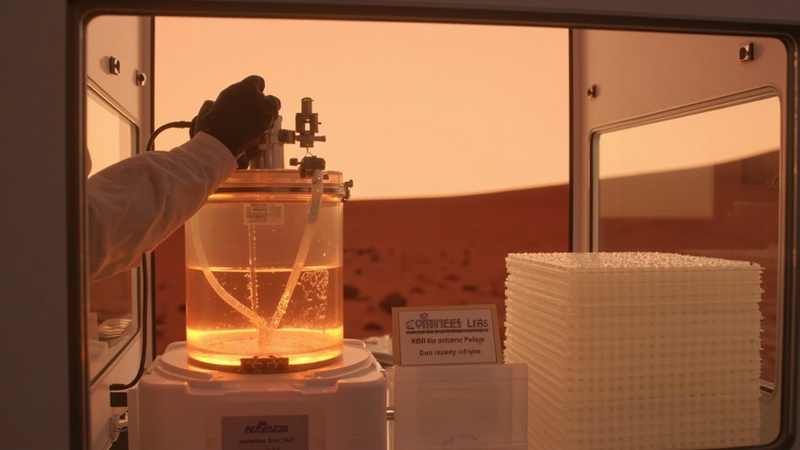
For the first time, an engineered bacterium has built a useful polymer using only what Mars has on the surface. No Earth fertilizer, no pre-processed feedstock, no shipped-in sugar. The strain, called sPL.001, was announced in late September by Pioneer Labs, a small nonprofit in Emeryville, California, and the underlying paper landed on bioRxiv on 14 September 2026 (Martin et al., DOI 10.64898/2026.09.14.748363). It is the first of five microbes the team plans to field on Mars, and the first to clear a load-bearing question that has hung over every serious terraforming proposal for forty years: can Earth life actually eat Martian dirt?
The case for carrying biology to Mars goes back to the early days of in-situ resource utilization. The standard playbook for a future base assumes you will land everything, refine everything, and recycle almost nothing; biology changes that calculus by adding a self-replicating partner. Pioneer Labs was founded in 2024 by synthetic biologist Erika DeBenedictis, who had cut her teeth on interplanetary mission design as a JPL undergraduate, and the company has spent the last two years narrowing the most ambitious version of the idea down to a single concrete first step (Pioneer Labs, 28 September 2026). The first strain had to be useful on day one, on the path to terraforming, and provably unable to escape and survive in the wild. sPL.001 is the answer they settled on.
What the strain does is unglamorous and important. It pulls carbon, nitrogen, phosphorus, and trace metals out of a slurry of leached Mars regolith, fixes acetate the bioreactor makes from atmospheric carbon dioxide, and stores what it cannot immediately burn as polyhydroxyalkanoate (PHA), the same class of biodegradable polyester that already shows up in compostable cups and medical implants. C. necator H16, the parent, is one of the best-studied PHA factories in biotechnology, with gram-per-liter yields from sugar feedstocks on Earth that have kept industrial microbiologists employed since the 1970s. The trouble is that the Martian surface is a hostile place for it. The regolith is loaded with perchlorate salts, the water activity is negligible, the temperature swings are 80 °C, and the only carbon comes from a thin CO2 atmosphere measured in millibars.
The team’s first move was to screen sixteen candidate chassis organisms in a chemically defined Mars medium that mirrored the soluble fraction of regolith without shipping the actual dirt. C. necator H16 and Pseudomonas putida KT2440 both grew, badly; everything else either stalled or died. They then put the survivors through more than 10^12 cumulative cell divisions of adaptive laboratory evolution, serial passaging under progressively higher acetate and perchlorate stress until a single C. necator isolate, sPL.001, kept dividing. The headline result is a more than three-fold increase in PHA titer compared with the parent strain under the same simulated Mars conditions (bioRxiv preprint, 14 September 2026). That is the engineering win: not a new species, but a strain whose metabolism is rewired for a chemistry no Earth bacterium has ever seen concentrated in one place.
PHA itself is a microbial carbon-storage polymer, a polyester that the cell lays down as intracellular granules when carbon is plentiful and another nutrient, usually nitrogen, is not. The monomer in sPL.001’s case is overwhelmingly 3-hydroxybutyrate, so the material is poly-3-hydroxybutyrate (PHB), a thermoplastic with tensile properties in the same neighborhood as polypropylene and a melting point around 175 °C, both of which matter for habitat shells. In a Mars bioreactor the polymer is harvested from lysed cells, dried, and fed into an extruder or a 3D printer; the resulting panels can be radiation-shielded, pressurized, and stacked into a shell whose raw atoms are 100% Martian (Pioneer Labs, 28 September 2026). That is the second engineering win, and it is the one DeBenedictis leans on: the first rocket lands one bioreactor’s worth of kit, and four years later you have a settlement’s worth of plastic.
The physics of the bioreactor is what makes the system honest. The cells are kept at 30 °C in a stirred, heated vessel that shields them from Mars ambient temperature, vacuum, and UV; they are fed a continuous trickle of acetate from an electrochemical cell running on compressed CO2 and a small amount of water. Outside that controlled environment, the strain is engineered to be helpless. sPL.001 is not photosynthetic, so without the fed acetate it cannot multiply, and without multiplication it cannot evolve. In dry, irradiated, water-starved regolith, desiccation alone sterilizes the cells within hours. A separate arXiv paper, posted in late September 2026 under DOI 10.48550/arXiv.2609.12015, walks through the contamination math: even a catastrophic leak of an industrial-scale Mars bioreactor, the team argues, would clear the COSPAR planetary protection threshold by a factor of several hundred. The numbers do not yet constitute a regulatory verdict, but they are the first quantitative case that an early industrial bioprocess on Mars can coexist with the unfinished business of searching for extant life.
The reception inside astrobiology is measured. Chris McKay, a planetary scientist at NASA Ames, told Scientific American that the organism is “neither revolutionary nor particularly complex” (Scientific American, 2 October 2026). He meant it as a description, not a dismissal. Cupriavidus necator has been in industrial culture collections for half a century, and the pathway that converts acetate into PHA granules is the same one that runs in any overfed microbe on Earth. What is new is the substrate. Neveda Naz, an astrobiologist at Tufts who has grown microbes in material from actual Martian meteorites, called the work a “useful engineering technique” because the team “picked an organism, adapted it to a defined Mars-relevant chemical environment, and demonstrated improved production of a useful material” (Scientific American, 2 October 2026). In other words, the contribution is not the bacterium, but the proof that the bacterium can run on Mars dirt alone, at yields that scale.
That distinction is what makes this a story about engineering, not biology in the usual sense. The bioreactor is a chemical plant whose feedstocks are regolith, water, and air, and whose product is a structural material. The cells are the catalyst. The same logic, run in reverse, is what makes every modern biorefinery work: the organism is a black box that turns cheap local feed into a polymer you would otherwise have to import. The local feed here is just unusually inhospitable, and the polymer ends up holding up a habitat instead of going into a trash can. DeBenedictis has framed it in exactly that language: she called the project “a recipe for building the log-cabin equivalent for Mars” (Asimov Press, 22 September 2026), the first dwelling in a long chain of manufactured ones.
What comes next is the harder part. Pioneer Labs is already engineering a second strain, a perchlorate-eater that would let biology work on regolith that has not been rinsed, and three more chassis organisms are planned to handle nitrogen fixation, photosynthesis, and food-chain starter cultures respectively. None of those will be as photogenic as the first, because the first gets to do the simple thing, eat acetate, store plastic, and stop. The next four have to wrangle Martian chemistry in the open, and the planetary protection math gets tighter with each one. A first launch is years away, and an actual bioreactor on the surface is years past that, but the science question that used to sit on top of the program, can Earth life actually run on what Mars already has, has now been answered in the affirmative, in a peer-reviewable preprint, with a strain whose kill switch is the absence of a feed line.
 Subscribe to our RSS feed









There are no comments.
Add A Comment