


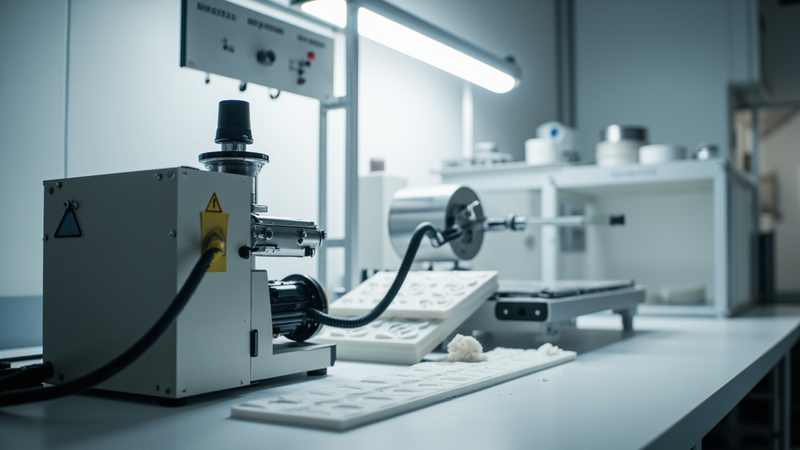
On the morning of August 28, 2026, in an engineering building on the campus of the University of Alabama in Tuscaloosa, fourteen teams competed in the finale of NASA’s LunaRecycle Challenge. The contestants included graduate students, hobbyists, a Wyoming aerospace LLC, an Austin 3D-printer company, and a doctoral cohort from MIT that calls itself CERBERUZ. None of them were building rockets or rovers. They were building trash compactors. The wrinkle: the trash had to be turned back into useful parts, on the Moon, in vacuum, in partial gravity, without resupply shipments from Earth.
Their brief was deceptively ordinary. Take a kilogram of dirty foam, plastic bags, Nomex flight jackets, and aluminum food wrappers — the kind of stuff astronauts throw away every day — and turn it into something a habitat can actually use. The competition carried a $3 million purse, a 1,200-team applicant pool, and a NASA program manager who announced the winners live at noon, CDT (NASA Centennial Challenges, August 28 2026).
Astronauts on the International Space Station produce roughly 2.5 kilograms of “non-metabolic” trash per crew member per day — packaging, food pouches, hygiene items, clothing offcuts, broken equipment. On the ISS, most of that ends up loaded onto a Progress cargo freighter and incinerated in the atmosphere. For a Mars mission lasting two and a half years, you can’t do that. For a permanent Artemis Base Camp on the lunar south pole, you can’t do that either, because every kilogram launched from Earth currently costs somewhere in the high five figures by the time it sits on the regolith.
The economics flip if you can keep what you bring. Recycling turns an “input” into a “stockpile.” Foam becomes a habitat tile. A torn glove becomes feedstock for a replacement bracket. The MIT team’s prototype grinds mixed waste into powder, then extrudes it into filament for a 3D printer or pellets for an injection mold. The first-place prize money — $500,000 for the prototype, $275,000 for the digital twin — is small change compared to a single Falcon Heavy launch.
Phase 1 of LunaRecycle launched in September 2024, ran through June 2025, and pulled 1,200 registrations — the largest response to any Centennial Challenge in NASA’s 20-year prize history (Wikipedia, Centennial Challenges). Seventeen teams were named Phase 1 winners from five countries and nine U.S. states. Phase 2 opened to U.S. teams only and required them to build a working prototype, optionally backed by a “digital twin” — a high-fidelity virtual model of the recycling line.
Sixteen teams cleared the Phase 2 milestone round in March 2026. They converged on Tuscaloosa from August 24 through August 28 to test their hardware at McAbee Construction, a local industry partner, with a public industry day and winners’ ceremony in H.M. Comer Hall (University of Alabama Engineering News, March 10 2026).
The first prize went to CERBERUZ, a team of undergraduate, graduate, and doctoral students at MIT. Their system — described in NASA’s award announcement as “Composites for Extraterrestrial Recycling By Engineering the Reuse and Upcycling of Zotek” — accepts mixed logistics waste, grinds it to a uniform powder, and remanufactures it into filament and injection-molded parts. The team’s insight was to stop treating the foam as contamination. Zotek F30, a closed-cell polyvinylidene fluoride foam from the British manufacturer Zotefoams, is what most aerospace interiors are made of — seat cushions, environmental control system ducting, equipment packaging. Once shredded, the foam acts as a reinforcing filler rather than a contaminant, and the resulting composite can be printed or molded into a fresh bracket or handle (NASA Centennial Challenges, August 28 2026).
The other nine teams on the prototype track ran the technology tree in different directions. Terasynth, an Orlando company, took second place with the Lunar Re-Forge System, which converts mixed waste into 3D-printing filament and recovers metals. Penn State’s RECLAIM team used microwave heating to convert plastic and metal waste into cast parts and fuel precursors — unusual because microwave heating penetrates materials volumetrically, not just at the surface. Cislune’s CRAFTER system from Rosemead, California ran pyrolysis, decomposing waste without oxygen to recover carbon, metal feedstock, and construction material. ACME Space LLC in Cheyenne, Wyoming compressed and thermally melted Zotek foam into dense tiles for lightweight structural panels (University of Alabama Engineering News, March 10 2026).
Five additional teams competed at the finale without milestone prizes, including Phoenix Loom (recycling cotton textiles), KLAW Industries (regolith-composite reinforcement), and Space Copy (foam-regolith extrusion).
The MIT team’s choice of PVDF is not incidental. PVDF is a semicrystalline fluoropolymer with a melting point of 177 °C and a density of 1.78 g/cm³ — higher than most commodity plastics, but inert to most solvents, acids, and hydrocarbons (Wikipedia, Polyvinylidene fluoride). In a vacuum-rated environment, the polymer also outgasses less than polyethylene or polyurethane, which matters when every gram of off-gassing condenses on a nearby optical surface. The Zotek F30 variant is a nitrogen-expanded closed-cell foam with densities from 30 to 150 kg/m³, thermally stable to 160 °C, and certified to the OSU heat-release and smoke-density standards required for commercial aircraft interiors (Zotefoams technical data sheet, 2024).
The grinding-and-reinforcement trick relies on a simple rule of composites. A short-fiber or particulate filler, well-dispersed, raises the modulus of a polymer matrix. The foam’s cells collapse into platelet-like fragments under the grinder, and the resulting powder behaves mechanically like a high-aspect-ratio reinforcement when re-melted with a virgin or reclaimed polymer carrier. The team’s digital twin — for which they also took first place — modeled throughput, energy use, and final-part mechanical properties under simulated lunar gravity (1.62 m/s², roughly one-sixth of Earth).
The microwave-based RECLAIM approach uses different physics. Microwaves at 2.45 GHz couple to polar molecules and lossy dielectrics; metal-bearing waste heats volumetrically, while pure plastics heat more weakly. That lets a single chamber process mixed trash without pre-sorting. Pyrolysis sidesteps oxygen entirely: at 400-700 °C under inert gas, polymers break into volatile tars, non-condensable gases, and a solid char. The char fraction typically retains 30-50% of the input carbon mass as a usable feedstock, while the gas fraction can be reformed into methane or hydrogen for fuel cells.
The throughput numbers matter as much as the chemistry. NASA’s challenge brief required finalist systems to demonstrate meaningful mass efficiency — converting a useful fraction of input waste into finished parts without prohibitive energy or astronaut time. The Highest Mass Efficiency award went to Cislune’s CRAFTER; the Most Trash Types Recycled award went to Bob Jones University’s LunaBrix, which combines recycled content with regolith simulant into stackable bricks. The Most Innovative prize went to RECLAIM for the microwave reactor. The People’s Choice went to Terasynth for the autonomous Lunar Re-Forge System (NASA Centennial Challenges, August 28 2026).
LunaRecycle is what NASA’s Centennial Challenges are designed for: a narrow, well-scoped problem with measurable success criteria, open to anyone with the engineering chops. It also happens to be one of the cheapest ways to test a piece of the Artemis program — $3 million, mostly going to small teams with no government contract overhead.
Two things will tell us whether this work matters. First, whether NASA pulls any of the prototypes into a flight experiment on a Commercial Lunar Payload Services lander or a Gateway resupply manifest. Second, whether the same chemistry shows up in the closed-loop life-support trade studies for Mars.
The deeper question is whether a Moon base can be a base at all if it cannot reuse what it already has. The fourteen teams in Tuscaloosa just spent a week making the engineering answer sound like yes.
 Subscribe to our RSS feed









There are no comments.
Add A Comment