


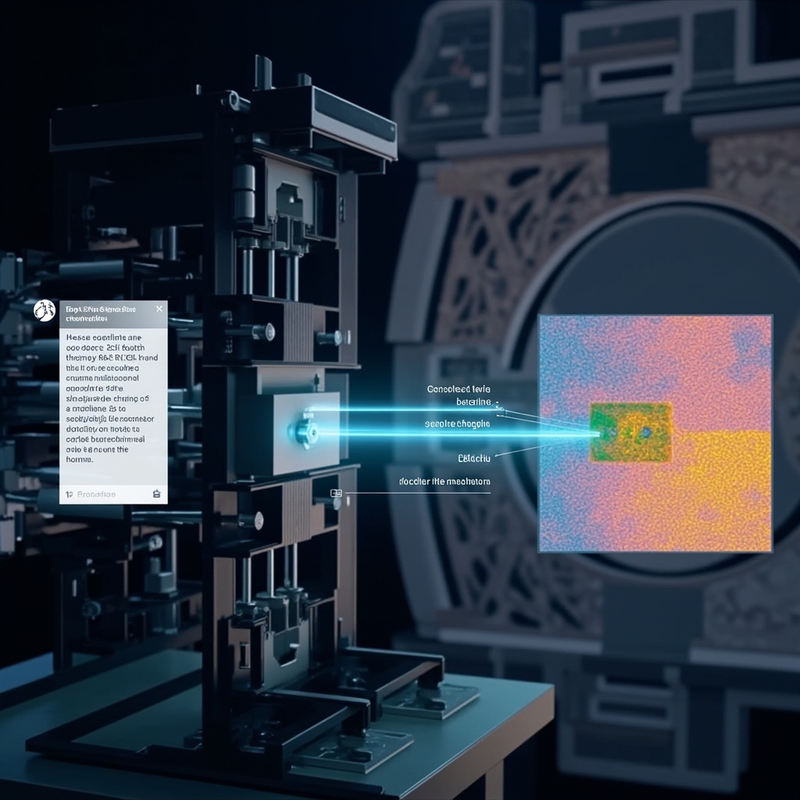
A microchip sat on the stage of beamline 26-ID at Argonne National Laboratory on a Tuesday in early October. Instead of guiding a motorized stage through a hand-scripted raster, a researcher typed “find the interface between these two regions” into a chat box. A software agent read the instruction, parsed a freshly reconstructed X-ray image, picked a new point on the sample, asked the beamline to move there, looked again, and decided on a third step. After a handful of those scan-reason-move cycles, the agent locked onto the boundary the user wanted and switched itself into a higher-resolution scan mode. No operator wrote Python. The human in the room just talked to the microscope.
That experiment, run at the joint Center for Nanoscale Materials and Advanced Photon Source hard X-ray nanoprobe in the first week of October 2026, is the first time a working agentic AI has steered a synchrotron beamline end-to-end through natural language. The team behind it, drawn from Argonne, Lawrence Berkeley, Brookhaven, SLAC, and Oak Ridge national laboratories, is calling the broader effort SYNAPS-I, short for Synergistic Neutron and Photon Science–Intelligence, and plugging it into the Department of Energy’s Genesis Mission as a flagship demonstration of what an AI-augmented user facility can look like in 2026 (Argonne, October 5, 2026).
For most of the synchrotron’s seventy-year history, the bottleneck at a beamline has not been the X-ray source. It has been the human at the controls. A modern storage ring like the APS sends electrons whirling at seven gigaelectronvolts through a 1.1-kilometer ring of bending magnets, where they shed X-rays bright enough to resolve features a few nanometers across. The catch is that the data deluge starts the moment the shutter opens. At 26-ID, a single experiment at a third-generation nanoprobe writes millions of ptychographic diffraction patterns in a few hours, and every pattern needs a heavy iterative computation to turn back into a usable image. Without live reconstruction, the team on shift has to choose what to scan on the basis of intuition and a coarse preview, then fly home and discover, days later, that the region of interest was three millimeters to the left the whole time.
The SYNAPS-I project, launched in 2025 and led out of Lawrence Berkeley, set out to change that ratio. The first phase, publicly reported in April 2026, replaced the slow offline reconstruction with a real-time engine. The engine, a fine-tuned 2D vision transformer the team calls PtychoFM, ingests raw diffraction patterns as they stream off the detector and returns a reconstructed phase-and-magnitude image in seconds (Argonne, April 2026). The math itself is well understood: a coherent X-ray beam is scanned across the sample in overlapping circles, and the resulting diffraction patterns are stitched together in Fourier space using a difference-map or gradient-descent solver. What PtychoFM adds is a learned prior, a model trained on enough examples that it can skip most of the iteration and guess a plausible reconstruction from a single forward pass, then refine it on the fly as more data arrives. For a beamline scientist, that turns hours of post-experiment waiting into a real-time video feed of structure under the beam.
The second phase, announced in early October, is what made the headline demo possible. The team wrapped PtychoFM in an agentic layer that uses a multimodal large language model as its decision-maker, alongside Meta’s Segment Anything Model 3 (SAM3) as its image-segmentation eye. The agent reads each new image, calls SAM3 to label the structures it sees, and reasons about what to do next in plain English — or rather, in plain tokens. “Agentic AI solves this by interpreting the images reconstructed in real time by PtychoFM, our ptychographic model, leveraging the vision capability of a multimodal large language model,” said Ming Du, an Argonne computational scientist on the SYNAPS-I team, in the October release. The architectural pattern is now familiar from the wider AI world: an LLM plays the role of a slow, generalist planner, a smaller specialist model handles perception, and a set of tool calls translate decisions into beamline commands. Here the tools are the motor controllers of a nanoprobe stage and a reconstruction pipeline running on the Argonne Leadership Computing Facility.
The integration was not trivial. SAM3 is a foundation model of non-trivial size, and the team needed it available to every beamline in the DOE complex rather than baked into one workstation. The Argonne Leadership Computing Facility stood up a cloud-style inference service, the ALCF Inference Service launched earlier in 2026, and the SYNAPS-I team plumbed SAM3 into it. From the agent’s point of view, segmentation is a function call. From the operator’s point of view, asking the beamline “what’s at this spot?” and getting a labeled map back is now as cheap as a chat reply.
The microelectronics demo that closed the October announcement was deliberately mundane. The interface between two doped regions in a chip is a classic defect-investigation target; in 2026 it is also a target that is genuinely hard to localize across devices, because process variation shifts the boundary unpredictably from wafer to wafer. Aileen Luo, the Argonne assistant computational scientist who led the ptychography-model work, framed the result this way: real-time reconstruction “changes the way experiments are performed, enabling researchers to adjust measurements on the fly instead of discovering key features they missed after the experiment has ended” (Argonne, October 2026). The agentic layer extends that loop by closing it. The microscope now decides what to scan next, not just what it has already seen.
What changes because of this is not the physics. The X-ray wavelength, the optics, the sample stage, and the math of ptychographic reconstruction are all the same as a decade ago. What changes is the operator. A graduate student who used to spend a year learning EPICS control scripts can now describe what they want in a sentence and spend the saved time on the science. That is the same labor-shifting move that swept structural biology when cryo-EM got its own AI denoisers, and astronomy when adaptive-optics pipelines learned to schedule themselves. Beamlines are next. By 2030 it is reasonable to expect that a substantial fraction of routine scanning at a synchrotron user facility will be conversational: the operator sets a goal, the agent handles the geometry, the human reviews the result and asks for the next scan.
The cleverness here is mostly plumbing. PtychoFM does the hard imaging work. SAM3 does the segmentation. A multimodal LLM does the planning. The novelty of SYNAPS-I is that Argonne, Berkeley, Brookhaven, SLAC, and Oak Ridge wired those pieces into the same end-to-end loop on a working beamline, and the Department of Energy underwrote it through Genesis. That is harder to copy than any single model. It is also more useful.
 Subscribe to our RSS feed









There are no comments.
Add A Comment