


SETI has spent decades listening for narrowband radio signals, mostly below a few gigahertz. Most of that listening has been concentrated in a small slice of the radio dial. A new analysis from the University of Manchester points at a different slice and asks what has been there the whole time.
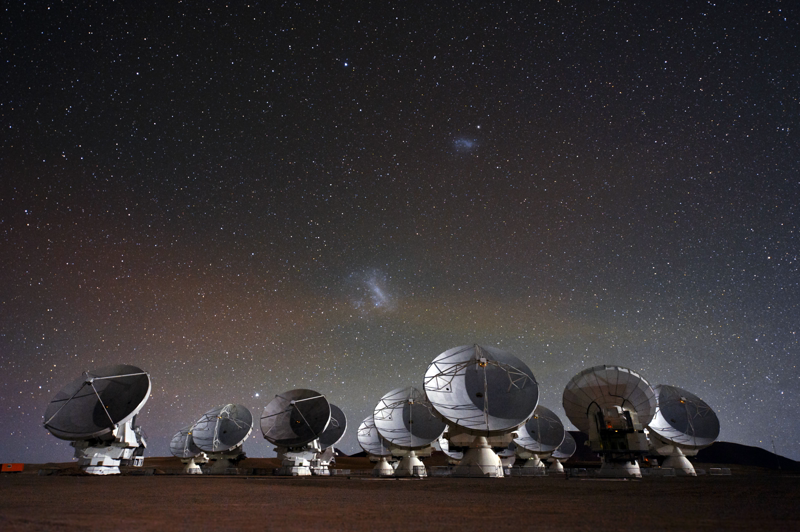
Louisa Mason, a PhD researcher at Manchester, used four archived observations from the Atacama Large Millimeter/submillimeter Array (ALMA) in Chile to run the telescope’s first SETI survey. The work, published in the Monthly Notices of the Royal Astronomical Society, focuses on ALMA’s Band 3 receivers and two narrow frequency windows near 90.642 GHz and 93.151 GHz. Those frequencies sit well above the traditional SETI bands and have barely been searched for narrowband technosignatures.
No candidate signals exceeded the survey’s detection thresholds. That is the expected result for a first pass, and the researchers describe the result as an opening of parameter space rather than a discovery.
SETI is shaped as much by instrumentation as by theory. Most narrowband technosignature work has relied on telescopes such as the Green Bank Telescope, the Parkes Murriyang telescope, and the Allen Telescope Array. Those instruments are excellent in their ranges but were not built for the millimeter and submillimeter bands. ALMA is sensitive above 35 GHz in a way few other facilities can match, and it has been producing archived data since 2011.
The implication is straightforward. A signal at 90 GHz could be present in ALMA data right now without anyone having looked. The new analysis is the first structured attempt to check.
There is a secondary finding, also presented at the Royal Astronomical Society’s National Astronomy Meeting in 2026. The same team used Gaia stellar catalogues to revisit the number of stars that earlier SETI surveys actually covered. ScienceDaily’s summary notes that the Manchester group found prior published counts may have understated the real coverage by more than an order of magnitude, with one estimate moving from roughly 288,000 stars to over 6 million once Gaia cross-matching was done properly.
The headline numbers are different from the search itself, but they are linked. Both findings argue that SETI has been sampling the sky less carefully than the literature suggests.
Mason did not request new ALMA time. The survey pulled four archived calibrator scans from the ALMA archive. Calibration observations are short, pointed at bright reference sources, and usually discarded after the data are reduced. Mason treated each scan as a science observation in its own right, looked at the stars that happened to fall in each antenna’s field of view, and searched for narrowband signals inside two narrow windows in Band 3.
The search covered 28 stars in total. They are a mix of main-sequence stars and white dwarfs, drawn from Gaia cross-matches. For each star, the analysis looked for narrowband emissions that would not be consistent with known natural processes in the band. Carbon monoxide, hydrogen cyanide, and diazenylium all produce molecular lines in this frequency range, so a SETI search needs to avoid flagging those as candidates.
The paper’s conclusion is that no candidate technosignatures passed the threshold. The survey’s sensitivity, the bandwidth of the search windows, and the relatively small star sample all limit how much can be inferred from a null result. The University of Manchester’s research record makes the same point in a more compact form.
Universe Today’s coverage walks through Mason’s quote that the millimeter and submillimeter bands “remain almost completely unexplored for SETI,” which is why the team framed the work as opening parameter space rather than confirming or refuting a particular hypothesis.
The Manchester team also pulled out a comparison with existing facilities. The figure in the MNRAS paper shows the frequency coverage each instrument could probe for narrowband SETI work. ALMA’s coverage sits in a region where other radio observatories are not conducting technosignature searches. That is both a justification for the work and an invitation to others to design complementary searches.
SETI looks for narrowband radio signals. The reasoning has not changed much since the early 1970s. Natural astrophysical sources tend to emit across broad frequency ranges, often with characteristic molecular or thermal signatures. A transmitter that uses a stable oscillator and a high-gain antenna concentrates its power into a narrow slice of spectrum. The narrower the signal, the harder it is to explain without technology.
A typical SETI pipeline breaks the recorded spectrum into fine channels, looks for narrow features, and checks that the candidate signal is consistent with the receiver’s beam shape and the motion of the telescope and the target. Drift rates, polarization, and the on-off pattern that comes from tracking a star are all used to separate terrestrial interference from real signals.
ALMA complicates this picture. ALMA is an interferometer, meaning it combines signals from many individual antennas. Each antenna has a defined field of view, and the dishes can resolve sources on the sky. At 90 GHz, that field of view is small. The good news is that any signal coming from a real source on the sky will appear in the antennas that were pointed at it, with a pattern that reflects the interferometer’s geometry. The bad news is that the same geometry creates challenges for confirming a narrowband signal across multiple baselines.
The Mason paper is explicit about these complications. Drift rates at high frequencies are larger because a transmitter of fixed velocity produces a larger Doppler shift per unit time when the carrier frequency is higher. The interferometer’s “undistorted field of view” sets a hard limit on how far off-axis a source can be and still be observed cleanly. The paper treats these as engineering constraints to design around rather than showstoppers.
The four archived scans used in the analysis were calibrator observations pointed at bright sources, not deep integrations. Each scan covers a few minutes of data. A real SETI survey would want longer integrations and a wider range of calibrator fields, but the short data are enough to demonstrate the analysis pipeline and to put a first constraint on narrowband signals at 90 GHz from a small star sample.
The Gaia cross-match that drives the higher star count is a separate but related piece of work. Previous published counts tended to use a single pointing on the sky and the simple catalog of stars within that beam. Cross-matching against Gaia, which has astrometry and stellar parameters for nearly two billion sources, lets researchers classify the targets and identify white dwarfs separately. White dwarfs are interesting for SETI because they are compact, old, and bright at optical wavelengths, and they often have stable proper motions.
The combined message is methodological. SETI can be expanded by re-examining existing archives, and existing surveys can be more ambitious about how they characterize their coverage. ALMA’s archive, described by the National Radio Astronomy Observatory as containing public data from 66 high-precision antennas in Chile, is the obvious next place to look. The European Southern Observatory’s ALMA instrument page adds the same picture from the operator side: a fifty-antenna main array plus a compact array of 12-meter and 7-meter dishes, all working as a single interferometer.
SETI’s search volume has been bounded more by receiver design than by theory. The Manchester group made that bound visible by stepping outside the usual bands and re-examining published star counts. Neither move produced a signal, but together they reset the baseline.
The next test is whether the technique scales. A follow-up that runs the same pipeline across the full ALMA calibrator archive, including longer integrations and additional Band 3 frequencies, would not require new telescope time. It would need a researcher willing to spend the weeks of compute and the careful bookkeeping the analysis demands.
Until that happens, the cleanest summary is also the most honest: SETI has more sky to listen to than it has listened to, and the millimeter bands are still open.
 Subscribe to our RSS feed









There are no comments.
Add A Comment