


IC 1101, the dim supergiant at the center of the Abell 2029 galaxy cluster, has been called the largest known galaxy for most of the past thirty years. A new analysis by Carlos Marrero-de la Rosa of the Instituto de Astrofisica de Canarias and 14 collaborators, posted to arXiv on July 16, 2026, fixes the boundary of the main stellar body at a radius of about 260 kiloparsecs, almost 850,000 light-years from the galactic center. The full diameter comes out to roughly 520 kiloparsecs, or about 1.7 million light-years, which makes IC 1101 wider than the Milky Way by a factor of seventeen. The cluster sits about 1.07 billion light-years from Earth, in the direction of the constellation Serpens.
The number is a measurement, not a guess. The team obtained the deepest g- and r-band images of IC 1101 ever taken, reaching surface brightness limits near 30 magnitudes per square arcsecond, using the Wide Field Camera on the 2.5-meter Isaac Newton Telescope at La Palma. They then built an extended point-spread function, removed the scattered light from 250 foreground stars, deconvolved the galaxy’s own glow with a wavelet-based method, and traced the surface brightness, color, and stellar mass density profiles out to where the galaxy’s own light runs out.
Galaxies are not supposed to have edges, in the ordinary sense. They fade smoothly into the intracluster light, the loose swarm of stars that fills the space between galaxies in a dense cluster, and any sharp boundary an observer draws depends on the threshold they choose. The cleanest test of a galaxy’s true size is to identify a radial feature that is coherent across multiple independent diagnostics: surface brightness, color, geometry, and stellar mass density all change at the same radius.
The Marrero-de la Rosa paper applies that full battery of tests to IC 1101. The team finds that a coherent change in ellipticity, position angle, color, surface brightness, and stellar mass density all happen at the same radius, around 180 arcseconds from the center, which works out to 260 kiloparsecs at the redshift of Abell 2029. That is the radius they adopt as the edge of the main body, and the paper argues that IC 1101 sits at the extreme upper end of the mass-size relation for early-type galaxies.
The result also tightens the link between a galaxy’s visible edge and the assembly history of its host cluster. Beyond the 260-kiloparsec edge, the team finds extended, asymmetric, very-low-surface-brightness features that line up with the X-ray spiral arms already mapped in the hot intracluster medium of Abell 2029. The optical and X-ray structures are tracing the same past disturbance in different wavelengths.
The deepest previous image of IC 1101 came from the early 1990s, when Juan Uson and collaborators used ground-based R-band photometry to trace stellar emission out to about 607 kiloparsecs. That paper established IC 1101 as a record-holder, but it could not say whether the system had an edge. Later work, including a 2017 Dullo MNRAS study, found that IC 1101 has the largest known galactic core, about 4.2 kiloparsecs across, but still left the outer envelope ambiguous.
The new measurement started in May 2022, when Fernando Buitrago and collaborators ran a four-night program on the Isaac Newton Telescope’s Wide Field Camera. They took 79 individual 180-second exposures in the g-band and 53 300-second exposures in the r-band, for a total of about 8.4 hours of integration. The co-added image covers a 55-arcminute by 66-arcminute patch of sky, about 0.5 kiloparsecs per pixel at the distance of Abell 2029.
The hard part was not getting the photons. It was subtracting the scattered light. Every bright star in the field spreads its image across several arcminutes, and IC 1101 itself has an extended stellar halo that smears its own light through the camera’s optics. The team built an extended point-spread function by stacking unsaturated stars in four magnitude ranges, supplemented with a bright calibration star observed in a different field. They subtracted the 250 brightest stars from the image, then applied a wavelet-based deconvolution to remove the galaxy’s own scattered light.
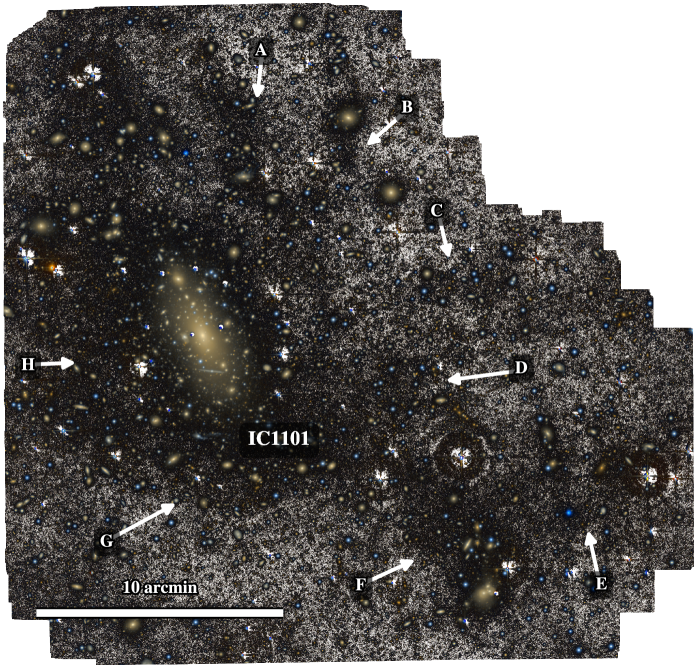
The result is the Figure 3 composite in the paper, reproduced here. IC 1101 is the yellowish elliptical blob slightly left of center. Around it, where the raw image looked like noise, the team now resolves a network of faint structures they label A through H. Some of those features, like the plumes labeled A, B, and C, are consistent with ongoing accretion. Others, like the broader features labeled H and G, sit exactly where a recent X-ray study of Abell 2029 has identified a cool “splash” of gas displaced by a past subcluster merger.
The contrast with the previous record is also worth noting. The 1991 Uson estimate of 607 kiloparsecs was based on R-band photometry that could not distinguish galaxy light from foreground contamination, and the 2017 Dullo MNRAS study constrained only the inner core. The new 260-kiloparsec edge sits well inside the 607-kiloparsec historical figure, but it is the first number that is anchored to a coherent physical boundary rather than a sensitivity threshold. The earlier Wikipedia entry for IC 1101 listed a similar isophotal diameter of about 400,000 to 550,000 light-years, consistent with both the Uson number and the new 520-kiloparsec figure after accounting for the different boundary definitions.
The stellar mass inside the 260-kiloparsec edge comes out to about 3.4 trillion solar masses. Including the diffuse envelope out to 475 kiloparsecs pushes the total to about 3.9 trillion, and extending to 620 kiloparsecs reaches 4.2 trillion solar masses. That is consistent with the earlier Uson estimate when the older luminosity is converted with modern mass-to-light ratios, and it is roughly a hundred times the stellar mass of the Milky Way.
Three methodological pieces make this measurement stick. The first is the extended point-spread function. The extended version captures the wide wings of the stellar image, out to half a degree from the star. Without that, the scattered light from the 250 brightest stars in the field would have added up to surface brightness levels of 27 to 28 magnitudes per square arcsecond, swamping the faint galaxy envelope the team was trying to measure.
The second piece is the wavelet-based deconvolution. Wavelets break an image into components at different spatial scales, and the team’s algorithm uses that decomposition to separate the smooth, large-scale emission of IC 1101 from the small-scale, high-frequency contamination introduced by the optics. The method is similar to the model-based deconvolution developed in earlier work, but it is run on the full image rather than on the radial profile.
The third piece is the multi-tracer edge detection. Instead of looking at one profile and drawing a line, the team looked for a radial feature that appears in surface brightness, color, and stellar mass density at the same time, with matching signatures in the ellipticity and position angle. That convergence is what justifies calling 260 kiloparsecs an edge rather than a threshold artifact. The team tested the result by varying the background subtraction and the mass-to-light conversion, and the edge location moves by less than 40 kiloparsecs across the full range of reasonable assumptions.
A preprint posted to arXiv on July 16, 2026, reports that IC 1101 has a coherent edge at about 260 kiloparsecs and a projected diameter of 520 kiloparsecs, making it the largest known galaxy by a margin wide enough that any future challenger will have to outshine a four-trillion-solar-mass central galaxy. The measurement is settled enough to cite, with a published arXiv number, a peer-reviewed acceptance in Astronomy and Astrophysics, and an independent Phys.org writeup and Debrief story describing the same numbers from the same preprint. The team is extending the analysis to other bright cluster galaxies in the same mass range and comparing the optical LSB features to the deep Chandra X-ray map of Abell 2029.
 Subscribe to our RSS feed









There are no comments.
Add A Comment