


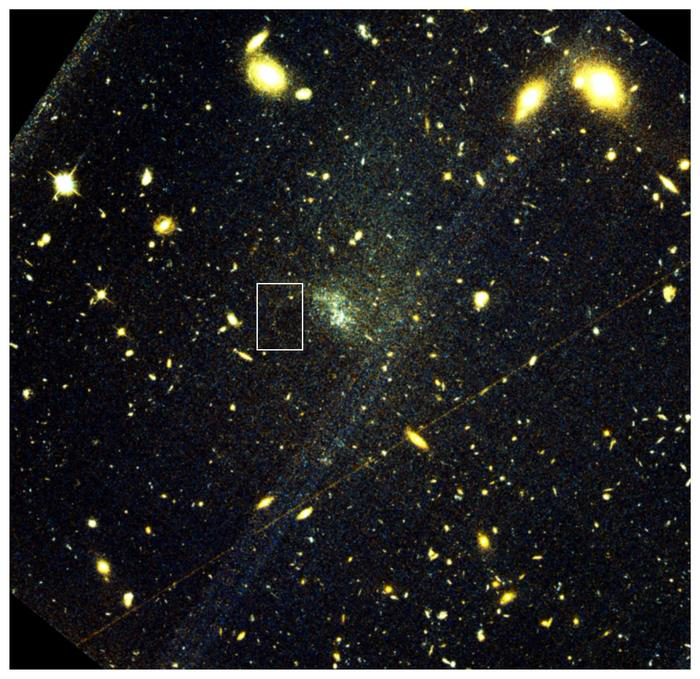
For thirty years, every stellar stream an astronomer could pull out of an image has come from inside the Milky Way. The Sagittarius stream winds under the galactic plane. The tidal tail of Palomar 5 drapes across the inner halo. All of them have lived inside our galaxy. On August 12, 2026, that monopoly ended. A team led by Julie Kiel Holm at the University of Copenhagen reported in Nature the first confirmed globular cluster stellar stream identified outside the Milky Way: a thin, two-kiloparsec-long arc the team named Oyashio, after a cold Pacific ocean current, in the ultra-diffuse galaxy UGC 9050-Dw1. The find is more than a first-of-its-kind image. The stars in a stream all travel along nearly the same orbit, and that orbit lets the team weigh the host galaxy’s dark matter halo from 35 megaparsecs away, the first time anyone has done that for an ultra-diffuse galaxy.
Ultra-diffuse galaxies are an awkward class for cosmologists. They have stellar masses closer to dwarf galaxies but physical sizes closer to the Milky Way, so they should not exist in the proportions that surveys keep finding them. The dark matter halo models that explain them range from nearly empty to absurdly heavy, and the two camps have argued about it for a decade. Standard kinematic tools (stellar velocity dispersions or rotation curves) need enough light to register a velocity, and ultra-diffuse galaxies do not give them much. Stellar streams sidestep the light problem. The stream’s stars travel along nearly the same orbit, that orbit is shaped by the gravitational field they fall through, so modelling the orbit gives the field, and the field gives the halo mass. That trick has worked inside the Milky Way for two decades. Holm’s paper is the first time it has worked on a galaxy 115 million light-years away. As co-author Tjitske Starkenburg of Northwestern put it in the Universe Today writeup: “By modelling that gravity, we can estimate the galaxy’s total mass. We already know roughly how much of that mass comes from visible matter like stars, so the rest must be dark matter.”
UGC 9050-Dw1 first surfaced in 2017 in a Canada-France-Hawaii Telescope survey for low-surface-brightness dwarfs. The host galaxy, UGC 9050, is a low-surface-brightness spiral. The companion dwarf sits 35.2 megaparsecs away (close enough to image deeply with Hubble, far enough that individual stars blur into integrated light). In September 2022, a team led by David Sand at the University of Arizona imaged the dwarf under HST program 16890 using the Advanced Camera for Surveys in the F555W and F814W filters, with 2,406 and 2,439-second exposures. The 2023 analysis by Fielder et al. catalogued the dwarf’s globular cluster population and concluded that most clusters formed in a single past merger event. The images sat in the archive for three more years before Holm’s collaborators pulled the stream out of them.
The team saw the feature by eye first, then confirmed it with a Rolling Hough Transform (a standard linear-feature detector) at a signal-to-noise of 7.34 in the combined HST image. The CFHT images independently show the same feature at signal-to-noise between 2.3 and 3.9 in the g, r, and i bands. The arc measures 72.3 ± 8.9 parsecs wide and roughly two kiloparsecs long, sweeping out of a compact bright source 2.5 kiloparsecs from the dwarf’s centre. Both the arc and its compact partner have nearly identical integrated colours (F555W−F814W of 1.0 ± 0.2 for the stream, 1.1 ± 0.1 for the progenitor candidate), consistent with the same stellar population. Holm’s group named the stream Oyashio in keeping with a Milky Way tradition of naming streams after ocean currents. The width rules out a dwarf-galaxy progenitor (the Milky Way’s Orphan stream, stripped from a low-mass dwarf, runs more than 200 parsecs wide); Oyashio is narrower, and its colour matches the bluer cluster population Fielder et al. identified in this galaxy. The narrow width, the colour match, and the orbital modelling together satisfy the team that the progenitor is a globular cluster rather than a dwarf.
The story of how to do this analysis outside the Milky Way has been building for years. Nibauer and Pearson released the X-Stream sampler in 2026, a tool that turns a stream image directly into constraints on the progenitor’s mass and the host halo’s mass and density profile. Holm’s collaborators ran X-Stream on Oyashio and got a 95 percent upper limit on the progenitor mass of 2.5 × 10⁶ solar masses (comparable to Milky Way clusters like ω Centauri and to clusters in M31). The best-fit halo mass comes out at log₁₀(M₂₀₀/M☉) = 11.63 (-0.83, +0.71) within the 68 percent confidence interval, a total mass of about 1.56 × 10¹¹ solar masses, in the same neighbourhood as estimates of the Large Magellanic Cloud’s halo and consistent with the GC-count halo mass of 1.5 to 1.8 × 10¹¹ solar masses from Fielder et al. The inner density slope γ comes out at 0.92 (-0.58, +0.57) slightly steeper than 0.3 measured for UDG Dragonfly 44 and the 0.2 typical of low-surface-brightness dwarfs, but consistent with UDG AGC 242019. As co-lead Holm told Universe Today: “Our results are consistent with previous studies and what they have shown about dark matter in this ultra-diffuse galaxy. We are measuring it with a completely new tool for this type of galaxy, demonstrating that this method also works beyond our own galaxy.”
The pipeline Holm’s team ran has three pieces. They extract a stream mask from the HST and CFHT data by following a polynomial fit to points selected manually in the F814W image and duplicating it on either side to define matched background regions. The stream width is measured by collapsing perpendicular slices along the fitted track, fitting a Gaussian with a linear offset to the brightness profile, and subtracting the HST point spread function in quadrature; the final width is 72.3 parsecs. They feed the masked stream into the X-Stream sampler, which generates dynamical stream models with parameters including progenitor mass, halo mass, inner density slope, halo concentration, and line-of-sight position, and produces a posterior distribution over those parameters by comparing each model stream to the observed one. They cross-check the sampler output with a forward simulation: a Palomar 5-like cluster with twenty times Pal 5’s mass, run through the same tidal stripping, produces a stream whose surface brightness reproduces Oyashio within the 95 percent confidence region. That closes the loop between the kinematic and photometric mass estimates.
The numbers worth sitting with: a 7.34σ signal in the HST image, in a structure 72 parsecs wide and 2 kiloparsecs long, in a galaxy whose total stellar mass is in the dwarf range. The dark matter halo mass of 1.56 × 10¹¹ solar masses is roughly 30 times the dwarf’s stellar mass, unusual since most ultra-diffuse galaxies have halo masses within an order of magnitude of their stellar masses. Holm’s team does not yet have an independent kinematic confirmation, but the consistency with the Fielder et al. GC-count estimate and the agreement between the sampler mass and the forward-model mass is what makes the case strong. The inner slope of 0.92 sits in the middle of the cosmological expectation range. Cold dark matter simulations predict a cuspy halo with γ near 1 in low-mass galaxies; observed low-mass galaxies tend to look cored with γ near 0.2. Oyashio’s γ is high enough to be consistent with the cosmological prediction, low enough that the result is still compatible with feedback-driven core formation.
Holm et al. used a 2,406-second Hubble exposure from September 2022 to find the first extragalactic globular cluster stellar stream and weigh the host’s dark matter halo to about 1.5 × 10¹¹ solar masses. The paper’s arXiv preprint is the canonical worked example for extending stream-orbit dark matter inference beyond the Milky Way. Euclid is already collecting wide-field imaging, and the Nancy Grace Roman Telescope will have a field of view roughly 100 times Hubble’s. Holm’s team expects both surveys to turn up dozens of comparable streams, each one a new anchor for the dark matter halo mass function at the dwarf end of the galaxy distribution. The Milky Way is about to become one of many places to do stream-based dark matter science.
 Subscribe to our RSS feed









There are no comments.
Add A Comment