


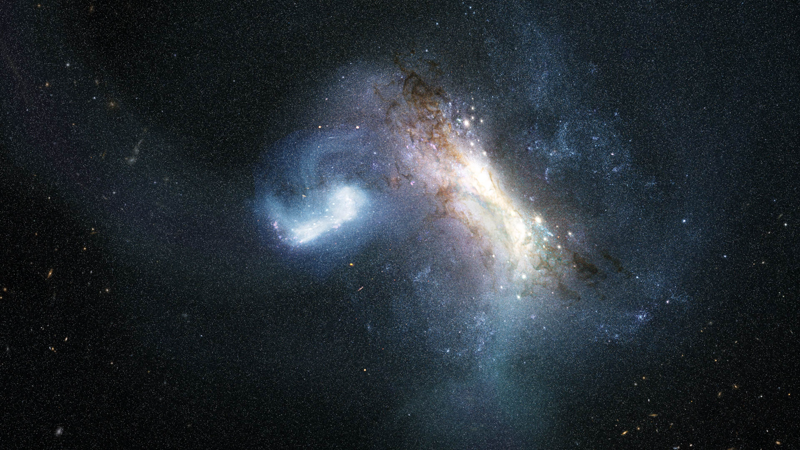
There is a version of our galaxy’s biography in which the Milky Way built itself quietly out of its own gas, and only later began collecting debris from smaller neighbours. That version is now much harder to defend.
On 17 August 2026, a team led by Davide Massari of the Astrophysics and Space Science Observatory of Bologna published evidence in Nature Astronomy that the young Milky Way absorbed a dwarf galaxy roughly 11.8 billion years ago, about two billion years after the Big Bang. The dwarf itself is gone, torn apart and mixed into the inner galaxy long before Earth existed. What survives is a set of globular clusters, dense balls of tens of thousands to a few million stars, whose ages and chemical compositions do not match anything the Milky Way could have made on its own.
The team named the vanished progenitor Low-energy-Kraken-Heracles, or LKH, a name that stitches together three separate strands of earlier work that had each argued for an early merger without being able to date it. As the ESA/Hubble release puts it, the result extends the firm merger history of our galaxy 1.8 billion years farther back than it reached before.
Galaxies in the standard picture grow hierarchically. Small systems fall together under gravity, the larger one strips the smaller apart, and the victim’s stars are redistributed through the survivor. The stars keep their chemical fingerprints and, to a degree, their orbits, so a galaxy carries a fossil record of everything it has eaten. That idea is not new, but confirming it in our own galaxy took decades of survey work: the 2026 Kavli Prize in Astrophysics went to Vasily Belokurov, Amina Helmi and Rodrigo Ibata for exactly this, uncovering the fossil evidence that the Milky Way was built through hierarchical accretion.
Until now the confident part of that record stopped around 10 billion years ago, at the merger with the dwarf galaxy Gaia-Sausage-Enceladus (GSE), which rearranged the structure of the galactic disk. The most recent large merger, with the Sagittarius dwarf, began more than 6 billion years ago and is still in progress. Earlier than GSE, the picture went soft. When the Milky Way was young it was small, so an incoming galaxy was not a minor satellite but a comparable building block, and the collisions were correspondingly messy. Signatures from that era have had billions of years to be smeared out.
That is the epoch where galaxy formation is currently most interesting and least constrained. The James Webb Space Telescope can image galaxies as they looked more than 12 billion years ago, but rarely resolves their individual stars. Galactic archaeology works the other way around, examining surviving stars in exquisite detail without ever seeing the galaxy they came from. Sven Buder of the Australian National University framed the pairing neatly in The Conversation: distant astronomy gives snapshots of young galaxies, galactic archaeology gives their fossils.
The team analysed Hubble observations of 39 globular clusters within the inner 20,000 light-years of the galaxy, the region where traces of the most ancient mergers should still be sitting. Going in, they expected two families: clusters that formed inside the young Milky Way, and clusters delivered by GSE about 10 billion years ago.
They found three. Plotting each cluster’s precise age against its metallicity, the abundance of elements heavier than helium, produced three separate age-metallicity sequences rather than two. One tracks the Milky Way’s own progenitor. One tracks GSE. Between them sits a third sequence whose clusters are consistently older than the GSE group and younger than the clusters born in place, regardless of their metal content.
An intermediate sequence is not an ambiguous result. Two overlapping populations can blur together, but a distinct third track implies a distinct chemical history, which means a distinct galaxy. From the sequence’s position the team estimated that the merger happened about 1.8 billion years before GSE, and that the incoming system carried roughly 500 million times the Sun’s mass in stars, comparable in stellar mass to GSE itself. Most of that material was deposited within the inner 6 kiloparsecs, which is why the evidence shows up in the bulge region rather than the outer halo.
“Our home is the Milky Way galaxy, but we do not know how our house was built,” Massari said in the NASA release. “In this paper we discover where the first significant batch of bricks came from: a dwarf galaxy that we call LKH.”
The naming is a deliberate act of bookkeeping. Previous work had identified a “Kraken” merger, a bulge population called “Heracles”, and a low-energy group of globular clusters, all pointing at an early accretion event from different directions and all difficult to reconcile with each other. By folding the three labels into one, the authors are arguing that the earlier claims were describing the same object with different instruments, and that the debate over whether such an event happened can now close.
Co-author Chiara Zerbinati of the University of Bologna credited the instrument pairing. High resolution and deep Hubble imaging gave the ages and metal content at unprecedented precision, she said, and combining that with Gaia measurements made it possible to separate one population of clusters from the rest.
The measurement rests on a specific and unglamorous piece of stellar astrophysics. A globular cluster’s stars formed at roughly the same time from the same gas, so on a colour-magnitude diagram they trace a single main sequence with a turnoff point where the most massive surviving stars are just exhausting their core hydrogen. The luminosity of that turnoff drops as the cluster ages, which makes it a clock. Reading it in absolute terms is hard, because the answer depends on distance, reddening by intervening dust, and the physics inside stellar models. Reading it in relative terms across many clusters observed by the same instrument in the same filters is considerably more robust, because the systematic errors largely cancel.
That is the leverage here. The absolute age of any one cluster still carries substantial model uncertainty, but the ordering of clusters relative to each other can be pinned down far more tightly, and ordering is what separates two age-metallicity sequences that overlap in metallicity. Hubble’s stable, well-characterised photometry over decades of archival imaging is what makes the relative comparison possible at all.
Metallicity supplies the second axis. A galaxy enriches its own gas as generations of stars produce heavier elements and die, so within a single galaxy age and metallicity climb together along a characteristic curve. A small galaxy enriches slowly and at low metallicity; a massive one runs the sequence faster and further. The shape of a sequence therefore encodes the progenitor’s mass, which is how a 500-million-solar-mass estimate comes out of a set of star cluster ages.
Gaia contributes the dynamics. Orbital energies and angular momenta computed from its astrometry let clusters be sorted by where they sit in the galactic potential, and the low-energy, tightly bound population is precisely the one expected from a merger that dumped its mass into the inner galaxy.
The limits are honest ones. Globular clusters are an incomplete census, since some early galaxies made few and others lost the ones they had, and turning a sequence into a progenitor mass requires models.
The concrete claim is narrow and testable: three sequences, 39 clusters, one merger dated 1.8 billion years before GSE, one progenitor mass near 5 x 10^8 solar masses. Fernando Aguado-Agelet of the University of Vigo and the University of La Laguna noted that Hubble is now observing globular clusters that have never been studied before, which is the obvious way to test whether a fourth sequence is hiding in the sample. The team’s stated goal is to characterise every massive merger in the galaxy’s history by this method.
The broader consequence lands on an argument about the first two billion years. Some earlier work held that the Milky Way’s earliest phase was defined by stars born in place. If a galaxy of GSE’s stellar mass arrived at 11.8 billion years ago, then accreted stars were part of the inner galaxy from nearly the beginning, and any model of the bulge that assumes purely local formation is missing a component that was there before the disk settled.
 Subscribe to our RSS feed









There are no comments.
Add A Comment