


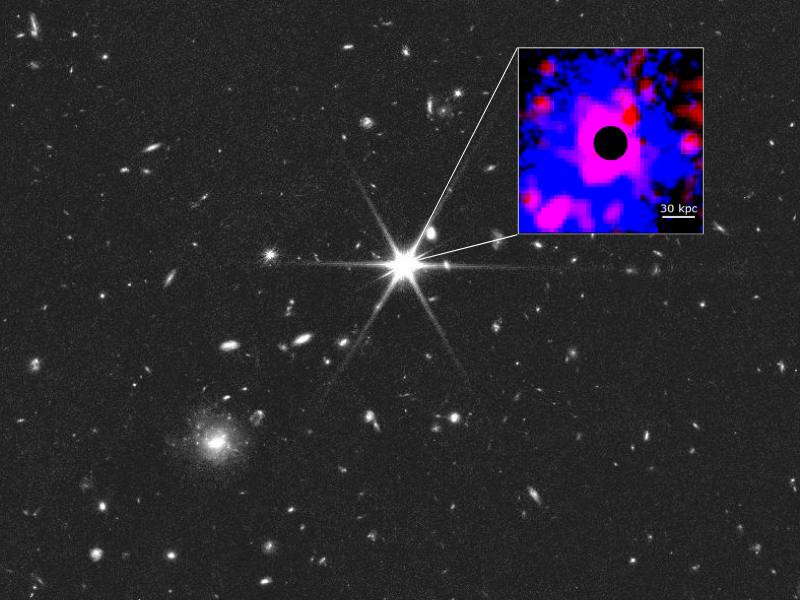
For a brief window about 2.1 billion years after the Big Bang, a hyperluminous quasar at the centre of a still-forming galaxy cluster puffed out a halo of X-ray-bright plasma at roughly 20 million kelvin, a temperature the local universe reserves for the intracluster medium that fills mature clusters today. A 634-kilosecond (about 176 hours) Chandra observation of the protocluster MQN01, reported by Andrea Travascio, Sebastiano Cantalupo and collaborators in the second paper of their X-ray series, has now caught that halo in the act of forming. After subtracting the bright point-spread function of the central quasar, the team is left with about 66 net X-ray counts in the soft 0.5 to 2 kiloelectronvolt band, an 8-sigma detection of extended plasma reaching out to at least 30 kiloparsecs, roughly 100,000 light-years, around quasar CTS G18.01.
Mature galaxy clusters hold most of their baryons not in galaxies but in a diffuse, X-ray-glowing plasma called the intracluster medium (ICM). That plasma is what makes clusters visible to X-ray observatories and what gives cluster cores their characteristic pressures, entropies and cooling times. The unanswered question has been when, exactly, that gas first becomes hot. At redshifts above about 3, almost every extended X-ray feature that telescopes have managed to pick out around a forming cluster has come from a radio-loud galaxy, where relativistic jets launder cosmic microwave background photons into X-rays through inverse Compton scattering. The thermal hot-gas component, the one that will become the future ICM, has been the part hiding.
MQN01 is the first clean case where the hot component shows up on its own. The central quasar is radio-quiet, so there is no jet to blame. Photoionization by the quasar cannot account for the morphology or spectrum. After a long checklist of alternatives, the only model that fits is thermal emission from a hot, optically thin plasma in collisional ionisation equilibrium. The detection therefore pins down a stage of cluster evolution that theorists have been modelling but have never before measured directly: cold gas pouring into the deep potential well of a forming halo and being shock-heated to X-ray temperatures as it falls.
The MQN01 field has been on Cantalupo’s target list for almost a decade. It hosts one of the brightest Lyman-alpha nebulae known at high redshift, mapped first by Borisova et al. in 2016 and now extended across more than two arcminutes by deeper VLT/MUSE adaptive-optics pointings. The same field also contains the largest galaxy overdensity seen at z > 3 and the highest concentration of rapidly accreting supermassive black holes of any surveyed protocluster, with six X-ray-detected active galactic nuclei inside a comoving volume of about 16 square megaparsecs (paper I, arXiv 2410.03933).
To follow up on the AGN census, Cantalupo’s Cosmic Web group at the University of Milan-Bicocca obtained 634 kiloseconds of Cycle 23 Chandra ACIS-I time on the field. Paper II, published in Astronomy and Astrophysics on 27 July 2026 and distributed as arXiv 2508.20074, focuses not on the point sources but on what is left when you subtract them. The team built a careful point-spread-function model for each observation, using simulated Chandra PSFs that account for the instrument response and spectral shape of quasar CTS G18.01, and subtracted it from the merged soft-band image.
What emerged is a soft, isotropic glow that follows a classical beta-model surface density profile with a steep inner slope (beta approximately 2.1) and a core radius near 36 kiloparsecs. Joint spatial and spectral fitting pins the gas temperature at kT about 1.8 plus or minus 0.4 kiloelectronvolts, which is about 20 million kelvin. The implied virial halo mass is about 3 plus or minus 1 times 10 to the 13 solar masses, and the hot gas inside the virial radius carries about 2.6 times 10 to the 12 solar masses, roughly 56 percent of the cosmological baryon budget expected for a halo of that mass.
The INAF press release of 27 July 2026 and a German-language scinexx write-up on 20 August 2026 popularised the work as the first clear image of a forming cluster atmosphere. A Space.com piece by Robert Lea on 29 July 2026 highlighted the temperature comparison: at 36 million degrees Fahrenheit the gas is hotter in absolute terms than anything in today’s nearby clusters, while being at an earlier point in its cooling life.
The detection method is the conceptual heart of the paper. Quasar CTS G18.01 dumps most of its 0.5 to 2 keV photons into a single pixel region, but a few percent leak into the surrounding 2- to 4-arcsecond annulus, which at z = 3.25 corresponds to about 15 to 30 kiloparsecs in projected distance. The team’s approach is borrowed from studies of local Seyfert galaxies: build a high-fidelity PSF from CIAO’s simulate_psf tool, weighted by the per-observation exposure and spectral shape, subtract it from the data, and look at what is left. The annulus holds 172 total counts in the 0.5 to 10 keV band and 96 in the soft band. After PSF subtraction, about 66 net counts remain, a significance near 8 sigma.
The spectral and spatial fits are performed jointly with an MCMC walk using emcee. The thermal component is modelled with xsmekal, a plasma code that includes bremsstrahlung, recombination continuum and line emission for highly ionised species in collisional ionisation equilibrium. Metallicity and temperature are tied across four concentric radial bins, while the normalisations scale with the surface density of a beta-model profile. The best fit yields kT approximately 1.8 plus or minus 0.4 keV and a hot gas mass fraction inside the virial radius of about 8 percent of the dynamical mass, or 56 percent of the available cosmological baryon budget.
The pressures and densities implied by that fit are one to two orders of magnitude above today’s clusters. Cooling times in the inner 15 to 30 kiloparsecs sit between 1 and 10 times the local free-fall time, which means the gas would be locally unstable if there were no heating source. The team argues that gravitational shocking, cool gas dropping into the halo’s deep potential well and being heated by the accretion shock, is enough to do the work. Quasar feedback cannot be ruled out, but the soft X-ray spectrum and the lack of any excess in the hard band make a feedback-dominated scenario hard to sustain.
The same field carries a 200-kiloparsec Lyman-alpha nebula mapped by Borisova et al. 2016 and recently extended with MUSE AO mosaics. The soft X-ray emission sits inside the inner 6 times 10 to the minus 18 erg per second per square centimetre per square arcsecond contour of that nebula, suggesting that the hot phase coexists with the cold phase rather than displacing it. The thermal pressure of the X-ray-emitting plasma is high enough to confine the cold clumps that produce the Lyman-alpha emission, which is one of the better pieces of evidence yet that the multiphase circumgalactic medium at cosmic noon can be pressure-confined rather than radiation-confined.
The combined view pairs the wide-field F150W2 mosaic of the protocluster with a zoom panel in which the Lyman-alpha nebula mapped by Borisova et al. 2016 appears in blue and the new soft-X-ray halo appears in red. The black disc in the zoom masks the quasar itself.
A radio-quiet quasar 11 billion light-years away has given astronomers the first direct look at hot, X-ray-bright plasma in the act of becoming the intracluster medium. The Chandra data show about 100,000 light-years of 20-million-kelvin gas around the quasar, with the pressure and density expected for a halo that is still accreting cool gas through gravitational shocks. Whether MQN01 is a typical waypoint for protoclusters or an unusually bright outlier is the open question; the team is working through archival X-ray data on hundreds of additional high-redshift quasars and has Atacama Large Millimeter/submillimeter Array time queued to test the gas conditions independently. If the picture holds up across a larger sample, the textbook story of how cluster atmospheres form will finally have a measurement at the epoch where it begins.
 Subscribe to our RSS feed









There are no comments.
Add A Comment