


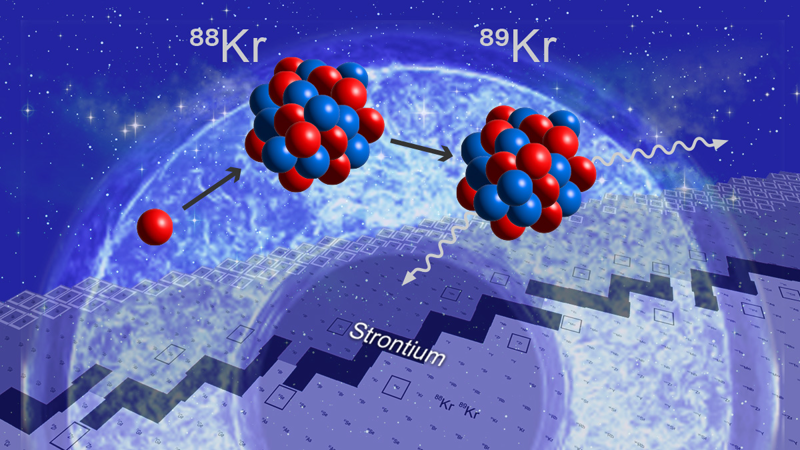
Astronomers who study the oldest stars in the Milky Way spend a lot of time reading chemical barcodes. When those stars formed, the universe had not yet built up much beyond hydrogen, helium, and a thin seasoning of lithium, so almost every heavier element in their atmospheres had to be made inside an earlier generation of stars and then scattered. The relative amounts of those elements tell you which stellar process actually did the forging, and one element in particular, strontium, has refused to behave. New measurements of a nuclear reaction on a related element, krypton-88, now narrow the gap between what the models predict and what the oldest stars show, and the result, published in Communications Physics on 8 June 2026 by Caley Harris, Artemis Spyrou, and a team of collaborators from twelve institutions in the United States, Canada, and Europe, was carried out at the Facility for Rare Isotope Beams (FRIB) at Michigan State University and the ATLAS accelerator at Argonne National Laboratory (FRIB newsroom; Nature paper). What made the experiment possible was a workaround for one of the hardest problems in nuclear astrophysics: most of the reactions that matter for stellar chemistry happen too rarely, and on too short-lived an isotope, to fire a beam straight at a target and count the products. The team measured a different isotope instead and worked backwards.
Why strontium is interesting starts with the fact that the periodic table heavier than iron cannot be built by normal stellar burning. Iron sits at the bottom of the curve of binding energy per nucleon, so fusing more nuclei releases less energy than it costs, and stellar cores cannot climb back up that hill. The solution, laid out in a famous 1957 review by Burbidge, Burbidge, Fowler, and Hoyle, was neutron capture. If a stellar environment can flood a seed nucleus with neutrons fast enough, the nucleus swallows them one at a time and walks up the chart before it has time to beta-decay. That framework identified two regimes: the slow neutron-capture process, or s-process, which works at relatively low neutron densities on long timescales, and the rapid neutron-capture process, or r-process, which runs at extreme neutron densities during, for example, neutron star mergers. Together, those two accounted for nearly everything heavier than iron. By the 1990s, however, surveys of metal-poor halo stars started turning up abundance patterns that neither the s-process nor the r-process could reproduce. Some of those stars had roughly solar amounts of strontium, yet barely any of the heavier elements that should have come along with it under either classical process. In between the two regimes sits a third option, the intermediate neutron-capture process, or i-process, with neutron densities around 10^13 to 10^15 neutrons per cubic centimeter and timescales measured in minutes rather than years. i-process models explain many of these strange patterns, but they consistently come up short on strontium, by factors of several, compared to what the old stars actually show, and modelers had flagged one specific reaction, the neutron capture on krypton-88, as the largest single uncertainty.
The team installed FRIB’s Summing NaI detector, called SuN, at the ATLAS facility to make that measurement. They fired a beam at a target to produce krypton-89, which is krypton-88 with one extra neutron glued on, then watched the gamma rays that krypton-89 emits as it relaxes. Those gamma-ray energies and intensities carry information about the structure of the nucleus and, crucially, about how readily krypton-88 would absorb a neutron in the first place. It is the same logic doctors use when they infer blood chemistry from a downstream signal rather than a direct needle stick: the measurement is indirect, but the inference is solid if the underlying physics is well understood. The result was not what theory had predicted. The measured krypton-88 neutron-capture rate came in consistently lower than the values most nuclear-theory calculations had been using, in some temperature regimes by nearly an order of magnitude. In parallel, the team’s reaction-rate uncertainty dropped from at least a factor of eight down to about a factor of three, which is still wide but no longer the dominant term in the strontium calculation. When the team plugged the new rate into three different i-process models, all of them produced more strontium than before, and the agreement with the stellar observations improved in every case.
The deeper question is what is happening inside the krypton-88 nucleus to slow down the neutron capture. Neutron-capture cross sections depend on the density and spacing of the nuclear energy levels just above the neutron separation energy. If those levels happen to be sparse or have the wrong parity, the incoming neutron has a hard time finding a resonance to grab onto, and the reaction rate drops. Direct measurements are impossible because krypton-88 itself is unstable, so the team turned to its more stable neighbor krypton-89 and used the Oslo method, a well-established technique that extracts level densities and gamma-ray strength functions from a single set of gamma-ray spectra. The SuN detector’s whole purpose is to capture those spectra efficiently; ATLAS provides a clean krypton-89 beam; together the two facilities make the indirect measurement practical. The takeaway is that nuclear structure details in one isotope can shift stellar predictions by a factor of two or more, and the only way to know which way the shift goes is to measure.
It is worth pausing on why strontium specifically shows up so much in this story. Strontium is the lightest element whose production has historically been a clean observational test of which neutron-capture process was active. Heavier elements like barium or lead have so many overlapping production paths that the signatures blur, but strontium sits near the edge of the s-process distribution and far from the r-process peak, so its abundance is sensitive to whatever process is producing the seeds in the middle neutron-density regime. Old stars with strong carbon and slow-neutron features but unusual strontium-to-barium ratios are exactly the kind of objects the i-process was invented to explain, and the FRIB result is the first time an experiment has directly tested the nuclear physics input rather than relying on theoretical estimates. What happens next is mostly back in the hands of the modelers, as Falk Herwig, a co-author at the University of Victoria, framed it in the press release: with the main nuclear uncertainty addressed, the i-process community can turn to the astrophysics, the neutron densities, the timing of the burning episodes inside candidate stars, and the conditions needed to match what the oldest stars actually show. Candidate i-process sites include very low-metallicity asymptotic giant branch stars, post-AGB stars, rapidly accreting white dwarfs, and the helium core flash in low-mass stars, and the new measurement gives all of them a more honest set of inputs to work with. The paper does not claim to have closed the strontium question, only to have removed the single largest nuclear physics unknown behind it. The remaining gap is astrophysical, and that is what the field will spend the next several years tightening.
 Subscribe to our RSS feed









There are no comments.
Add A Comment