


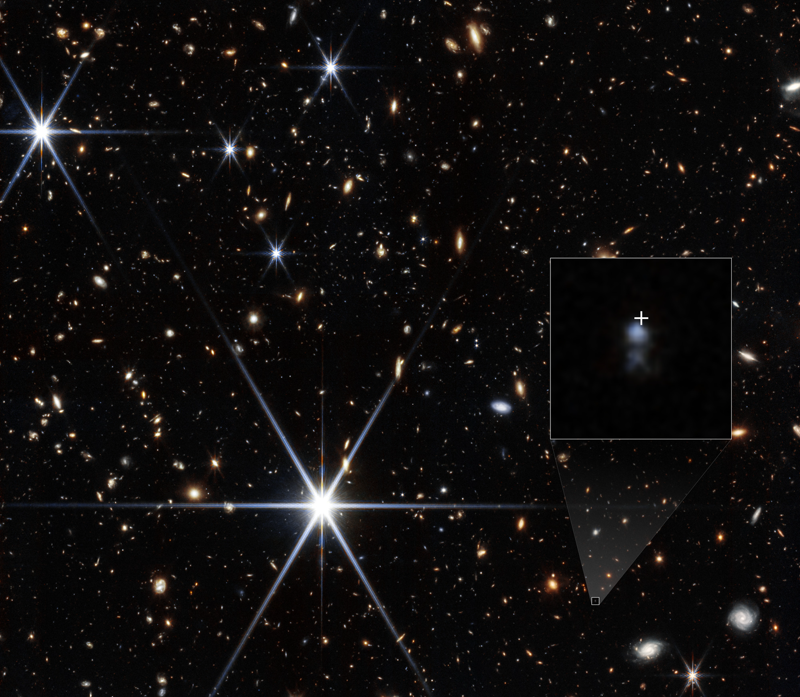
On March 4, 2024, a 64-dish radio array in the South African Karoo picked up a flash that lasted less than a blink. The pulse, named FRB 20240304B and reported on the NASA Webb mission page, arrived at the MeerKAT telescope at 00:50:12.567 UTC with a dispersion measure of 2458 pc cm^-3, a value so high that the signal had clearly travelled through a vast column of ionised gas before reaching Earth. Localising it to within arc-second precision on the sky took another thirty seconds of offline processing. Doing anything useful with that position took the James Webb Space Telescope. In the October 8, 2026 issue of Science, the team led by Manisha Caleb and Themiya Nanayakkara at the University of Sydney report that Webb pinned the burst to a faint dwarf galaxy at a spectroscopic redshift of 2.148 plus or minus 0.001, a record that more than doubles the redshift reach of any previously localised fast radio burst.
The result matters because fast radio bursts, millisecond flashes of coherent radio emission whose origins are still debated, have until now been almost entirely local phenomena by cosmic standards. Of roughly one hundred FRBs with redshifts measured from their host galaxies, the great majority sit at redshifts below 0.5. Pushing that frontier to z = 2.148 means the team can now read the line-of-sight through roughly eighty percent of cosmic history in a single burst. The Macquart relation, which converts an FRB’s dispersion measure into an integrated electron-density estimate along the line of sight, has been constrained almost entirely by nearby events. A single very distant source stretches the calibration into the regime where cosmological ionised gas dominates the budget and where the missing baryons problem, once a curiosity of low-redshift surveys, becomes directly measurable.
To find a host, the team first searched public surveys and ran deep optical and near-infrared follow-up at the Keck and MMT observatories. The host stayed invisible down to five-sigma limiting magnitudes of R = 26.24 and J = 23.38 in the AB system. A faint, distant dwarf at redshift two is dim enough that ground-based eight- and ten-metre telescopes cannot pick it out of the foreground, which is exactly the regime where Webb’s cold infrared sensitivity overwhelms everything else in the astronomer toolkit. The team was awarded Director’s Discretionary Time on the observatory (programme 6779) and turned the Near Infrared Camera onto the field in the F200W and F322W2 filters on 26 December 2024. A candidate host appeared at an offset of about 0.3 arcseconds from the radio position. The Probabilistic Association of Transients to their Hosts (PATH) formalism gave a 97.5 percent posterior probability that the candidate is the real counterpart, with only a 2.4 percent residual chance of an unseen alternative.
The clincher was spectroscopy. Webb’s Near Infrared Spectrograph Integral Field Spectrograph caught strong H-alpha and [O III] lambda 5007 emission lines from the candidate, two of the canonical redshift markers at this cosmic epoch. The measured redshift of 2.148, defined to three decimal places, places the burst firmly in what cosmologists call cosmic noon, the era between roughly two and four billion years after the Big Bang when the cosmic star-formation rate reached its peak. MeerKAT’s dispersion measure had predicted a redshift of 2.8 with a 1.6 to 3.4 range, so the spectroscopic answer was consistent with the radio estimate but on the lower side of its confidence range.
The host galaxy itself turned out to be the bigger surprise. Most FRB host galaxies discovered to date are massive, dusty, vigorously star-forming systems. This host is none of those things. It has a stellar mass of about ten million solar masses, around a thousand times less than the team’s prior expectation, and a star-formation rate of about 0.2 solar masses per year. Its gas-phase metallicity is only ten to twenty percent of solar. By contrast, the FRB with the most well-studied host to date, FRB 20121102A, sits in a galaxy about ten times more luminous. The galaxy is, in the words of lead author Manisha Caleb, “a little dwarf galaxy, although it was actively forming stars.”
That mismatch is where the science gets sharp. There are two leading classes of FRB progenitor model in the current literature. The first invokes the merger of two neutron stars, compact objects whose orbit shrinks over billions of years through gravitational-wave emission until they collide, an end-stage process that should preferentially occur in older galaxies with evolved stellar populations. The second invokes young magnetars, the highly magnetised neutron stars left behind when a massive star ends its life in a supernova, that can power a fast radio burst through starquake-like activity within only millions of years of their birth. A dwarf host at cosmic noon with the metallicity of a primordial starburst fits the second scenario cleanly. The Milky Way’s own Galactic magnetar SGR J1935+2154, located only about ten kiloparsecs away, has produced FRB-like bursts in modern observations, and the metallicity of the new host is in the range where the initial mass function favours the formation of the very massive progenitors that become magnetars.
The team concludes that a neutron-star merger is unlikely to be the source of FRB 20240304B. The energetics back this up: the isotropic-equivalent energy of the burst is around ten to the forty-one erg, on the high end of what is reported for non-repeating FRBs but consistent with the magnetar picture.
FRBs are not just telephone signals from exotic objects, they are probes of everything their light passes through. Each burst carries an imprint of every free-electron it encountered between source and observer, which means a single very distant FRB can trace the cosmic web of ionised matter, the diffuse intergalactic medium, the circumgalactic halos of intervening galaxy clusters, and the warm interstellar medium of the Milky Way itself in one observation. The team’s dispersion-measure analysis for FRB 20240304B found the imprint of two structures along the sightline: an intervening galaxy group at a redshift of 0.3, about 3.5 billion light-years from Earth, and the nearby Virgo Cluster, which lies about 54 million light-years away in the constellation that gives the burst’s host its other nickname. Splitting the dispersion-measure budget across these contributions is what calibrates the Macquart relation across most of cosmic time.
The immediate next step is more of the same. The team estimates that MeerKAT can detect and localise several FRBs per year at redshifts above one, and the upcoming SKA-Mid array, with its order-of-magnitude jump in sensitivity, should push that rate higher. Each new burst becomes a Webb target for spectroscopy, and each new spectrum refines the picture of where and how these energetic flares arise. Whether most FRBs turn out to be magnetars, mergers, or some mixture is still an open question, but the new host galaxy, small, metal-poor, vigorously star-forming, and viewed as it was ten billion years ago, is the kind of place where a magnetar should be living. That is enough, for now, to weight the debate.
 Subscribe to our RSS feed









There are no comments.
Add A Comment