


On 18 September 2025, the European Southern Observatory’s Very Large Telescope turned its FORS2 spectrograph toward a point of sky in Pisces that no telescope had ever measured at high resolution. The target, catalogued as TXS 2354+015, had been flagged two years earlier as a candidate high-redshift radio galaxy because the optical light from its host galaxy dropped sharply between the green and red filter bands of the Subaru telescope’s Hyper Suprime-Cam. The September observations, reported by Barbara Balmaverde of the INAF Astrophysical Observatory of Turin and four colleagues in a paper uploaded to the arXiv preprint server on 23 September 2026, produced a single bright asymmetric emission line at 7220 Angstroms with an equivalent width of 900 Angstroms and a flux of just under one ten-thousandth of a billionth of an erg per square centimeter per second. That signature, confirmed by a second emission line at the wavelength expected for NV at the same redshift, fixed the source’s redshift at 4.946, a value that places the galaxy as it looked when the universe was 1.1 billion years old and the cosmic microwave background was still warm.
The result makes TXS 2354+015 the most powerful radio galaxy currently known. The team measured its intrinsic radio luminosity at a rest-frame frequency of 500 megahertz, a value long used as the standard reference for comparing radio galaxies because the emission is uncontaminated by synchrotron self-absorption at the source’s redshift. They found 6.2 times ten to the twenty-ninth watts per hertz, almost twice the previous record, held since 2008 by TN J0924-2201 at 3.22 times ten to the twenty-ninth. The new source edges past a threshold that had stood for nearly two decades, and the gain comes not from a marginal improvement but from a clean factor of two.
High-redshift radio galaxies matter because they are the most extreme manifestations of accretion onto a supermassive black hole that the early universe produces, and because the energy the jets pump into the surrounding gas regulates star formation in the host galaxy and balances the cooling of the intracluster medium in its neighbourhood. Numerical simulations of how massive galaxies grow require this feedback to match the observed galaxy luminosity function, so finding the brightest examples at the highest redshifts is a way to test how aggressive that feedback could have been at the time galaxies were assembling their first bulges. The candidate selection is also where the new paper departs from tradition: earlier searches for radio galaxies beyond redshift three relied on the ultra-steep-spectrum technique, which is biased toward one subpopulation, and the team argues that selecting candidates by their optical dropout in the red filter of the Hyper Suprime-Cam Subaru Strategic Program, the Lyman-break method, catches high-redshift radio galaxies whose flat radio spectra would slip past the steepness cut. TXS 2354+015 itself has a radio spectral slope of 0.94, well short of the steepness criterion of 1.3 that traditional searches enforce, and the authors present it as the prototype of an entire missed population.
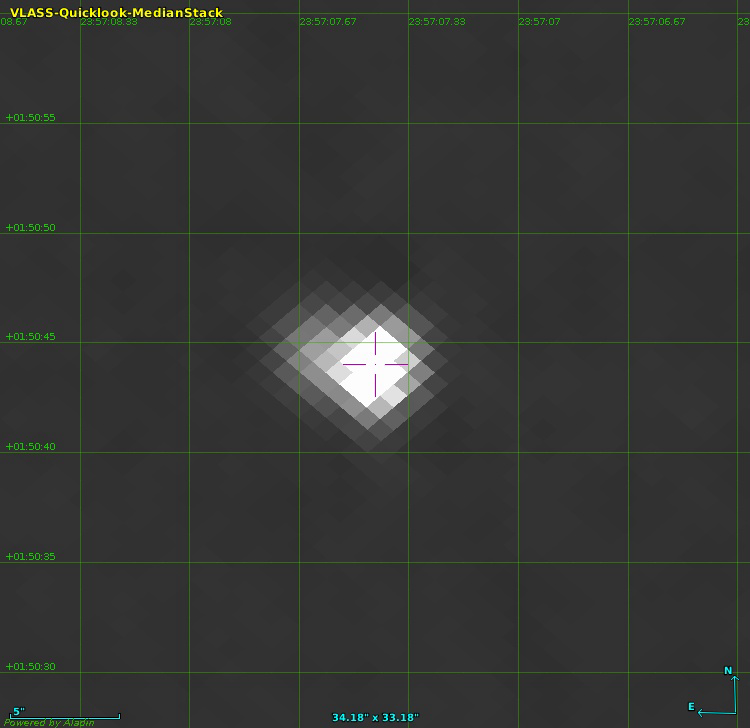
The follow-up spectroscopy was conducted at the VLT under programme 116.28LA.001 on 18 September 2025, and the radio data were assembled from two large surveys rather than a single observation. The team used the FORS2 spectrograph with the GRIS600RI grism and GG435 blocking filter, a setup that delivers wavelength coverage from 5120 to 8450 Angstroms at a resolution of about 300 kilometres per second; they placed the slit so that it included both the target and a brighter pivot star four arcseconds to the northwest, then took two 1218-second exposures. The extracted spectrum showed a continuum below the detection threshold on the red side of the line and a sharply asymmetric emission line whose blue edge drops within a single resolution element, the canonical signature of the Lyman-alpha line from a galaxy whose neutral hydrogen is being eaten away by the intergalactic medium at that epoch, and a second emission feature at the wavelength expected for doubly ionised nitrogen at the same redshift sealed the identification. The 150 megahertz TIFR GMRT Sky Survey, produced with India’s Giant Metrewave Radio Telescope, gave the low-frequency anchor at 25 arcsecond resolution and 17.5 millijansky sensitivity, while the Karl G. Jansky Very Large Array Sky Survey gave the high-frequency anchor at 3 gigahertz, 2.5 arcsecond resolution, and 70 microjansky noise. The team cross-matched the two catalogs, looked for HSC-SSP optical counterparts within 1.5 arcseconds of the VLA positions, and selected candidates with the Lyman-break dropout signature in the red filter. The candidate that survived was TXS 2354+015, with a radio flux density bright enough to ensure a robust identification and a clean offset of just 0.2 arcseconds between the VLA and optical positions. The 3 GHz image itself, retrieved from the HTML build of the paper, shows a single compact source on a flat background, the canonical appearance of an unresolved high-redshift radio core.
The combined picture is more striking than any single measurement. The host galaxy, as seen by Subaru in the i-band, has a half-light diameter of about 5 kiloparsecs, several times larger than the typical 1.5 kiloparsec radius of a z equals five galaxy in deep-field samples, and the Lyman-alpha emission line is spatially extended over a full width at half maximum of roughly 6 kiloparsecs, consistent with the giant Lyman-alpha nebulae that are known to surround powerful high-redshift radio galaxies and that are aligned with the radio jet axis. The radio position angle, measured from a marginal Gaussian fit to the VLASS image, is 71 degrees, while the slit was oriented at minus 30 degrees, almost perpendicular to the jet, so the team’s measurement likely underestimates the true extent of the nebula. The stellar mass the team infers from the host’s mid-infrared luminosity carries an unusually long list of caveats: the WISE W1 band at 3.4 micrometres captures several emission lines at this redshift, with the brightest being the doubly ionised oxygen line at 5007 Angstroms rest frame, and extrapolating the well-known correlation between radio power and that line’s luminosity from low-redshift samples suggests a host stellar mass near 2 times ten to the twelfth solar masses, a value that would place the galaxy at the very top of the local luminosity function, but a younger stellar population would reduce the estimate by a factor of ten and better spectral energy distribution coverage is required before the number can be trusted.
The discovery will not stay unique for long. The combination of the Lyman-break dropout selection with the cross-matched radio catalogs is now a template that can be reapplied to the rest of the HSC-SSP wide field, a 1400-square-degree footprint that the team estimates contains hundreds of similar candidates. Each one will need VLT or Keck spectroscopy to confirm its redshift, but the path from candidate to confirmed high-redshift radio galaxy is now routine rather than rare, and outside coverage has already framed TXS 2354+015 as the prototype of a population that the older ultra-steep-spectrum searches missed. The implication is that the radio-loud active galactic nuclei population at z greater than four is larger, flatter-spectrum, and more energetic than the existing sample suggested, and that the brightest examples may have been hiding in plain sight in the same wide-area optical surveys that astronomers have been using to find high-redshift galaxies for the past decade. Whether TXS 2354+015 is itself unique or merely the first of a new class is the question the next round of spectroscopy will answer.
 Subscribe to our RSS feed









There are no comments.
Add A Comment