


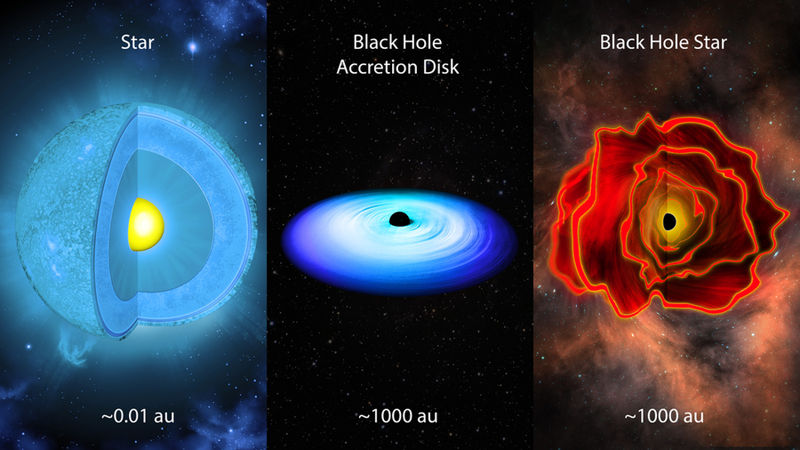
Six hundred and sixty million years after the Big Bang, when the universe was barely five percent of its current age, the James Webb Space Telescope picked up a red dot that almost no model on the shelf could explain. It looked, at first glance, like an enormous star. It had the broad emission lines of an active galactic nucleus. Its light vanished entirely below a certain wavelength in a way that almost no known object manages. The brightness sat at roughly 100 billion times the energy output of a star like the Sun, well past anything stellar nucleosynthesis can produce. Astronomers at MIT and collaborating institutions argue in a paper published August 12 in Nature that the source is something not previously classified: a black hole, weighing in at around 100,000 times the mass of the Sun, wrapped in a hydrogen envelope the size of the solar system and shining almost entirely by accretion rather than fusion. The team named it MoM-BH*-1, and the broader configuration a “black hole star.”
The discovery lands in the middle of one of the most active arguments in extragalactic astronomy. JWST has spent the past three years turning up “little red dots” in almost every deep field it images: compact, very red, surprisingly bright sources in the first 1.5 billion years of cosmic time, each one tiny on the sky but radiating as much as a small galaxy. They are catalogued as LRDs. They are extremely common in the early universe and almost vanish by the present day, which is itself a clue that whatever they are, they represent a phase most black holes pass through quickly.
If MoM-BH*-1 is what the MIT team says it is, the LRDs may not be a mixed bag at all. They may mostly be one thing: supermassive black holes at cosmic dawn, growing through super-Eddington accretion inside dense gas cocoons, briefly visible before feedback or mergers dissolve the envelope. That would resolve two puzzles: how billion-solar-mass black holes existed at redshift seven without violating standard accretion physics, and why these sources fade from view by the present, since the dense envelope they need to look “star-like” is a transient early-life configuration rather than a steady state. As Naidu puts it, “every massive black hole may have gone through this phase.” If that holds, the LRD mystery was never about exotic physics. It was about catching black holes mid-birth.
Rohan Naidu, a NASA Hubble Fellow at MIT’s Kavli Institute, was not looking for a black hole star. He was running a JWST survey called Mirage or Miracle (MoM) to figure out which of the bright galaxies at extreme distances were genuinely primordial and which were foreground contaminants masquerading as early-universe sources. As Naidu told MIT News, “what looks like an extremely bright early galaxy, aka a ‘miracle,’ in some cases actually could be a ‘mirage.'” The team picked targets for spectroscopy using NIRSpec, the workhorse near-infrared spectrograph for early-universe follow-up.
One target stood out. Its color was very red, its brightness was off the scale, and its spectrum had a tell-tale shape: an abrupt cut-off blueward of a certain wavelength, then bright emission redward. That cut-off is a Balmer break, which usually appears in the atmospheres of a few-hundred-million-year-old stars, where dense hydrogen absorbs photons just shortward of 3647 angstroms. The team had never seen one this deep. As Naidu put it, it was “the deepest break we have ever observed in any object, ruling out ‘ordinary’ stars as the source.” The spectrum also contained almost no metals, only hydrogen and helium.
The team ran simulations. Could hydrogen alone, without dust, make something this red? Yes, but only if the hydrogen was so dense that it behaved like a stellar surface, a pseudo-photosphere rather than a wispy nebula. That explained the color and the deep Balmer break, but not the brightness. Stars run on fusion, and fusion tops out at a known energy ceiling for a given mass. This source was a hundred billion times brighter than that ceiling.
The fix was to swap the power source. The simulations added a black hole accreting at super-Eddington rates instead of nuclear fusion at the center. The team varied the black hole mass and other parameters until the simulated spectrum and total luminosity matched what JWST saw. The closest match was a black hole of about 100,000 solar masses inside a hydrogen envelope the size of the solar system. The Nature paper lays out the model: the Balmer break and absorption features come from extremely dense, turbulent gas forming a dust-free envelope, and radiation from the black hole dominates almost all the observed light.
The team named the specific source MoM-BH*-1 and proposed “black hole star” as the category. If the interpretation holds, every other LRD in the JWST archives becomes a candidate. Sci.News covered the paper the same day, and phys.org ran a parallel writeup noting that an accompanying paper by Alberto Torralba and colleagues identifies a similar object at “cosmic noon,” roughly three billion years after the Big Bang. TechTimes emphasized the super-Eddington accretion angle, noting that Naidu has proposed that early globular clusters with the right conditions underwent runaway stellar mergers, producing supermassive stars weighing tens of thousands of solar masses.
The spectroscopic work hinges on two features JWST is uniquely equipped to measure: the depth of a Balmer break at very high redshift, and the shape of broad hydrogen emission lines from the inner accretion flow.
A Balmer break is a sharp drop in continuum light at wavelengths shorter than the Balmer limit, the energy required to lift a hydrogen electron from its second shell to a free state. Any gas cool and dense enough to keep hydrogen in its lowest excited state will soak up photons below 3647 angstroms and let longer wavelengths pass; the size of the resulting step tells you how much cool, dense hydrogen sits in front of the light source. At a redshift of about seven, the same break shifts into the near-infrared, into the JWST band, and the depth can be measured precisely with NIRSpec’s multi-object spectroscopy. The MoM-BH*-1 spectrum shows the deepest such break ever recorded at any redshift, which forced the team to a dense hydrogen atmosphere rather than a typical nebular one.
The black hole mass estimate comes from a separate argument. The light is dominated by accretion, not starlight, so the team applied standard active galactic nucleus scaling relations between continuum luminosity and broad-line region radius. The H-beta emission line is multi-peaked and broad, consistent with several thousand kilometers per second in the inner accretion flow, and the width scales with the square root of the black hole mass inside it. Super-Eddington accretion, the only way to push 100,000-solar-mass objects to LRD-like luminosities from small seeds, is the theoretical prediction the team is matching against.
The third piece is the absence of dust. Most red objects in JWST images are red because interstellar dust absorbs blue light. MoM-BH*-1 is red because hydrogen itself is absorbing at the Balmer limit. The Nature paper is explicit: “the redness of the black hole is due to gas, not dust,” which rules out standard dust-reddened active galaxies and puts the object into a small set of dust-free compact sources at cosmic dawn. The structural claim the team is asking the community to test is straightforward: a black hole of roughly 100,000 solar masses, an envelope about the size of the solar system, accreting at super-Eddington rates, lighting up a hydrogen pseudo-photosphere that looks star-like from a distance.
A single observation in JWST’s third year of operations has reframed an open question in extragalactic astronomy. If the Nature paper holds up to scrutiny, the universe’s ubiquitous little red dots are not exotic new objects but a transient phase in the life of every massive black hole: a brief window in which a seed black hole, growing through super-Eddington accretion inside a hydrogen envelope, briefly outshines its host galaxy before feedback or mergers dissolve the cocoon. The MIT team expects JWST’s archive to contain many more MoM-BH* candidates waiting to be confirmed. The next step is spectroscopic follow-up on the brightest LRDs across multiple deep fields, which should settle whether the same dust-free, hydrogen-dominated signature shows up in the rest of the population.
 Subscribe to our RSS feed









There are no comments.
Add A Comment