


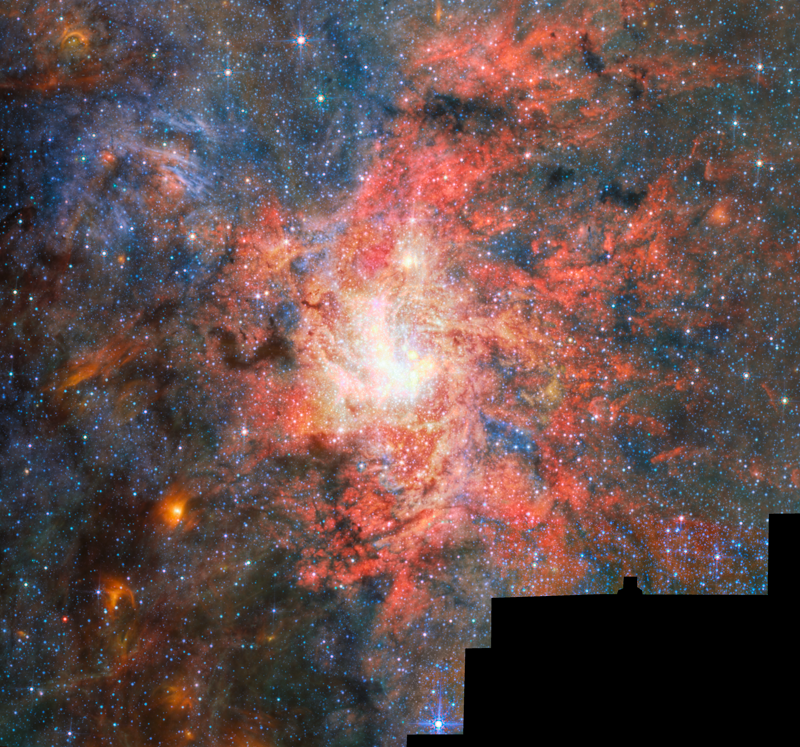
A star only 0.55 light-years from Sagittarius A* is still making water.
Astronomers working on the Mid-Infrared Characterisation of Nearby Iconic galaxy Centres programme (MICONIC) used Webb’s Mid-Infrared Instrument (MIRI) to take the first continuous mid-infrared spectrum of IRS 3, an oxygen-rich asymptotic giant branch star that sits inside the most punishing radiation environment in the Milky Way. The spectra carry clear silicate dust features and, for the first time in this object, a water signature inside the star’s outflowing envelope. The result, published on 11 August 2026 in Astronomy and Astrophysics, shifts a long-standing assumption about galactic centres: stars there can keep producing the kind of molecular and dusty material that future planetary systems are built from, even when they are essentially inside the black hole’s sphere of influence.
Why this matters comes down to where the chemistry of galaxies gets done. A normal disk galaxy gets most of its interstellar dust and much of its recycled gas from evolved, mass-losing stars like IRS 3. These stars puff off their outer layers as they age, and the ejecta cool into grains that seed the next generation of star and planet formation. Galactic centres are different in kind, not just degree. The supermassive black hole at the centre of every large galaxy pumps out enough ultraviolet and X-ray radiation to break water apart in seconds in unprotected gas, and its gravity roars past anything orbiting closer than a few parsecs. If stars near galactic centres cannot produce dust and molecules, the inner few hundred light-years of a galaxy should be remarkably dust-poor, with a different chemistry than the disk. That in turn changes how astronomers read the spectra of distant galactic cores taken by mid-infrared space observatories, since the same chemistry that runs in our own galactic centre runs in every other large galaxy’s centre. The MICONIC programme was created to test exactly that question, and IRS 3 is its flagship target.
The Webb observation tells the IRS 3 story in detail. Lead author Florian Peissker of the University of Cologne and his team, including Macarena Garcia Marin of ESA (the MICONIC principal investigator), pointed MIRI at IRS 3 during the 2025 Guaranteed Time Observations campaign (programme ID 1266) and collected a continuous spectrum across the mid-infrared. The MIRI medium-resolution spectroscopy mode spans wavelengths where cold dust and molecular gas both radiate, so a single exposure covers the silicate bands, the water rotational-vibrational lines, and the broader dust continuum that anchors the dust mass estimate. Two strong silicate features in the data reclassify the star: earlier studies had flagged it as a candidate carbon-rich AGB star, but the new spectrum is unambiguously oxygen-rich, with the silicon-oxygen grain signature that is the standard fingerprint for a dusty red giant shedding mass in an oxygen-dominated envelope. Layered on top of the silicate features is a water signature inside the envelope, which is the first clear molecular detection for this object and the headline result. The reclassification is important on its own terms: carbon-rich AGB chemistry would have implied a different set of grain types, and confirming that IRS 3 follows the oxygen-rich path is the precondition for the water finding being meaningful.
The numbers behind that headline make it sharper. IRS 3 lies about 0.55 light-years from Sgr A*, roughly 3,300 astronomical units, which puts it well inside the sphere where the black hole’s tidal forces are a factor in the star’s mass-loss budget. The dust envelope itself extends some 10,000 AU from the photosphere, with temperatures falling from roughly 1,200 Kelvin close to the star to around 100 Kelvin in the outer regions; the spectrum is consistent with a shell-like, layered distribution rather than a smooth outflow, which is useful because layered shells are exactly the structures models expect when an AGB star loses mass in pulses. Stellar modelling puts IRS 3 at about six solar masses and roughly 72 million years old, near the end of its AGB phase. Both the geometry of the envelope and the chemistry of its grains point to a star that is still very much in the business of enriching its surroundings, as the ESA/Webb release weic2617 lays out.
The deep dive into why the water survives is where the physics gets interesting. Water in space is fragile because ultraviolet photons break the molecule into hydrogen and oxygen on timescales of days in an unprotected environment, and the same harsh UV field also drives chemistry off the silicate grain surfaces that protect newly formed water in cooler clouds. Around Sgr A*, that radiation field is unusually intense because hot stars in the central parsec and the black hole’s own outflows pile ultraviolet photons on top of one another. The MICONIC result shows two things at once: the silicate dust itself has survived, which it would not have done if the radiation had sputtered the grains apart, and water has formed and persisted inside that dust. The standard interpretation is that the water molecules are locked onto grain surfaces in the cooler outer regions of the envelope, the same way water ice is locked onto silicate grains in dense molecular clouds in the solar neighbourhood. The fact that those ices survive this close to a supermassive black hole is the result that makes the paper more than a detection.
The takeaway for galactic evolution is the part that will move through the field. If IRS 3 is doing this, other AGB stars in the same neighbourhood almost certainly are, and the central parsec of the Milky Way likely contains a steady drizzle of newly formed silicate and icy grain material rather than the chemically barren zone some models had assumed. That material feeds the mini-spiral of gas and dust that orbits Sgr A*, the reservoir that has been indirectly imaged by the Event Horizon Telescope in 2022 and by GRAVITY at the Very Large Telescope in subsequent years. Over millions of years, even a small per-star dust contribution adds up, and the chemistry of the inner galaxy starts to look more like the chemistry of the disk than the chemistry of a void. The MICONIC programme is extending the same MIRI observations to other evolved stars in the inner parsec; the answer to how many more IRS 3s are out there is the next observational push, and the TechTimes coverage traces the working assumption that the survey will turn up several similar cases.
What we have learned is that proximity to a supermassive black hole is not, by itself, a death sentence for water or for silicate dust in evolved-star envelopes, and the next step is observing the same kind of spectroscopy on the next dozen AGB candidates inside the central parsec to see whether IRS 3 is representative or unusually resilient. The next MICONIC data release, plus parallel JWST spectroscopy of the dusty objects orbiting within a few arcseconds of Sgr A*, will pin that down.
 Subscribe to our RSS feed









There are no comments.
Add A Comment