


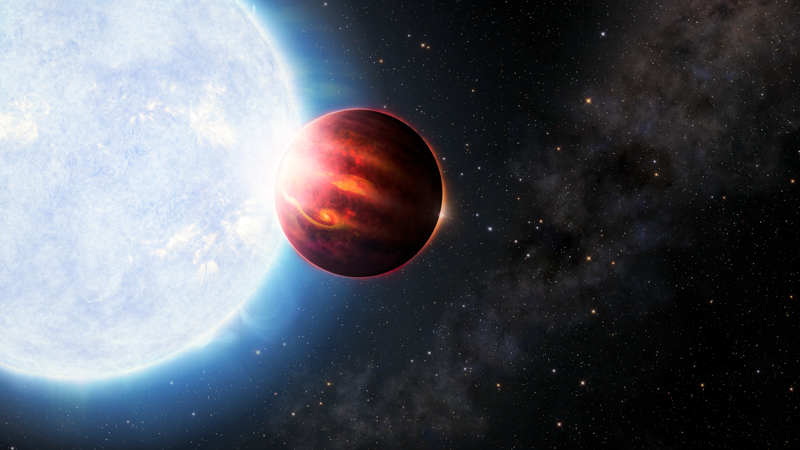
Almost 320 light-years away, in the direction of the constellation Libra, a giant planet swings around its star in just under three days, glowing red and orange because the side that faces the star is hot enough to vaporize rock. WASP-189b is the textbook example of a class that astronomers call ultra-hot Jupiters, planets that look like Jupiter in size and bulk composition but orbit so close to their stars that their dayside temperatures climb above 2,500 kelvin, well past the vaporization point of minerals such as magnesium, silicon, and iron. New observations of WASP-189b with the Immersion Grating Infrared Spectrograph (IGRINS), mounted on the Gemini South telescope in Chile, have produced the first simultaneous measurement of gaseous magnesium and silicon in any exoplanet atmosphere, and the ratio between the two elements in the planet turns out to match the ratio in its host star. The result, published by Jorge Antonio Sanchez of Arizona State University and an international team in Nature Communications on 18 February 2026 and highlighted in a NOIRLab press release on 13 October 2026, is the first direct evidence for a long-standing assumption that astronomers have used since exoplanet science began (Sanchez et al. 2026, Nature Communications; NOIRLab press release noirlab2609).
The assumption in question is simple to state and powerful in practice. Planets form from the same protoplanetary disk of gas and dust as their host star, and the chemistry of that disk is set by the chemistry of the parent molecular cloud. The expectation, therefore, is that the relative proportions of the major rock-forming elements in a planet should match the relative proportions of those same elements in the star. In the Solar System this expectation has been borne out within a factor of about two for the rocky planets, and the small departures from a perfect match are useful constraints on the violent early history of the inner Solar System. For every other planetary system astronomers can detect, the question had to be inferred. Stellar spectra are easy to come by, because stars are bright, but exoplanet spectra are not, because exoplanets are faint, sit right next to a much brighter source of light, and are usually moving quickly through the background. Until the new WASP-189b measurement, no team had ever detected two rocky-element species in a single exoplanet at the same time, so the assumption that exoplanet chemistry tracks stellar chemistry was reasonable but unverified (SciTechDaily; ScienceDaily).
Why the magnesium-to-silicon ratio, in particular? The two elements sit at the heart of rock-forming mineralogy. Magnesium and silicon together build the silicates that make up most of Earth’s mantle, the olivine and pyroxene minerals that dominate the rocky bodies of the inner Solar System, and the iron-magnesium-silicate matrix that is the default material from which any rocky planet is expected to condense. The Mg/Si ratio of a planet, more than its absolute abundance of either element, sets the dominant mineral phases it can carry, which in turn control how easy it is for a planet to retain plate tectonics, generate a magnetic dynamo, and outgas volatiles that contribute to oceans and atmosphere. The same ratio in a star, measurable from high-resolution stellar spectra, has therefore been used for two decades as a proxy for the mineralogy of any rocky planets in that system, even ones whose spectra are beyond current reach. The WASP-189b result is the first observational check on that proxy, and it passes (NOIRLab Nuggets: Decoding Planet Origins with Gemini).
WASP-189b is a useful target for this measurement for a reason that has nothing to do with its bulk composition and everything to do with its orbit. The host star, catalogued as HD 133112, is a hot blue-white A-type star about 2.7 times the mass of the Sun. The planet is tidally locked, with the same hemisphere permanently facing the star, and its 2.7-day orbit takes it through a particularly favorable alignment called secondary eclipse, when the planet passes behind the star as seen from Earth. During secondary eclipse the planet’s own emission drops out of the combined spectrum and the star’s emission drops in, and a careful subtraction of one from the other yields the planet’s dayside spectrum in isolation. The IGRINS spectrograph, built by a consortium led by the University of Texas at Austin, Korea Astronomy and Space Science Institute, and the Korea Institute of Science and Technology, was a visiting instrument on Gemini South from 2022 to 2023 and was chosen because its near-infrared coverage and spectral resolving power are high enough to separate the planet’s individual atomic and molecular lines from the much brighter signal of the host star. The team collected a series of transit and eclipse observations of WASP-189b with IGRINS at Gemini South, then used high-resolution cross-correlation techniques to extract the magnesium and silicon lines from the planet’s contribution. The matched Mg/Si ratio was the central result (Sanchez et al. 2026, Nature Communications).
The instrumentation choice was a constraint as much as a convenience. Ground-based telescopes can deliver the spectral resolution that this kind of work requires only in narrow wavelength windows where Earth’s atmosphere happens to be transparent, and the near-infrared windows around 1.5 and 2.3 micrometers are the most productive because they sit in absorption bands of gaseous magnesium and silicon at the temperatures found in ultra-hot Jupiter atmospheres. The IGRINS spectrograph covers both windows simultaneously, which is what made the simultaneous detection possible. A more common approach in the field is to use a space telescope such as Hubble or JWST, but the trade-off is that those instruments do not have the same spectral resolving power and cannot easily separate the planet’s line from the star’s line for atomic species at high temperature. The success of the IGRINS run on Gemini South, and the fact that the instrument’s successor IGRINS-2 has now been commissioned as a facility-class instrument on Gemini North in Hawaiʻi, is a sign that high-resolution ground-based spectroscopy is on its way to becoming a standard tool for this kind of measurement, with more targets and more elements in the coming years.
A practical consequence of the result is that the long list of rocky exoplanet host stars whose Mg/Si ratios have already been measured, mostly by ground-based stellar surveys, can now be used with more confidence to predict the mineralogy of any rocky worlds in those systems. The assumption is no longer just a reasonable extrapolation from Solar System chemistry. It is a tested prediction, validated for one of the hottest and most alien gas giants in the catalogues, and almost certainly applicable, to a close approximation, to cooler and more temperate planets that no instrument yet exists to measure directly. For astrobiologists in particular the result closes a methodological gap: the standard practice of using a star’s elemental makeup to estimate the geochemistry of its planets, and through that the suitability of those planets for plate tectonics, magnetic fields, and long-term habitability, is now backed by direct observation rather than by an unverified assumption.
The IGRINS-2 commissioning on Gemini North, and the parallel development of other high-resolution spectrographs for the upcoming extremely large telescopes, suggest that the WASP-189b measurement is the first of a series rather than a one-off. The next steps are likely to involve measuring additional ultra-hot Jupiters with comparable precision, extending the technique to cooler gas giants and Neptune-class planets where the chemistry is more complex, and eventually applying the same kind of cross-correlation analysis to rocky planets around small stars, where the same Mg/Si assumption will need to be tested under different conditions. None of that happens quickly, and the WASP-189b result will remain the cleanest single demonstration of the principle for some time, but the door it opens is the same one that exoplanet science has been pushing on for the past two decades: turning stellar spectra, which are easy to obtain, into statements about planetary interiors, which are not.
 Subscribe to our RSS feed









There are no comments.
Add A Comment