


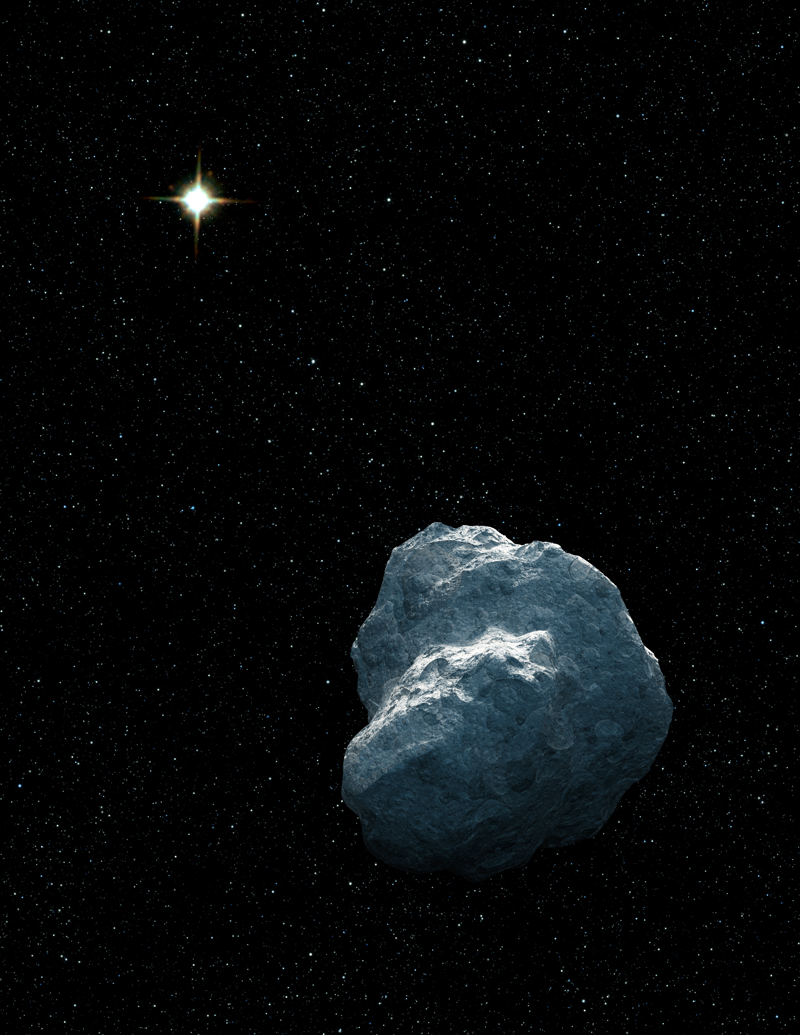
Image: an artist’s concept of a trans-Neptunian object, a small and faint icy body orbiting the Sun beyond Neptune. Credit: NASA, ESA, Leah Hustak (STScI), via Wikimedia Commons.
There is a size of telescope that can look at a planet and a size that can look at a firefly on the Moon. The Webb and Hubble combination that has just found 27 previously unknown objects beyond Neptune is the second kind. One of the new bodies is about 10 kilometres across, roughly the length of six city blocks, sitting tens of astronomical units from the Sun where the light that reaches it has been stretched and dimmed almost to nothing (NASA’s release on the discovery). Most of these things are more than 100 million times fainter than anything you can see with your unaided eye. The survey team’s own way of putting it: one object is as hard to spot as a small swarm of fireflies on the Moon, seen from Earth.
What makes the result more than a photography trick is what the researchers did with the objects once they had them. These are trans-Neptunian objects, the frozen planetesimals that orbit past Neptune and that never went on to become anything larger. They come in two flavours that astronomers sort by the shape of their orbits. The dynamically cold ones sit on tidy, nearly circular paths close to the plane of the solar system, and they formed where they now are, roughly 25 astronomical units out. The dynamically hot ones have been flung onto stretched, tilted orbits and were probably born further out, around 45 astronomical units, before the giant planets shuffled around during the early solar system. The question that has haunted the field for years is whether collisions have been grinding these small objects down over four billion years, scrubbing their surfaces and leaving them unable to tell you anything about how planets form.
The answer the new data gives is no, and the way it says no is quietly strange. Webcam-sized detectors and clever stacking get you part of the way. Webb’s near-infrared camera looked at the same patch of sky at three separate epochs, five days apart, and the team stacked and co-added the frames to dig faint moving specks out of the background, then trained a machine learning network to sift out the false positives that the stacking process creates (Eduardo and colleagues on the luminosity function). The depth they reached was a 40 percent detection threshold at magnitude 28.8 in the infrared, which the paper calls the deepest solar system survey carried out to date. Hubble was not a passenger on that trip. It supplied visible-light imaging of the same field so that the infrared detections could be recovered at optical wavelengths and given colours, since colour is how you read off what a surface is made of.
What the colours showed is the part that has the astronomers talking. The small cold objects came out occupying a narrow band of colours, consistent with a single sequence already established for larger cold objects, with no sign of the pattern breaking at smaller sizes. The excited objects showed a broader spread of colours, matching the several distinct compositional families seen among their bigger relatives (Morgan and colleagues on the colour measurements). In other words, the tiniest bodies still carry the chemical signature of the place they were born, roughly four and a half billion years after the fact. Anastasia Morgan, a PhD candidate at Northern Arizona University who led the colour work, described them as somehow “remembering” and preserving the history of how they were made. The paper’s own conclusion is that the characteristic colour distribution of these objects extends to smaller sizes than anyone had previously studied, which points to a primordial origin rather than to size-dependent collisional processing.
The size distribution carries the same message from a different direction. The number of objects as a function of brightness fits a single power law with a slope of 0.29, and the cold and hot subsamples are consistent with each other. That is a slightly awkward result for anyone hoping the two populations formed in genuinely different places under different conditions, because it suggests the planetesimal formation process turned out to be largely indifferent to whether the surrounding disk was hot or cold, dense or fluffy. Marielle Eduardo, a PhD candidate at the University of Victoria who led the size work, put it as the process being insensitive to disk conditions and producing similar planetesimal sizes either way. The scenarios under test are the ones that have been winning ground for a decade, streaming instability followed by pebble cloud collapse, in which aerodynamic drag concentrates pebbles into self-gravitating clumps that collapse into planetesimals of roughly 100 kilometres in size. The low densities, high binary fractions and compositional similarities that have long supported that picture all remain in place.
There is one genuine puzzle, and the team is not pretending otherwise. The models predicted more of these small objects than were found. Fewer tiny bodies than expected is not what a collision-dominated picture would predict, since grinding should have produced plenty of leftovers. That leaves two readings the authors put forward: either there really are fewer collisions out there than the models assume, or these objects have some way of holding on to their original surfaces despite being hit. Both would be a surprise, and both would need more data to settle. The survey itself was not designed to last. Three epochs of a patch of sky a fraction of a square degree across is a small sample of a very large population, and the machine learning filter that made the discovery possible also discards real objects along with the false ones, a loss the authors track and try to correct for.
What all of this leaves is a set of small, cold, apparently unaltered leftovers that still remember where they formed. That is a better set of fossils than the field had a week ago, and it is the kind of result that tends to be dull for exactly one afternoon and then interesting for a decade. The next step is not hard to guess and it is slow: more field, more epochs, more of the faintest end of the distribution, until the count of objects smaller than ten kilometres stops depending on how the data are cut. The fireflies are still there. They were always there. The difficulty has been that nothing human-made was pointed at the right patch of sky for long enough to notice them, and that Webb and Hubble, pointed together at the same three square arcminutes of nothing in particular, finally were (Phys.org coverage of the findings).
 Subscribe to our RSS feed









There are no comments.
Add A Comment