


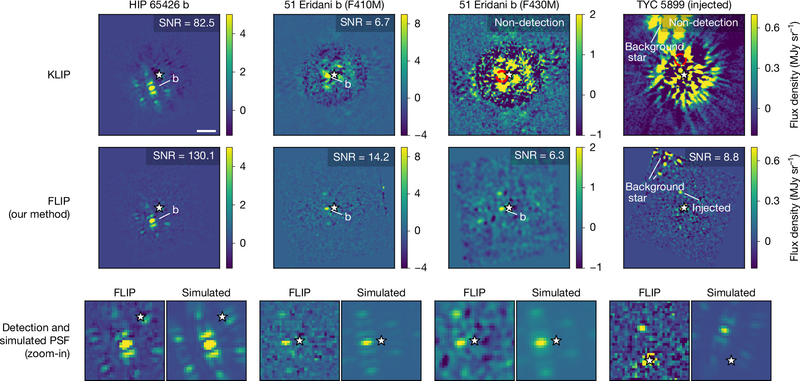
Somewhere in the archive of the James Webb Space Telescope sits a picture of a planet the standard analysis pipeline could not see. The planet is 51 Eridani b, a hot gas giant roughly three times the mass of Jupiter, about 96 light-years from Earth, orbiting a star only around twenty million years old (Chauvin et al. 2015). Webb observed it at 4.10 and 4.30 microns. In the longer band, where carbon dioxide in its atmosphere absorbs, the published analysis came back empty (Balmer et al. 2025). The planet’s light was in the detector data all along, buried in the scattered light of the star, and the subtraction method the field had used for two decades could not lift it out.
Then a doctoral student at Northwestern University built a physical model of the telescope and let it fit itself to the real observations. Subtract the synthetic starlight and 51 Eridani b was there, at 6.3 sigma, in a band where it had never been seen.
Direct imaging studies a planet’s own light rather than inferring it from a dimming star, and it is the hardest kind of observation in astronomy. Even the brightest young giants run about a hundred-thousandth as bright as their hosts in the near-infrared, a contrast of roughly 10^-5, and the next generation of space observatories aims for 10^-10, enough to photograph an Earth analog around a Sun-like star (Nature, Nov. 2026). Webb’s answer is a coronagraph, a mask inside the instrument that blocks starlight before it reaches the detector. Blocking is not removing. What leaks past is a field of speckles shaped by every micron of surface error, thermal wobble and misalignment in the optics.
The standard answer has been to observe a different star of similar type and brightness and use that image as a reference. Karhunen-Loeve image processing, known as KLIP and introduced by Soummer and colleagues in 2012, builds principal components from a library of reference frames and projects the science image onto them, discarding the directions that hold only star-like structure (Soummer et al. 2012). It has been the workhorse of direct imaging ever since, with one structural weakness: reference and science images are never identical. As Jason Wang, the Northwestern physicist who co-led the new work, put it, “We try to make telescopes extremely stable, but there are extreme engineering challenges that we haven’t quite solved yet” (Northwestern, Nov. 2026).
Those instabilities are mundane and unforgiving. Webb’s cryocoolers hold the near-infrared instrument near 40 kelvin, and their little motors shake the mirrors. A thermal change can expand a mirror by a picometer, enough to reorganize the speckle pattern completely. The telescope drifts in pointing too, so the star sits in a slightly different place behind the coronagraph mask each time. Such mismatches set the floor on how faint a planet you can detect, and that floor belongs to the subtraction method rather than to the detector or the optics.
The team, led by astronomy graduate student Rodrigo Ferrer-Chavez with Jason Wang, Katherine Bouman of Caltech, William Freeman and Brandon Feng of MIT, and Laurent Pueyo and Marshall Perrin of the Space Telescope Science Institute, named their method FLIP: Physics-based Learning for Imaging Planets (Nature, Nov. 2026). Where KLIP combines images taken at different times, FLIP simulates what the telescope did. It starts from STPSF, the open-source optical model the Space Telescope Science Institute maintains for predicting Webb’s point spread function, rewritten in PyTorch so that it is differentiable. That lets the software compute analytic gradients through the simulation and optimize it directly against real detector data.
The model carries roughly a million free parameters, in four families: the star’s flux and position behind the mask, the optical path difference before the mask, the optical path difference after it, and the response of each detector pixel. The first two capture pointing error and mirror misalignment, the third captures instrument-specific phase errors, the fourth soaks up pixel effects the optics cannot explain. The optimization runs in two stages. Stage one calibrates the full model against a reference star, where no planet can hide, repairing inaccuracies in the nominal optics. Stage two then tunes a reduced set of parameters on the science image itself, recovering whatever changed since calibration. On a single NVIDIA A30 GPU, stage one takes ten to fifteen minutes and stage two ten to thirty (Nature, Nov. 2026).
The gains were not marginal. On HIP 65426 b, the first exoplanet Webb ever photographed directly, the signal-to-noise ratio rose from 82.5 to 130.1, a factor of 1.6. On 51 Eridani b at 4.10 microns it went from 6.7 to 14.2, a factor of 2.1. In the 4.30-micron band it went from a non-detection to a 6.3-sigma detection, the first image of the planet where carbon dioxide absorbs. That band is out of reach from the ground because Earth’s own atmosphere absorbs there, so this is an independent look at a planet whose carbon dioxide was inferred from the ground (Northwestern, Nov. 2026). The clearest gain came on a star with no known planets. TYC 5899 was observed four months after the reference stars a self-referenced survey used to build its speckle library, a drift that should have wrecked the subtraction. FLIP recovered an injected fake planet KLIP could not see, and delivered roughly fifteen times better sensitivity at half an arcsecond and five times better at one arcsecond. It also beat the team’s estimate of the best KLIP could achieve given realistic drift.
Two details deserve attention. The first is how the optimization knows when to stop. Push a flexible model against real data long enough and it starts eating the planet you are hunting, so the team injects synthetic planets at several separations, tracks their signal-to-noise against iteration count, and halts when those curves plateau, around eleven thousand iterations (Nature, Nov. 2026). The second is the honest cost. FLIP subtracts some of the planet’s own signal along with the starlight, losing between 5 and 60 percent depending on separation, against a comparable range for KLIP. It has also not reached the floor set by photon noise alone. The authors are explicit that no observation hit that limit, that the models cannot yet attach uncertainties to the drift terms they solve for, and that the detector model needs work before it can handle the deepest exposures of bright stars.
The method does not need a new telescope to matter. It extends to Webb’s Mid-Infrared Instrument, where thermal background rather than contrast sets the floor, and to ground-based telescopes, where data volumes are severe but the photon limit is worth chasing at short wavelengths, where the extremely large telescopes could otherwise reach only for temperate terrestrial planets around low-mass stars. More consequential is the error budget of the Habitable Worlds Observatory, whose picometre-level stability requirement, one hundred to a thousand times tighter than Webb’s, is a main reason its design is so hard. If processing can absorb part of that instability, the requirement shrinks and the observatory gets cheaper to build. The Nancy Grace Roman Space Telescope, launched on 30 August 2026 with the Roman Coronagraph Instrument aboard, is the obvious place to test that: it was designed in part as a pathfinder for this class of hardware (JPL).
For thirty-five years the field has treated the stability limit as a property of the telescope. This result suggests it is substantially a property of the software, and that a fair amount of astronomy is sitting in archives waiting for better subtraction.
 Subscribe to our RSS feed









There are no comments.
Add A Comment