


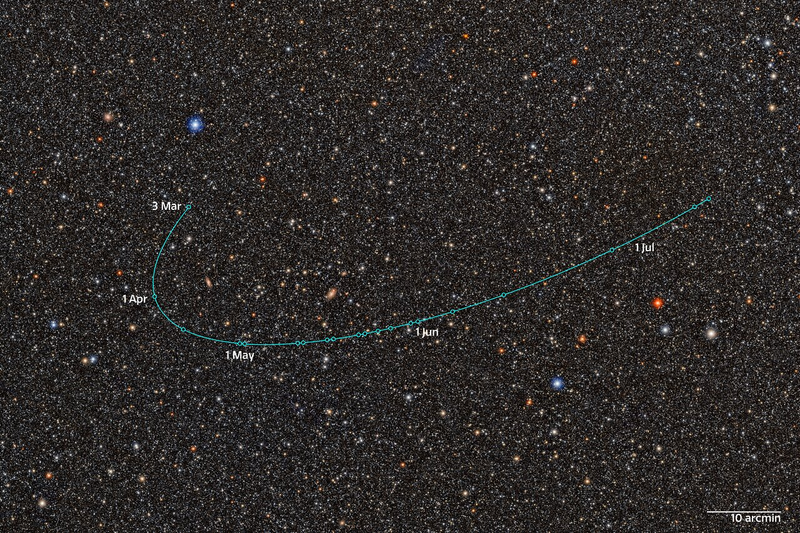
On 27 October 2026 the Minor Planet Center issued a circular announcing a new arrival in the outer Solar System: the object 2026 ED138, currently about 47 au from the Sun and brighter than almost anything else catalogued that far out. The unusual part is the method. Nobody was at a telescope. The detection came out of software comparing survey images, and the circular announcing it carried 74 observations strung across a decade with residuals of a tenth of an arcsecond. The object had been on camera since 2016, sitting in a crowded stretch of the Milky Way’s plane, and nobody had noticed.
Beyond Neptune lies a population that would not be there if the Solar System had been built and then left alone. The Kuiper belt holds tens of thousands of icy bodies, most on near-circular orbits close to the plane of the ecliptic. Those are called cold classical objects, and they sit roughly where the protoplanetary disk left them. A minority tilt and stretch their orbits instead. Those are called hot, and they are the ones Neptune scattered when the giant planets migrated outward, which makes their inclinations a fossil record of that migration. The Minor Planet Center’s orbit for ED138 gives a semi-major axis of 42.95 au, an eccentricity of 0.142, an inclination of 24.47 degrees and a Tisserand parameter of 5.3. That inclination puts it squarely in the hot population, and it is currently near aphelion at 49 au. Neptune has been near this object.
To count as a dwarf planet rather than a large asteroid, a body has to be round, which means its own gravity has to beat down the rigidity of its material. The International Astronomical Union recognizes five: Pluto, Ceres, Eris, Haumea and Makemake. Rubin’s Solar System team puts ED138’s diameter between 600 and 1,500 kilometres, which would place it among the largest candidates ever found beyond Neptune (NOIRLab, October 2026). That diameter is inferred from brightness rather than measured, and the difference decides whether this is a planet.
How it turned up matters more than the announcement. On the evening of 13 October, Matthew Holman, a Rubin Operations team member at the Center for Astrophysics | Harvard & Smithsonian, ran 2026 survey data through a search code written with CfA colleague Kevin Napier. The code takes billions of individual moving-object detections, compares them, and picks out the sets that belong to the same object. ED138 came out of that run. Holman’s first reaction, as he described it, was “excited disbelief” (NOIRLab, October 2026). Objects that large are rare, so he went straight to work checking whether he or the code had erred.
Mario Jurić, Rubin’s Solar System lead scientist at the University of Washington, went looking for more. Sifting through the observatory’s catalogues and images, he turned up 20 further detections reaching back to 4 March 2026. All told the Simonyi Survey Telescope saw ED138 30 times on 20 nights between 4 March and 11 July. The next step was precovery, pulling the object out of old archives where nobody had thought to look: frames from the Dark Energy Camera on the Victor Blanco 4-m telescope at Cerro Tololo, run through the Asteroid Institute’s ADAM precovery service, extended the trail back to 2016. The Minor Planet Center’s current orbit solution reaches further still, to March 2010, using 89 observations across an arc of 5,959 days and eight oppositions, with an RMS residual of 0.07 arcseconds. Jurić and Holman presented the result at the 58th Annual Division for Planetary Sciences meeting in Spokane, and MPEC 2026-U85 went out the same day.
The decade of silence has little to do with faintness. ED138 sits close to the galactic plane, where the sky is thick with stars, and to most telescopes it was simply lost among the background sources (NOIRLab, October 2026). What changed is how Rubin looks. The LSST Camera is a 3.2-gigapixel focal plane built from 189 science CCDs in 21 rafts of nine sensors each, and it reads out in two seconds, about two orders of magnitude faster than a conventional astronomical camera (Brookhaven National Laboratory). Data comes off it at roughly 11 trillion bits per hour, so a ten-hour night of raw camera output runs to about 14 terabytes. The Simonyi Survey Telescope behind it has an 8.4-metre primary and a 3.42-metre convex secondary, feeding a 3.5-degree field that covers about 10 square degrees in one exposure (NOIRLab). The survey takes an image every 40 seconds and will do so for ten years. Software differences each exposure against a static model of the stars and hunts for what is left over and has moved. Repeating the same field thousands of times turns the sky into a film, and moving objects are what change between the frames.
The second half of the problem is turning brightness into size. The standard relation for a small body is D = 1329 / sqrt(p) * 10^(-H/5) km, where D is the diameter, p the geometric albedo and H the absolute magnitude. The Minor Planet Center lists ED138’s H as 2.93 and its phase slope G as 0.15, and the object sits near magnitude 20 at opposition. Substituting gives D = 344 / sqrt(p) km, so a 600-kilometre diameter requires an albedo near 0.33 while a 1,500-kilometre diameter requires one near 0.05. Both are plausible for icy bodies, and that ambiguity is the difficulty: a single measurement of reflected light cannot separate a large dark object from a smaller bright one. Infrared settles it. At 47 au the equilibrium temperature works out to T = 278 / sqrt(p * D) * sqrt(40/r) K, which for a 900-kilometre body of albedo 0.15 comes to about 22 K. At that temperature nitrogen ice has largely sublimated away while methane and carbon monoxide hold on, so the ratio of thermal emission to reflected light fixes the albedo and the spectrum fixes the composition. No infrared follow-up has been scheduled yet, and the Centre lists the object as receding from Earth at 13.8 km per second, so whoever takes that measurement will be chasing it.
One detail in the orbit deserves a pause. ED138’s perihelion fell on 4 February 1926. It has not been this close to the Sun in a hundred years and will not be again until 2207. Everything known about it comes from light that left it far beyond Neptune, spread thin enough that a single telescope sees a moving dot. Rubin’s answer is not a bigger telescope but ten years of smaller ones, and the survey has barely started. In April 2026, before the formal ten-year run began, Rubin’s Solar System team submitted more than 11,000 new asteroids to the Minor Planet Center, about 380 of them trans-Neptunian objects, and called the batch “the tip of the iceberg” (NOIRLab, October 2026). ED138 was already in the data collected before the survey started. The sky has been recording itself for billions of years. The new part is that someone finally built a camera fast enough to read the frames back.
 Subscribe to our RSS feed









There are no comments.
Add A Comment