


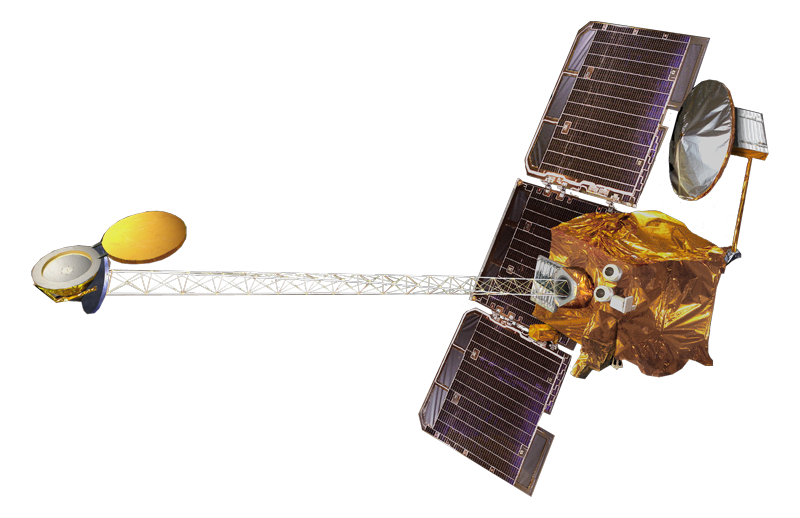
On 24 October 2001, a spacecraft fired its main engine and dropped into orbit around Mars (Wikipedia on the mission history). Twenty-five years on, the same machine is still flying, and its job has changed far more than its hardware. NASA’s 2001 Mars Odyssey was built to map what the Martian surface is made of, and it still does that work. It is also, in NASA’s accounting, the longest-running spacecraft still in orbit around a world beyond Earth (NASA on the mission record). It was, for much of the 2000s and 2010s, the switchboard through which almost every rover on Mars reached Earth, and that role has since shrunk to something much smaller. In the relay statistics NASA publishes for the Mars Relay Network, Odyssey carries the smallest data volume of any active orbiter, and most of its daily passes over the rovers go unused for relay (NASA on the Mars Relay Network).
The spacecraft is still useful, and its reduced role shows how thin the communications layer around Mars exploration has become. Every image captured on the Martian surface since 2004 has reached Earth through an orbiter, because a rover on the ground loses line of sight to Earth for about twelve hours a day and would need a dish and far too much power to close the link itself. Until June this year the network had five orbiters, including NASA’s MAVEN, which went quiet on 6 December 2025. A review board convened in February found it unrecoverable, so NASA declared the mission over on 3 June 2026 and the remaining orbiters took up its traffic (NASA on the end of the MAVEN mission). The load has since concentrated elsewhere: ESA’s ExoMars Trace Gas Orbiter sent an average of 2,228.1 megabits per day between February and May 2026 and the Mars Reconnaissance Orbiter 850.6, against 107.3 for Odyssey, which flew two to four passes a day over the rovers and used zero to one of them for relay. Odyssey also came close to not getting this far. The FY2026 request from the White House proposed ending it outright, alongside termination plans drawn up for 19 flying missions, and Congress restored 10.6 million dollars for it in the appropriations minibus passed in January, after the House voted 397 to 28 and the Senate 82 to 15 (The Planetary Society on the FY2026 budget).
Odyssey was a salvage job. It flew as the orbiter half of Mars Surveyor 2001 after the lander meant to accompany it was cancelled in the reorganization that followed the 1999 losses of Mars Climate Orbiter and Mars Polar Lander (a summary of the mission record), and it launched on 7 April 2001 at 11:02 a.m. EDT on a Delta II from Cape Canaveral (NASA on the Mars Odyssey mission). It reached Mars seven months later and then spent about eleven weeks bleeding off energy against the upper atmosphere instead of firing its engine to circularize the orbit, a maneuver that saved roughly 200 kilograms of propellant and made it possible to launch on a smaller Delta II. By February 2002 it was in a near-polar, sun-synchronous orbit about 400 kilometres above the surface and taking science. Within four months of reaching that mapping orbit the Gamma Ray Spectrometer had detected hydrogen buried across the high latitudes. Reading that hydrogen as frozen water was an inference at the time, argued from where thermal models said ice ought to be stable, and it took a different spacecraft to settle the question: Phoenix went north in 2008, landed where Odyssey’s maps pointed, and dug up water ice (Wikipedia on the mission history). The thermal camera THEMIS then built the global maps of surface minerals that landing-site selection for every rover since has leaned on, with more than a million images to its credit (NASA on 25 years of the mission), and the same spacecraft handled the great majority of the data sent home by Spirit and Opportunity. Its own instruments did not all survive. The radiation experiment MARIE was knocked out by the Halloween 2003 solar particle events, and the Gamma Ray Spectrometer’s sensor head died in 2009, leaving THEMIS and the neutron detectors from the GRS package as the working instruments. The spacecraft lost its last reaction wheel redundancy in December 2013, which means a further wheel failure would push attitude control onto the thrusters and into propellant that is already scarce (NASA on the Planetary Mission Senior Review).
What keeps Odyssey flying is careful accounting of what it has. The spacecraft carries no fuel gauge, so engineers measure the hydrazine by heating the two propellant tanks and timing how long they take to reach a given temperature, on the reasoning that a nearly empty tank heats faster than a full one. That method produced two alarming readings: about 5 kilograms of hydrazine in the summer of 2021 and 2.8 kilograms in January 2022, the latter implying the orbiter would run dry within a year. Engineers at JPL and Lockheed Martin ruled out a leak, then found the real cause, heaters on a fuel line between the tanks that were warming them faster than the model allowed for. The corrected figure, about 4 kilograms, was published in March 2023 with the conclusion that the mission could fly at least through the end of 2025 (NASA on the Odyssey fuel supply). Propellant is a finite resource because the spacecraft needs it continuously. Three reaction wheels spin up to point the instruments at the ground, and each one builds momentum that has to be unloaded by firing the thrusters in small bursts. The bus is a 725-kilogram box a little over two metres long, with a RAD6000 processor at its heart, a radiation-hardened version of the PowerPC chip once used in most Macintosh computers, working from 128 megabytes of RAM (NASA on the technical specifications).
Odyssey’s remaining life now turns on an arithmetic nobody can read off a gauge. NASA’s 2025 Planetary Mission Senior Review put usable propellant at 3.2 kilograms, with an uncertainty of plus or minus 2.0 kilograms, and calculated that the tenth extended mission needs 1.3 kilograms to reach fiscal 2028 in the absence of a safe mode event (a summary of the Senior Review propellant figures). The same review was told that Odyssey had recently handled 14 percent of Perseverance’s relay sessions and 13 percent of Curiosity’s, and noted that THEMIS is the only infrared camera now orbiting Mars, with a global catalogue of alluvial fans already turning up 175 newly identified examples (the Senior Review panel evaluation). By April 2026 the spacecraft had completed more than 105,000 orbits and 219,000 hours of operation (a summary of the mission record), and it had passed 100,000 orbits and 1.4 million images back in June 2024 (NASA on the 100,000th orbit). On 26 October 2026 it was still sending telemetry to NASA’s Deep Space Network, two days past its quarter-century at Mars. Whether it flies much past that depends on a tank-heating measurement repeated every few months, and on a Congress that had to be persuaded the mission was worth 10.6 million dollars.
 Subscribe to our RSS feed









There are no comments.
Add A Comment