


The Green Bank Telescope, which spent 7.5 hours listening for the pulsar across four sessions in late 2025 and early 2026. Credit: NRAO/AUI/NSF, via Wikimedia Commons, under CC BY 4.0.
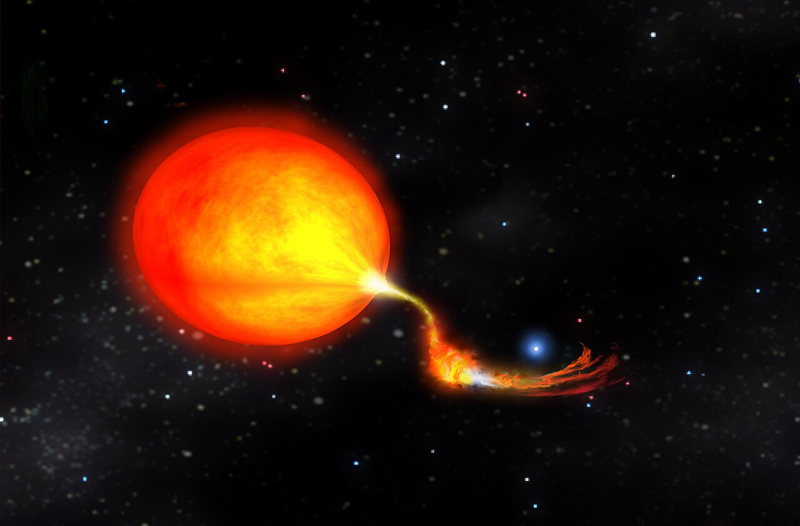
A neutron star about 12,000 light years away completes 597 revolutions on its axis every second, and the reason anyone noticed is that the star it orbits is being eaten. The object, PSR J2053+6905, is a redback: a millisecond pulsar in a close binary with a companion that the pulsar’s particle wind strips of its outer layers and heats to a glow. Anna Karpova of the Ioffe Institute in St Petersburg and James Taylor of West Virginia University report the detection in a paper posted to arXiv on 5 November, with observations gathered between October 2025 and January 2026 (the preprint). At 1.68 milliseconds, the spin period makes it the third fastest redback on record and the tenth fastest pulsar of any kind in the Australia Telescope National Facility catalogue.
The speed is a fossil. A neutron star does not get to spin that fast on its own. It has to be dragged up to those rates by dragging gas off a companion, and the same process leaves the star heavier than a typical neutron star and the companion lighter than it started. Both halves of that history show up here. The pulsar is a recycled millisecond object, and the companion has been reduced to about 0.3 solar masses, roughly half what a zero-age main sequence star of its radius would have carried. There are only about 90 confirmed redbacks and black widows in the Galactic field and roughly three dozen more candidates, so each new member is a data point in a small sample, and this one comes with a mass that tightens the constraints on the equation of state of ultradense matter. A neutron star of 2.12 solar masses, as the modelling here suggests, sits near the upper limit of what matter can support against its own gravity without collapsing into a black hole, and every good mass measurement narrows the menu of allowed physics for the cores of collapsed stars.
The route to this object ran through gamma rays long before it reached a radio dish. Fermi mapped 4FGL J2054.2+6904 as an unassociated gamma-ray source, and Kerby and colleagues proposed in 2021 that it might be a pulsar, since a Swift counterpart nearby looked variable. Three years of archival optical data, plus fresh Swift and eROSITA X-ray observations, led Karpova and her collaborators to call it a plausible redback. Zwicky Transient Facility light curves folded on an orbital period of roughly 7.5 hours showed a single peak rather than two, which is what irradiation looks like when one hemisphere of the companion does all the facing, and the X-ray spectrum was hard, with a photon index near 1. What nobody had was the radio pulse itself. Without it the object stayed a candidate, and candidates are common; confirmed spiders are not.
Searching for it took the kind of patience the Green Bank Telescope makes possible. Its L-band receiver pointed at the Gaia coordinates of the optical counterpart for a total of 7.5 hours, split across four sessions between 29 October 2025 and 9 January 2026. A pulsar in a binary does not hold a steady frequency, because the orbit keeps speeding the spin up and slowing it down, so the team ran a jerk search that tracks how quickly that drift changes, testing eight harmonics with thirty-minute segments to keep the drift within each segment small. The first candidate pulled out of the data was the right one.
Turning that detection into a mass took three instruments and a stubborn bit of bookkeeping. Radio timing gave an orbital period of 7.46657907 hours, a projected semi-major axis, and a mass function for the pair. Optical spectroscopy with the 10.4-metre Gran Telescopio Canarias on La Palma then measured the companion’s radial velocity from the magnesium triplet near 5170 angstroms, returning a velocity amplitude of 337 km per second and a systemic velocity of minus 191 km per second. A brighter star in the same field turned out to drift by about 30 km per second over the course of the run, which is instrumental rather than orbital, so that drift was measured with the same technique and subtracted before the fit. Combining the radio and optical mass functions fixes the ratio of pulsar to companion at 7.05. Folding the optical light curves and fitting a model in which the pulsar heats one face of the companion returns a pulsar mass of 2.12 solar masses, a companion of 0.30, a distance of 3.6 kiloparsecs and an inclination near 66 degrees. The companion comes out at about 5550 kelvin on its dayside and 4960 on the nightside, a 600 kelvin swing that sits in the range typical for this class of binary.
The hardest number to explain is not the mass but the shape of the light curve. Folded on the orbital period, the companion does not rise and fall the way a tidally distorted star should. Instead it is lopsided, and the lopsidedness grew. The section of the curve between orbital phases 0.25 and 0.75 held steady across three observing campaigns in September 2023, June 2024 and August 2025, while the rest of the orbit brightened steadily across the same three years. Straight irradiation and ellipsoidal distortion cannot produce a shape like that, and neither can the shock that forms where the pulsar wind hits the companion. The authors favour a picture in which the companion, locked to a 7.5-hour orbit and therefore spinning fast itself, drives a magnetic dynamo vigorous enough to hold large surface spots for years, and a cold spot slowly dissipated or drifted during the run. Similar long-lived spots have been invoked to explain the light curves of other pulsar binaries, and if the spot does fade, the clean full-orbit light curves would tighten the geometry and confirm the heavy pulsar mass.
Several things are still open. The radio timing could not be phase connected, because the algorithm that links separate sessions found hundreds of equally good solutions for how many rotations the star made between them, so the fit carries free phase jumps and the timing parameters remain loosely constrained. New observations with the CHIME6 telescope are planned to fix that, together with a fuller treatment of the gamma-ray data. The mass of 2.12 solar masses rests on a light curve model with a reduced chi-squared of 469 over 149 degrees of freedom, which the authors themselves read as evidence that the model is missing something, most likely the spot itself. And the distance from the timing dispersion measure of 44.13 parsecs per cubic centimetre comes out between 2.3 and 3.0 kiloparsecs depending on which model of the intervening electron column is used, a little closer than the 3.6 the light curve fit prefers. The companion’s spectrum also shifts between K and G spectral types with orbital phase, which is itself odd and worth watching.
What is not in doubt is the pulsar. A 1.68 millisecond spin, a confirmed redback classification, a companion being cooked by its own companion’s wind, and a neutron star heavy enough to make the equation of state uncomfortable. The team behind it is candid that the system is more complicated than the simple models they tried, and the next round of photometry and timing will be the test of whether their explanation for the growing light curve asymmetry holds up.
 Subscribe to our RSS feed









There are no comments.
Add A Comment