


A flare appeared in November 2025 near the outer edge of a galaxy in Cetus. It shone in ultraviolet light with roughly the output of 10 billion Suns and, for a few months, outshone the galaxy itself. That sounds like the sort of event astronomers would notice immediately. The awkward part was its address.
The flare sat more than 30,000 light-years from the galaxy’s center, nowhere near the central supermassive black hole that should have been capable of producing it. Follow-up observations nevertheless showed the signature of a star pulled apart by a massive black hole. The event, named TDE 2025abcr, had exposed an otherwise dark object wandering through the galactic outskirts.
The NASA account of the discovery describes it as the most distant-from-center example of its kind. More important than the record is how it was found: a search deliberately stopped assuming that a galaxy’s biggest black holes must stay in the middle.
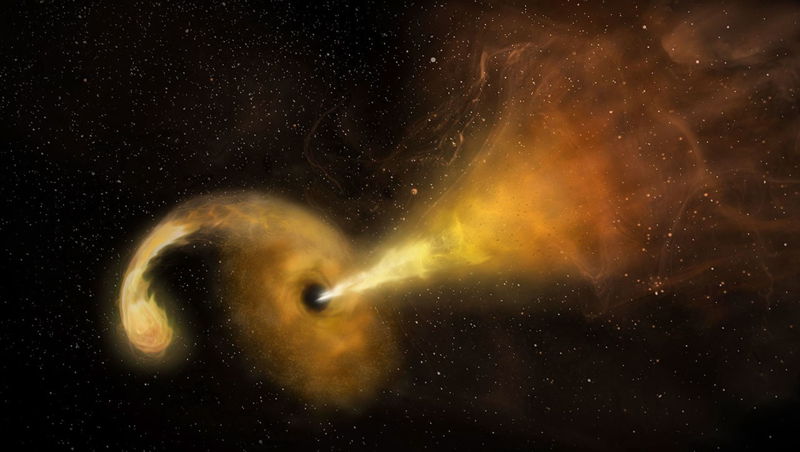
Artist’s concept of a tidal disruption event. Credit: NRAO/AUI/NSF/NASA. NASA JPL image page.
Supermassive black holes are usually found through their effects rather than by seeing the objects themselves. At a galaxy’s center, the surrounding stars and gas provide several ways to measure an unseen mass. Far from the nucleus, a quiet black hole can disappear against the sky. It may reveal itself only when matter falls in.
Tidal disruption events offer that brief illumination. NASA estimates that one occurs in a given galaxy about once every 100,000 years, while surveys find roughly 30 across the sky each year. Until recently, optical searches concentrated on galactic nuclei. That was a reasonable filter because known supermassive black holes lived there, but it also built the expected answer into the search.
TDE 2025abcr shows what happens when that positional filter is relaxed. The accepted paper and open preprint calls it the first optical tidal disruption event discovered in the outskirts of a host galaxy. Its inferred black hole mass is about 10^6.09 solar masses, far below the roughly 10^8.82-solar-mass black hole estimated at the host’s center. One galaxy may therefore contain two massive black holes with very different histories and locations.
Finding more such objects would put numbers on a poorly measured population. Wandering black holes preserve evidence of galaxy mergers, stripped dwarf galaxies, and gravitational encounters among black holes. They also test whether catalogs built around bright galactic centers have missed a class of massive objects hiding in plain sight.
The Zwicky Transient Facility, or ZTF, first flagged the brightening in November 2025. ZTF surveys the northern sky from Palomar Observatory and produces an enormous stream of changing points. According to NASA, about half a million flashes are detected each night. A custom version of the machine-learning classifier tdescore examined that stream without requiring candidates to coincide with a galaxy nucleus. It recognized the light curve of TDE 2025abcr even though the source was well off-center.
That initial match was only a prompt for more observing. The galaxy WISEA J014656.04-152214.7 lies about 750 million light-years away. The transient was separated from its nucleus by 9.5 arcseconds, corresponding to a projected distance of 9.3 kiloparsecs. Spectra from ground-based telescopes, including the SOAR telescope in Chile, showed hydrogen and helium emission associated with a tidal disruption event. NASA’s Neil Gehrels Swift Observatory then supplied ultraviolet and X-ray measurements unavailable from the ground. Swift’s ultraviolet telescope measured a temperature near 30,000 degrees Celsius.
Together, the light curve, spectrum, temperature, and location ruled out more ordinary explanations. The researchers classified the source as a hydrogen-and-helium tidal disruption event. Scaling relations between peak luminosity and black hole mass gave an estimate of 10^6.09 solar masses, with an uncertainty of 0.53 dex. That uncertainty is broad, but the result still separates the wandering object from the much heavier black hole expected in the main galaxy’s nucleus.
How did it get there? The team offers two possibilities. In one, several galaxies merged and the interaction among their central black holes ejected the lightest one toward the outskirts. In the other, the black hole remains at the center of a faint dwarf galaxy now being stripped during a minor merger. The dwarf’s stars may be too dim or too dispersed to stand out in current images.
Those explanations can be tested. Deep late-time imaging, after the flare fades, could expose a faint stellar system around the black hole. More off-nuclear events would reveal whether large offsets favor one merger history over another. The paper places the rate of events more than 3 kiloparsecs from a nucleus below 10 percent of the nuclear TDE rate, while predicting that the Vera C. Rubin Observatory could find dozens with resolvable offsets each year.
The timing has an engineering wrinkle. Swift’s pointed observations are temporarily suspended while the mission awaits an orbit boost. Its primary mission ran from 2004 to 2006, yet it has continued watching the changing sky for more than two decades. Rubin can supply a much larger optical sample, and NASA’s Roman telescope can extend the search to greater distances. Swift, once normal operations resume, remains useful for the ultraviolet and X-ray follow-up that turns an unusual point of light into a physical diagnosis.
A tidal disruption begins with a gradient. Gravity is stronger on the side of a star facing a black hole than on the far side. If the star passes close enough, that difference overwhelms the star’s self-gravity. The star stretches, breaks apart, and becomes a stream of gas. As the NASA tidal disruption explainer shows, some debris escapes while some returns, collides, heats up, and gathers around the black hole.
The rough boundary is the tidal radius, often written as r_t approximately equal to R_star times (M_BH/M_star)^(1/3). A larger star is disrupted farther out. A more massive black hole also raises the tidal radius, but only with the cube root of its mass. The event horizon, by contrast, grows directly with black hole mass. This difference explains why a million-solar-mass black hole can tear a Sun-like star apart outside its horizon, where the hot debris remains visible.
The flare is not a photograph of the black hole. It is radiation from gas responding to extreme gravity. Ultraviolet temperature constrains the hot emitting region. Spectral lines identify elements and track changing velocities. X-rays probe hotter material closer to the compact object. None of these measurements alone settles the case; their agreement does.
The classifier solves a different problem. A survey camera records real transients alongside variable stars, supernovae, moving objects, and instrumental artifacts. A model trained on known tidal disruption light curves can rank candidates, but a model trained only on nuclear examples may learn location as a shortcut. The off-nuclear version of tdescore removed that shortcut. Its success is a clean lesson in survey design: changing a selection rule can reveal objects the telescope had already become capable of seeing.
TDE 2025abcr did not make a wandering black hole appear. It made one observable for a few months. A star supplied the fuel, ZTF caught the changing light, and Swift helped establish what produced it. The result is a black hole of roughly a million solar masses projected 9.3 kiloparsecs from the center of a massive galaxy.
The remaining question is whether this object was kicked out of a galactic nucleus or still occupies the fading core of a stripped dwarf. Late-time imaging may answer that for this system. Rubin’s larger alert stream can answer the population question by finding enough examples to compare.
The useful change was modest: researchers searched outside the place where theory and habit told them to look. If Rubin finds the predicted dozens of resolvable off-center events each year, TDE 2025abcr will become less of an oddity and more of a map marker for a hidden population moving through galactic outskirts.
 Subscribe to our RSS feed









There are no comments.
Add A Comment