


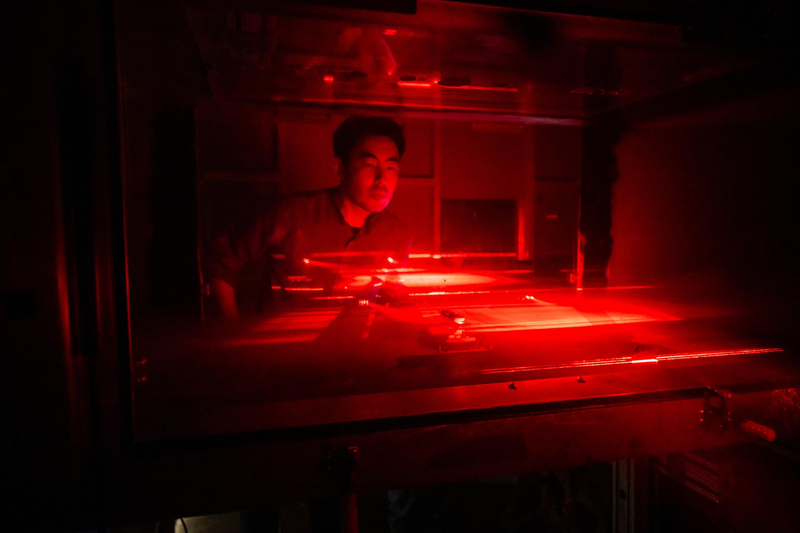
For an hour, the ceramic-lined furnace at Rex Heat Treat in Bedford, Pennsylvania, climbed from room temperature to 465 degrees Celsius. The vessel inside was titanium, about a meter across, the size of an exercise ball. The DAVINCI team put it through that profile six times. Six times it came out the same shape it went in. Each run mimicked the way the probe will heat up over the fifty-five to sixty minutes of its one-way trip through the atmosphere of Venus, a place whose surface sits at 740 kelvin and a pressure equivalent to nine hundred meters of seawater. The fact that the engineering development unit survived its own near-death preview is the news from NASA Goddard this week, and the reason scientists who study Venus are starting to plan around a real measurement instead of a hypothesis (NASA Science, 24 September 2026).
What DAVINCI is after is older than the program. Venus and Earth started as near twins, similar size, similar rock, similar distance from a young Sun. Today one is a temperate water world and the other is a planet whose surface would crush a submarine and whose clouds rain sulfuric acid. The question of when and how that divergence happened, and whether Venus ever had liquid oceans, has been the central question of inner-Solar-System science for two generations. The Pioneer Venus Multiprobe dropped four small entry probes in 1978, and Vega 2 carried the Soviet Vega program’s last successful lander to the surface in 1984. Venera 14 returned the only close-up images of Venus’s surface, and they are forty-four years old. Every chemical measurement below forty kilometers of altitude that exists today was made by instruments that fit inside a Soviet-era school bus and ran for a few minutes before the heat killed them (Garvin et al., 2022, Planetary Science Journal 3, 117).
The mission NASA picked to fill that gap is named, improbably, after Leonardo. Deep Atmosphere Venus Investigation of Noble gases, Chemistry, and Imaging started as a Discovery proposal in 2015, lost to Lucy and Psyche, came back as DAVINCI+ in 2019, and was selected in June 2021 alongside its companion orbiter VERITAS. The flight system is two pieces: a Lockheed Martin carrier that will perform two flybys of Venus to map cloud motions and surface composition, and a descent probe that will be released about two days before atmospheric entry. The current schedule puts launch in December 2030, atmospheric entry in 2034 or 2035, and a one-hour descent that ends at Alpha Regio, a tessera, a piece of the old continent-like crust that may hold the chemistry of whatever ocean Venus once had (NASA, Discovery Program selection, 2 June 2021; Wikipedia, DAVINCI).
The August furnace tests at Rex Heat Treat are about the inside of the probe, not the heat shield. The DAVINCI descent sphere, an oblate titanium pressure vessel about 0.98 meters by 0.85 meters and roughly two hundred kilograms, is what carries the science instruments down. The carbon-phenolic aeroshell that surrounds it for entry, a 2.24-meter cone designed to absorb peak heating above ten thousand degrees Celsius during the minutes of peak dynamic pressure, burns away and falls off below the cloud layer. After that the descent sphere is on its own, passively cooled by a layered thermal-soak design and by the buoyancy of the lower atmosphere, broadcasting measurements for an hour through a relay on the carrier spacecraft nine thousand kilometers overhead. The team put more than a hundred thermal sensors on instrument simulators inside the development unit and watched them through every cycle. Kristen Brown, the probe manager at Goddard, called the system a huge engineering challenge because the instruments have to be kept alive while the probe deliberately lets hot Venus gas in through inlet ports to feed the mass spectrometer and tunable laser spectrometer. The tests verified that the layered insulation, the inlet geometry, and the internal layout can do both at once (NASA Science, 24 September 2026; Garvin et al., 2022).
The science payload is the reason anyone cares about an hour of in-situ measurement. DAVINCI carries five primary instruments inside the descent sphere plus a context imager. The Venus Mass Spectrometer and the Venus Tunable Laser Spectrometer are tuned to read the ratios of noble gases, sulfur species, and water-related molecules with enough precision to test the leading hypothesis for Venus’s history. That hypothesis goes like this: early Venus was hot but had water; the water dissociated in the upper atmosphere, the hydrogen escaped to space, and a runaway greenhouse locked the planet into its present state. If the mass spec finds a primordial argon and neon inventory that matches a wet early Venus, the runaway model survives; if the ratios look like the mantle of a dry planet, the story changes. The Venus Descent Imager and the Venus Imaging System for Observational Reconnaissance, riding on the descent sphere and the carrier respectively, will produce the first sub-hundred-meter pixel-scale images of tessera terrain and the highest-resolution images of the surface since the Venera landers. Below the clouds the descent sphere’s pressure rises to roughly ninety-two bar and the temperature pins to four hundred and sixty-seven degrees Celsius, conditions the instruments are rated for, but only if the thermal design lets them keep measuring all the way down (Garvin et al., 2022; Wikipedia, Atmosphere of Venus).
Two engineering choices make that possible. First, the descent sphere is hermetically sealed: every gas path between the hot outside and the cold inside is broken by a long, narrow inlet that lets flow in without letting heat conduct in. Second, the relay link to the carrier operates at X-band through a high-gain antenna on the back shell, with the carrier recording the descent and playing it back to Earth later. Together the choices turn the descent sphere into something like a deep-ocean submersible, a thin titanium shell, internally cold, externally roasting, surviving because the thermal mass of the vessel is large compared to the heat leaking in through the instrument feed-throughs. The descent profile is also gentler than a Mars entry. Venus’s thick atmosphere is itself the brake, dropping entry velocity to about thirty meters per second by the time the parachute stage jettisons and the sphere free-falls the last thirty kilometers of cloudy, acidic air to the surface.
The test campaign is the second of two major engineering milestones the team targeted for 2026. The first, in June at Crater Island in Utah, was a VADIX helicopter demonstration of the descent imager concept under realistic lighting and dust; the second, just completed in Bedford, was the thermal survival test of the descent sphere itself. The team now turns to final design and fabrication, with a third milestone likely in 2027 covering full-up entry-vehicle qualification, then integration with the carrier and launch from Cape Canaveral in the December 2030 window. If the schedule holds, the first new measurements from below Venus’s cloud base in fifty years will arrive on Earth in the spring of 2035. They will not settle the runaway-greenhouse question on their own, but they will give planetary scientists a starting point that no present model of Venus has, measured chemistry, measured wind, measured surface composition, at every altitude from seventy kilometers down. That dataset, not the next spectacular image, is what will change the science.
 Subscribe to our RSS feed









There are no comments.
Add A Comment