


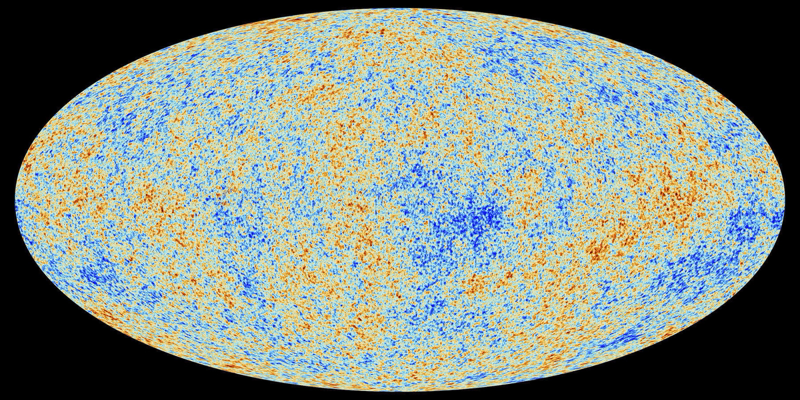
Image: Planck map of cosmic microwave background temperature fluctuations across the full sky. Credit: ESA and the Planck Collaboration, CC BY 4.0, via Wikimedia Commons.
The universe is full of missing mass and nobody has the faintest idea what it is made of. Roughly five-sixths of all matter is dark, and the only handle cosmologists have on it is its gravity, which is an awkward position to be in when one candidate answer is something as ordinary as a black hole. It is a stranger position still when the candidate in question is not ordinary at all. A scattering of black holes with masses in the trillions of Suns would be invisible to any telescope and would sit far outside any galaxy, and until recently nobody had found a way to rule them out. A paper accepted by Physical Review Letters finds one, and it does the job using the oldest light in the universe as the instrument.
These hypothetical objects have a name: stupendously large black holes, or SLABs, for a category of primordial black holes heavier than roughly 100 billion Suns. The name was coined by Bernard Carr, Florian Kuhnel and Luca Visinelli, whose 2021 review of the observational constraints on such objects noted how thin the coverage was. Between 10^12 and 10^18 Suns there were, they wrote, no published constraints on a SLAB population at all. That gap mattered, because the range from about 10^14 to 10^19 Suns sits in an awkward sweet spot. Such an object is too heavy to sit comfortably inside a galaxy, which rules out nothing, while being light enough that simple arguments about disrupting dwarf galaxies or heating surrounding gas do not settle the question. Carr and colleagues judged that a population of primordial black holes in that band could still hold a meaningful fraction of the dark matter while remaining hidden. No such object has ever been found. According to Space.com, the heaviest black hole anyone has confirmed so far may weigh only about 36 billion Suns, which leaves a gap of several orders of magnitude between what has been seen and what the arguments had to cover.
The new result comes from Christopher Gerlach, Yann Gouttenoire, Antonio Iovino and Nicholas Leister, working at the Mainz Institute for Theoretical Physics and at New York University Abu Dhabi. Their paper, Closing the Mass Window for Stupendously Large Black Holes, was accepted by the journal on 9 September 2026 and is scheduled to appear in print on 26 October. The argument is indirect and rather elegant. Rather than trying to find the black holes, the team asks what the universe would have looked like if they had been there.
The trick is that a population of discrete objects does not behave like a smooth fluid of particles. If dark matter consisted of particles spread evenly at the moment the universe became transparent, the primordial density field would be smooth everywhere, with ripples that grew in a well-behaved way as the universe expanded. A population of individual black holes is lumpy by construction. The gaps between them depend on where they happen to fall, and that statistical unevenness writes itself into the earliest perturbations in the universe. Cosmologists call this contribution isocurvature, and the microwave background constrains it hard. Gerlach put the intuition plainly when he spoke to Space.com about the result. If dark matter is packed into a handful of gigantic objects, “the universe becomes grainy on very large scales,” and the grain is something we can look for.
Formally, what the team computed is the isocurvature power spectrum that a monochromatic, non-spinning population of primordial black holes would have produced, and then how far that spectrum overshoots the tightest available bounds. The bounds came from a general analysis of isocurvature modes in the CMB and the baryon acoustic oscillation signal, computed with the CLASS and MontePython codes by Buckley, Fernandez and their collaborators. Planck’s own three-point limits on how much of the primordial fluctuation can be isocurvature rather than the usual adiabatic kind were used as an independent check, and they reach the same conclusion. At the largest of the three wavelengths probed, the isocurvature fraction of the primordial fluctuation is capped at about 2.5 percent. A population of black holes each weighing 100 billion Suns or more overshoots that cap across the entire band of interest, and it does so under the more conservative of the two truncation assumptions the authors tested, so the result does not hinge on a technicality.
One boundary deserves flagging. The exclusion runs up to about 10^19 Suns and then stops abruptly, and the reason is not that the constraint weakens but that the objects stop being possible. A primordial black hole that heavy would have had to form before recombination, and anything heavier could not have been made in the early universe at all. The paper also notes that the same range of masses was closed independently and shortly before it was submitted, by an analysis of Lyman-alpha absorption data. A different line of work, published in the Journal of Cosmology and Astroparticle Physics this year, attacks astrophysical SLABs from an unrelated direction: their shadows would be wide enough to appear as dark patches against the microwave background itself, which rules out anything above 10^17 Suns within the last scattering surface and caps the dark matter fraction they could supply at roughly one part in a hundred thousand. Two separate techniques, the same conclusion.
Read carefully, the result is a statement about proportion rather than existence. Gerlach’s group is not claiming that stupendously large black holes cannot exist, only that they cannot make up a significant share of the dark matter. That is still a meaningful narrowing, because the class was a live candidate, and it arrives with consequences in two other directions. The same calculation strengthens the case that the nanohertz gravitational wave background reported by pulsar timing arrays cannot be sourced by primordial black hole mergers. It also challenges scenarios that attribute the surprisingly massive early galaxies seen by the James Webb Space Telescope to primordial black holes seeding density fluctuations.
The forward-looking part is more interesting than the demolition. The paper points at next-generation microwave background instruments, LiteBIRD and the Simons Observatory, as the experiments that will tighten these bounds further, and it flags two ideas for the heaviest masses where the microwave background runs out of leverage: ringdown gravitational wave signals from the formation of very massive primordial black holes, and strong gravitational lensing of the microwave background itself. The team is also turning its attention to the opposite end of the mass range, asking whether the tiny asteroid-mass black holes that remain an allowed candidate can be shut out as a major constituent of dark matter. For now one candidate is gone. The list of things that could be filling the universe’s missing mass is a little shorter, and the sky’s oldest light did the removing.
 Subscribe to our RSS feed









There are no comments.
Add A Comment