OrbitalHub

Where curiosity reaches escape velocity.

Domain is for sale. $50,000,000.00 USD. Direct any inquiries to contact@orbitalhub.com.

Archive for the Space Exploration category


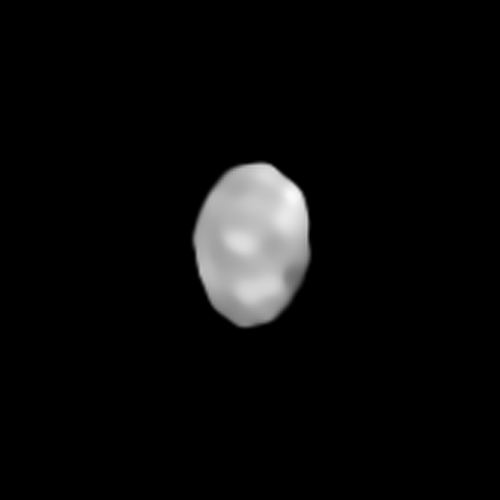
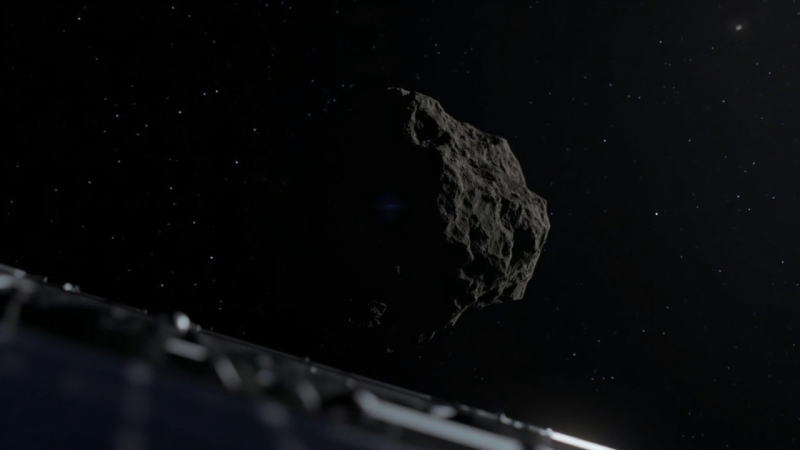
Artist's view of the small, jagged quasi-satellite Kamoʻoalewa, as seen from roughly 20 km during Tianwen-2's approach on July 2, 2026.


A small, jagged rock tumbling through space about 20 million kilometers from Earth just had its portrait taken. On July 6, 2026, the China National Space Administration released the first close-range images of (469219) Kamoʻoalewa, captured by the Tianwen-2 spacecraft from roughly 20 kilometers away on July 2. The pictures are grainy, low-resolution, slightly fuzzy at the edges. They are also the only close-up views humans have ever gotten of Earth’s most stable known quasi-satellite, and they sharpen a debate that has dragged on for nearly a decade about where this object came from. The rock’s elliptical path around the Sun takes it between roughly 0.1 and 0.3 AU closer and farther from Earth’s orbit, depending on where in the multi-decade cycle you sample it. From a ground-based telescope on any given night, Kamoʻoalewa is a faint dot moving against the stars: too small for any existing instrument to resolve as a disk, but bright enough that sensitive CCDs can pin down its spectrum and its rotation period. Both numbers have mattered for the past decade’s argument.

Kamoʻoalewa (a Hawaiian name meaning “oscillating celestial object”) was discovered in 2016 by the Pan-STARRS survey at Haleakalā Observatory in Hawaii (JPL Small-Body Database). Estimates put it somewhere between 16 and 40 meters across, it rotates once every 27 minutes, and it shadows Earth in a peculiar gravitational dance. Not a true moon, but a small body trapped in a 1:1 mean-motion resonance with our planet, looping the Sun in an orbit nearly identical to ours. From Earth’s perspective, the rock traces a slow, bean-shaped path that drifts between leading and trailing horseshoe configurations on timescales of decades. For at least the past hundred thousand years, give or take an order of magnitude, it has been Earth’s quiet companion. At some point it will leave.

For most of that history, nobody could get close enough to study it. Ground-based spectroscopy showed a spectrum that resembled space-weathered lunar regolith, with a weak 1.0 μm absorption band and a steep red slope that closely matched samples returned by Apollo 14 and the Chang’E-5 lander (Zhang et al., Nature Communications, May 2026). That match suggested the asteroid might be a piece of the Moon, blasted off by a relatively recent impact and gently nudged into a co-orbital path. But other groups showed that heavily weathered LL chondrite powder could produce a similar spectrum, and a Flora-family origin in the main belt remained plausible. Without a sample in hand, the question stayed open.

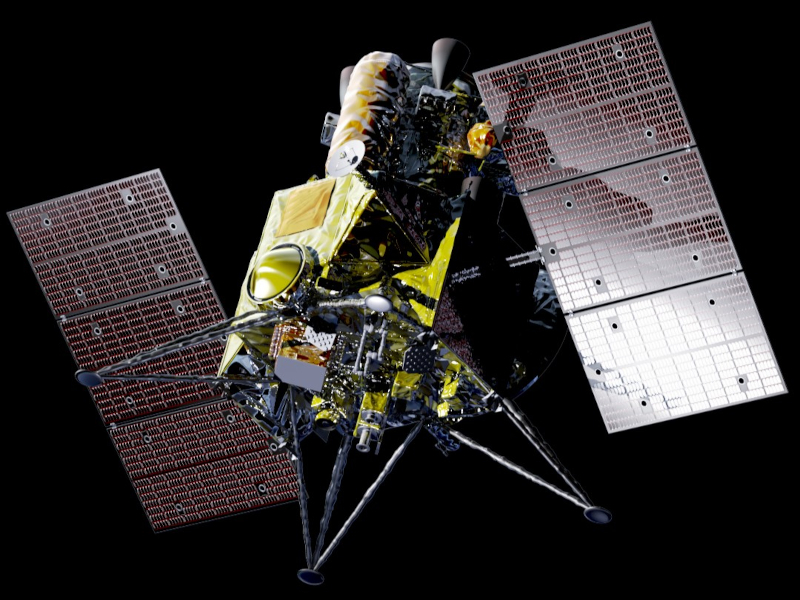
Tianwen-2 launched on May 29, 2025 from the Xichang Satellite Launch Center on a Long March 3B rocket, carrying 11 scientific instruments and a sample-return capsule designed for two distinct collection methods: a Hayabusa-style touch-and-go to grab regolith kicked up by a small thruster pulse, and an anchor-and-attach approach using robotic arms to clamp onto boulders and retrieve larger fragments. The spacecraft’s primary target was Kamoʻoalewa; an extended mission will later send it onward to main-belt comet 311P/PANSTARRS using a lunar gravity assist, with arrival in 2035.

The cruise phase took just over a year. Tianwen-2 first detected Kamoʻoalewa on June 6, 2026 at a range of 30,000 kilometers and refined the asteroid’s ephemeris from kilometer-scale uncertainty down to tens of meters (CNSA, July 2026). By June 19 it had closed to 2,000 km. Two weeks later, the framing camera returned the first resolved frames: a small, asymmetrical, jagged fragment, rotating visibly between exposures. The shape, in early analysis, looks more like a single competent block than the loose rubble pile some pre-arrival models had predicted.

The clincher will be the samples themselves, scheduled for collection later this year and return to a landing site near Jiuquan in late 2027. Tianwen-2 is the third mission in a decade-long run of asteroid sampling attempts, after JAXA’s Hayabusa2 (returned 5.4 g from Ryugu in December 2020) and NASA’s OSIRIS-REx (returned 121 g from Bennu in September 2023). Both of those targets were bigger than this one — Ryugu at about 900 m, Bennu at about 500 m — and both had escape velocities of tens of centimeters per second. Tianwen-2 is operating at a scale where escape velocity drops to a few centimeters per second, which puts the spacecraft closer to the asteroid in gravitational terms than a hang glider is to a hillside.

A new Nature Communications paper from Zhang and colleagues, published May 27, 2026, lays out what Tianwen-2’s near-approach spectroscopy already tells us about composition. The body’s reflectance spectrum matches the Itokawa-like LL chondrite class but with deeper space-weathering features than Hayabusa2 saw on its target. That tilts the evidence away from the lunar-ejecta hypothesis and toward a main-belt origin, but does not settle it. Samples in hand will.

Sampling on a 27-minute rotator is not trivial. A touch-and-go sequence has to compensate for the asteroid’s rotation, surface translation, and the very weak gravitational field — escape velocity from a 27-meter rocky body is on the order of a few centimeters per second. The Tsiolkovsky rocket equation, Δv = v_e * ln(m_0 / m_f), governs the maneuver budget for the descent burn. With a hydrazine thruster exhausting at roughly 2.2 km/s, Tianwen-2 has only a few hundred meters per second of total Δv available for the rendezvous, descent, sampling, and escape sequence combined. Each kilogram of mass the spacecraft sheds by venting or by jettisoning a sampling arm after contact translates directly into extra Δv headroom on the way home.

The anchor-and-attach method sidesteps some of that timing pressure. The arms can latch onto a boulder and ride the rotation with the asteroid for one full spin, giving the sampling drill time to work without the spacecraft having to hover. For both methods, the engineering constraint is the same: a few hundred grams of regolith, in a sealed capsule, must survive the return trip.

After the samples are sealed, Tianwen-2 will swing by the Moon for a gravity assist — adding roughly 1 km/s of heliocentric velocity for a negligible fuel cost — and aim for an Earth return in November 2027. If the capsule lands intact, the lab work begins: isotope ratios, cosmic-ray exposure ages, mineralogy. For the lunar-ejecta camp, the smoking gun would be a sample’s oxygen isotope signature falling outside the range of known meteorites and inside the range of lunar rocks. For the Flora-family camp, the clincher would be cosmic-ray exposure ages older than any plausible lunar crater’s age.

Either answer is interesting. A confirmed lunar origin would make Kamoʻoalewa the first known natural sample of the Moon without ever landing there, and would let planetary scientists calibrate impact-ejection dynamics with real data rather than simulations. A confirmed main-belt origin would rewrite the textbook on how quasi-satellites are captured and how space weathering proceeds on small bodies. By late 2028, with luck and a soft landing in Inner Mongolia, we will know which way the cosmic dice rolled when this little fragment came tumbling into Earth’s neighborhood. Until then, the new images are already doing their job: they have made an abstract orbital curiosity into a place with a shape, a spin, and a surface.
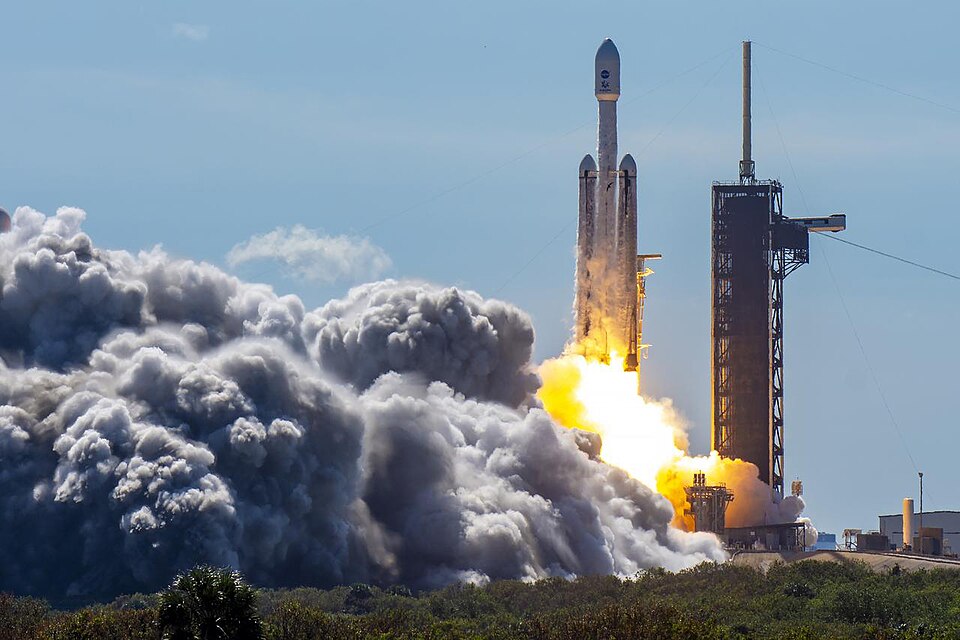


SpaceX filed confidentially with the U.S. Securities and Exchange Commission in early April 2026, setting in motion a process that could result in the largest initial public offering in market history. The filing, reported on April 1 by Bloomberg, Reuters, and CNBC, confirmed months of speculation about the timing of SpaceX’s transition from private to public ownership. The company, privately held since its founding in 2002, has grown into the world’s dominant commercial launch provider while operating as a closely controlled enterprise with no external public shareholders.

The confidential nature of the filing is standard procedure for companies testing the waters before a formal public offering. SpaceX submitted the paperwork under Jumpstart Our Business Startups Act provisions that allow emerging growth companies to keep their S-1 registration statements private during the SEC review period. The approach gives the company time to gauge institutional investor interest before committing to the full disclosure required for a public listing. The initial public filing is expected to become public between late April and mid-May 2026, with the roadshow to pitch the company to investors projected for early June.

The scale of the offering, if reports prove accurate, would be unprecedented in the aerospace sector. SpaceX is targeting a valuation between $1.75 trillion and $2 trillion, with plans to raise $50 to $75 billion in new capital. By comparison, Saudi Aramco’s 2019 IPO raised $29.4 billion at a valuation of approximately $1.7 trillion, making it the largest in history. The numbers reflect the extraordinary growth trajectory of a company that generated an estimated $16 to $18 billion in revenue during 2025, driven primarily by the Starlink satellite internet constellation that now serves millions of subscribers worldwide.

Financial details emerging from the preparation phase reveal a business that has transformed from a launch provider into an integrated space services company. Starlink revenue reportedly grew 842 percent over two years, reaching approximately $4.4 billion in the most recent annual period, according to data cited in multiple financial reports. The launch services division, while profitable, represents a smaller share of revenue than the constellation business, which has scaled to over 7,000 operational satellites and coverage across dozens of countries. SpaceX refinanced $20 billion in debt ahead of the IPO filing, positioning the balance sheet for public market scrutiny.

The ownership structure preserves founder Elon Musk’s control over the company after the IPO. SpaceX will issue super-voting shares that give Musk and insider investors effective control over board decisions, allowing the company to maintain its “controlled company” status under stock exchange rules. This structure is common in technology companies where founders seek public capital without surrendering operational authority. Musk’s other company, Tesla, operates under a similar dual-class structure that has kept Musk as the dominant voice in corporate governance despite owning a minority of shares.

The decision to go public arrives at a time when SpaceX’s operational momentum is at a peak. The company has conducted over 60 orbital launches already in 2026, with the Falcon 9 fleet achieving reuse milestones that validate the economic model underlying the IPO valuation. Booster B1067 reached 34 flights in late March 2026, demonstrating that hardware can sustain repeated use far beyond initial design expectations. Starship, the next-generation heavy-lift vehicle, continues its test program, with Flight 12 targeting early May 2026 from Starbase in Texas using the first Block 3 hardware configuration.

The integration of xAI into SpaceX, completed in February 2026, adds another dimension to the IPO narrative. The merger, reportedly valued at $60 billion, brings together SpaceX’s launch and satellite infrastructure with xAI’s artificial intelligence capabilities. The combined entity positions itself as an integrated space and intelligence company, potentially serving both commercial and government customers with combined hardware and AI services. Whether public market investors will assign premium valuations to this combination remains to be seen.

For the aerospace industry broadly, a public SpaceX could reshape competitive dynamics. United Launch Alliance, Blue Origin, and Rocket Lab all operate as private companies, and the success or failure of SpaceX’s public offering will signal whether capital markets view space infrastructure as a growth sector worthy of mainstream investment. The company’s stated intentions include 100 Starship launches per year, a Starlink constellation expansion to tens of thousands of satellites, and eventual crewed missions to Mars. The capital requirements for these ambitions are measured in tens of billions of dollars, which a public equity offering could help address.

The timeline for the actual listing remains subject to market conditions. The roadshow and SEC review process typically span several months, and market volatility could push the debut to late 2026 or 2027. The company has not confirmed specific listing dates, and reports from anonymous sources cited in financial coverage carry the caveat that plans can shift based on regulatory feedback or changing market sentiment. Investors seeking pre-IPO exposure have limited options through secondary markets, but those platforms trade at prices that imply valuations already near the reported IPO targets.

SpaceX’s IPO valuation rests substantially on the economics of rocket reusability, a concept that the company has spent a decade turning from theoretical to operational. The Falcon 9 booster fleet has now accumulated over 600 successful landings and 560 reflights, demonstrating that the same hardware can sustain multiple missions with periodic refurbishment. Each reflight avoids the cost of manufacturing a new booster, estimated at 30 to 40 percent of the approximately $74 million launch price.

The marginal cost of each additional reflight reflects declining refurbishment needs as the fleet matures. Early boosters required extensive inspections and part replacements after each flight. Current boosters, with thousands of flights of operational data, have undergone multiple design iterations that reduce wear and extend service life. The Merlin engines, which experience the most severe thermal and mechanical stress, have been modified between flights to reduce carbon buildup and improve tolerance to repeated firing cycles.

Starlink revenue changes the economic calculus by providing a captive launch customer that reduces dependence on external commercial contracts. When SpaceX launches Starlink satellites, it does so at internal cost rather than market price, effectively subsidizing constellation growth with launch profits from external customers. The combined business allows SpaceX to grow both its infrastructure and its customer base simultaneously, something that has not been possible for traditional launch providers constrained by smaller manifest sizes.

The valuation multiples implied by the reported IPO targets exceed those of comparable aerospace and satellite companies by substantial margins. Traditional aerospace companies trade at price-to-revenue ratios of 1.5 to 3 times, reflecting slow growth and dependent on government contracts. SpaceX’s reported revenue and growth rates, if accurate, suggest a multiple closer to technology companies than traditional aerospace. Whether public markets will sustain that multiple depends on whether the Starlink growth curve continues and whether Starship achieves the operational scale the company has projected.


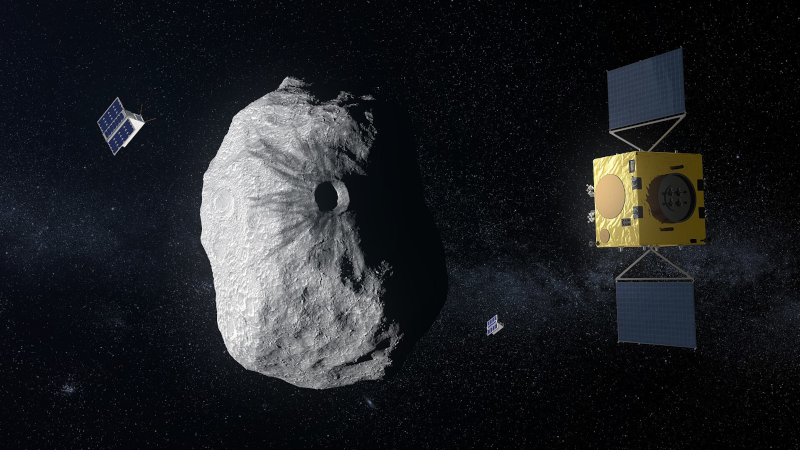
The European Space Agency’s Hera spacecraft is on course for a November 2026 rendezvous with the Didymos binary asteroid system, carrying with it the culmination of humanity’s first attempt to change the orbit of a celestial body. Launched in October 2024 aboard a SpaceX Falcon 9, Hera is now completing the final leg of its 24-month journey, having already executed a critical deep-space maneuver in February-March 2026 that refined its trajectory toward the asteroid pair.

The mission represents the follow-up to NASA’s Double Asteroid Redirection Test, which struck the moonlet Dimorphos in September 2022 at approximately 6.6 kilometers per second. That impact shortened Dimorphos’s orbital period around its parent asteroid Didymos by about 32 minutes, and that seemed dramatic until subsequent research revealed something even more significant: the entire binary system’s orbit around the Sun had actually shifted by more than 10 micrometers per second. For the first time in history, human activity had measurably altered an asteroid’s solar orbit.

Hera’s primary objective is to document what happened. The spacecraft carries three main instruments: an Asteroid Framing Camera that will map the surface in color, a thermal infrared imager to measure temperatures across the moonlet, and a laser altimeter to precisely gauge topography. The spacecraft also carries two briefcase-sized CubeSats named Milani and Juven tas that will deploy once Hera arrives at Didymos. Milani will analyze surface composition using spectroscopy, while Juven tas will attempt a landing on Dimorphos to measure subsurface density using ground-penetrating radar.

When Hera enters orbit around Didymos in late 2026, it will begin mapping the impact crater created by DART. The spacecraft will approach to within a few hundred meters of the asteroid, close enough to produce images with 10-centimeter resolution. This close proximity work represents some of the most demanding navigation in deep space, requiring software that can reconstruct the environment from cameras and sensors in real-time.

The February 2026 trajectory correction burned 123 kilograms of propellant, the largest maneuver of the mission. This burn aligned Hera for the approach phase that will bring it to Didymos in November. Ground controllers at the European Space Operations Centre in Darmstadt monitored the burn, which lasted just under three minutes and changed the spacecraft’s velocity by approximately 180 meters per second.

Data from Hera will inform future planetary defense strategies. The kinetic impactor technique demonstrated by DART works, but questions remain about exactly how efficiently momentum transfers from an impact to an asteroid. The density and porosity of the target affect outcomes significantly. If an asteroid is rubble-pile in structure, held together by its own gravity, impact energy spreads differently than if it were solid rock. Hera will answer these questions.

When a spacecraft collides with an asteroid, the resulting deflection depends on several factors described by the momentum equation p = mv, where momentum equals mass times velocity. The spacecraft carries momentum equal to its mass multiplied by its impact velocity. But the asteroid also receives momentum from ejected material accelerated away from the impact site. This “bonus” momentum from ejecta can substantially exceed the spacecraft’s incoming momentum, sometimes doubling or even tripling the effective deflection.

The efficiency is measured by beta, a factor indicating how much more effective the impact is than the spacecraft alone. DART achieved a beta of approximately 2.5, meaning the deflection was 2.5 times what the spacecraft’s momentum alone would predict. Hera will measure beta more precisely, enabling accurate predictions for real threat scenarios.

The challenge for future missions is timing. A deflection works best when performed years in advance, as even a small velocity change accumulates over multiple orbits. The earlier the intervention, the less delta-v is required. For an asteroid discovered decades before potential impact, a gentle push could suffice where a late intervention might require unprecedented velocities.


Japan’s ambitious mission to explore the moons of Mars is entering its final phase of preparation at the Tanegashima Space Center, with launch targeted for the latter half of 2026 aboard the country’s H3 rocket. The Martian Moons eXploration, or MMX, represents one of the most complex interplanetary missions ever undertaken by the Japan Aerospace Exploration Agency, combining multiple scientific objectives with demanding navigation and operations in the relatively unexplored environment around the Red Planet’s two small moons, Phobos and Deimos.

The spacecraft, developed by JAXA in partnership with Mitsubishi Electric and numerous international contributors, arrived at the Tanegashima Space Center in early April 2026 following its transport from Mitsubishi Electric’s manufacturing facilities. The spacecraft is now undergoing protoflight testing in the Spacecraft Test and Assembly Building, where engineers will verify that all systems function correctly in simulated space conditions before committing to launch. This testing phase represents the final major milestone before the mission receives its launch window confirmation.

The scientific objectives of MMX address fundamental questions about the origin and evolution of Mars and its moons. Phobos and Deimos, with their irregular shapes and relatively low densities, have long puzzled planetary scientists. Several competing theories suggest they could be captured asteroids, remnants of a disrupted moon, or debris from a giant impact on Mars. MMX carries instruments designed to determine which hypothesis is correct by characterizing the moons’ composition, internal structure, and surface geology in unprecedented detail.

The spacecraft is equipped with a suite of scientific instruments from multiple space agencies. NASA’s contribution includes a neutron spectrometer and a gamma-ray spectrometer that will measure the elemental composition of the moon surfaces. The European Space Agency provides a hyperspectral camera system capable of mapping mineral distributions across the moons’ surfaces. France’s CNES contributed the microphone instrument, which will attempt to detect seismic signals from marsquakes transmitted through the moons themselves. Germany and Italy round out the international partnership with additional sensors and support systems.

One of the most ambitious elements of the mission involves a small rover that will land on Phobos and explore its surface. The rover, designed with contributions from both JAXA and the German Aerospace Center, uses a hopping mobility system that allows it to traverse the low-gravity environment of the moon, where conventional wheeled rovers would struggle. The rover carries instruments to analyze the composition of Phobos regolith and will collect samples for return to Earth.

The sample return component of MMX represents a critical capability that has not been attempted at Mars since the Soviet Union’s Phobos 2 mission in the 1980s. The mission plans to collect surface material from Phobos using a pneumatic sampling system and return it to Earth aboard a dedicated return capsule. The samples will be analyzed in laboratories worldwide, where researchers can apply the full range of analytical techniques impossible to duplicate with remote sensing instruments.

The navigation challenges of MMX are substantial. The spacecraft must arrive at Mars during a specific window when the orbital geometries allow efficient insertion into Mars orbit and subsequent approach to Phobos. The moon orbits at only approximately 6,000 kilometers above the Martian surface, placing it well within the planet’s gravitational influence. Maintaining a stable orbit around this small body requires precise understanding of its gravitational field, which scientists have been refinement through analysis of data from previous Mars missions.

The mission timeline calls for approximately one year of operations at Mars, beginning with a period of remote observation from Mars orbit before any descent attempts. During this reconnaissance phase, the spacecraft will map the surface of Phobos to identify safe landing sites and scientific targets of interest. The descent and landing operations will occur during a subsequent phase, with the rover deployment following successful touchdown.

Phobos, the larger of Mars’s two moons, measures approximately 22.4 kilometers in its longest dimension, making it one of the smaller objects ever orbited by a spacecraft. The moon’s gravitational acceleration at its surface is only approximately 0.008 meters per second squared, less than one thousandth of Earth’s surface gravity. This weak gravitational field presents unique challenges for orbital operations.

A spacecraft orbiting such a small body experiences perturbations from multiple sources. Mars’s gravitational influence dominates the orbital dynamics, causing the spacecraft’s orbit to precess rapidly. The irregular shape of Phobos creates variations in gravitational acceleration across the moon, which can cause orbital instability if the spacecraft approaches too closely. The MMX mission plans to operate at orbital distances that balance scientific observation needs against navigation safety.

The low-gravity environment also affects how the spacecraft must approach for landing. A simple descent trajectory would require constant thrust to avoid accelerating into the surface, unlike landing on larger bodies where ballistic trajectories are possible. The MMX spacecraft uses a combination of chemical propulsion and gravity-turn guidance to achieve controlled descents to the moon’s surface.


Private companies aiming to extract resources from asteroids are advancing rapidly in 2026, with multiple startups targeting their first deep space missions. AstroForge, Karman+, and TransAstra are pursuing different approaches to what analysts describe as a potential trillion-dollar industry, though significant technical and regulatory hurdles remain before commercial operations become reality.

AstroForge, a California-based startup, is preparing for its DeepSpace-2 mission in 2026, which aims to become the first private spacecraft to land on an asteroid outside Earth’s planetary gravity well. The mission follows earlier tests and targets platinum-group metals that exist in concentrated quantities on certain asteroids. The company has designed scalable spacecraft specifically for deep-space prospecting, moving beyond the concept stage to flight hardware.

Karman+ raised 20 million dollars in 2025 and is targeting 2026 for its first autonomous asteroid-mining demonstration. The company’s technology focuses on extraction systems that could process water and metals in the low-gravity environment of small bodies. This “second wave” of space mining companies has learned from earlier efforts that encountered technical challenges, applying those lessons to more robust system designs.

TransAstra has taken a more ambitious approach, proposing what it calls the “Honey Bee” vehicle for optical mining of water and metals. The company’s most publicized concept involves bagging a house-sized near-Earth asteroid and relocating it for processing over 900,000 miles from Earth. While still conceptual, the approach has attracted attention and investment, though the engineering challenges of capturing and moving an asteroid remain substantial.

Market analysts project the asteroid mining sector could grow from approximately 2 to 2.5 billion dollars in 2025-2026 to over 5 billion dollars by 2030, representing compound annual growth exceeding 20 percent. The theoretical resource potential is enormous: a single metal-rich asteroid could contain more platinum than has been mined throughout human history.

However, the legal framework governing asteroid resources remains uncertain. No clear international framework exists for ownership claims or environmental protections in space. The 2015 U.S. Commercial Space Launch Competitiveness Act grants American companies property rights over extracted resources, but this position is not universally accepted internationally.

NASA continues to monitor the sector, with interest in asteroid tracking capabilities that have both mining and planetary defense applications. The space agency’s Psyche mission, which arrived at the metal-rich asteroid 16 Psyche in 2024, provides data relevant to understanding potential mining targets, though no NASA-funded mining missions are planned for 2026.

Extracting resources from asteroids differs fundamentally from terrestrial mining operations. On small bodies with surface gravity less than one-thousandth of Earth’s, even modest thrust can overcome gravitational binding, enabling extraction techniques impossible on Earth.

Optical mining, as proposed by TransAstra, uses concentrated sunlight to heat asteroid surface material, causing volatile compounds to sublimate and become collectable. The water content of certain near-Earth asteroids makes this approach attractive for potential propellant production in space.

The mechanical properties of asteroid material present challenges for traditional drilling or excavation approaches. Many asteroids appear to be “rubble piles,” collections of debris held together by weak gravity rather than solid rock. This structure affects how materials respond to extraction efforts.

The value proposition for asteroid resources depends heavily on the target material. Water ice, if processable into liquid hydrogen and oxygen, could serve as rocket propellant in space, avoiding the need to launch propellant from Earth’s surface. Platinum-group metals, valuable on Earth, would require return to surface markets to realize value, adding transportation costs and complexity.


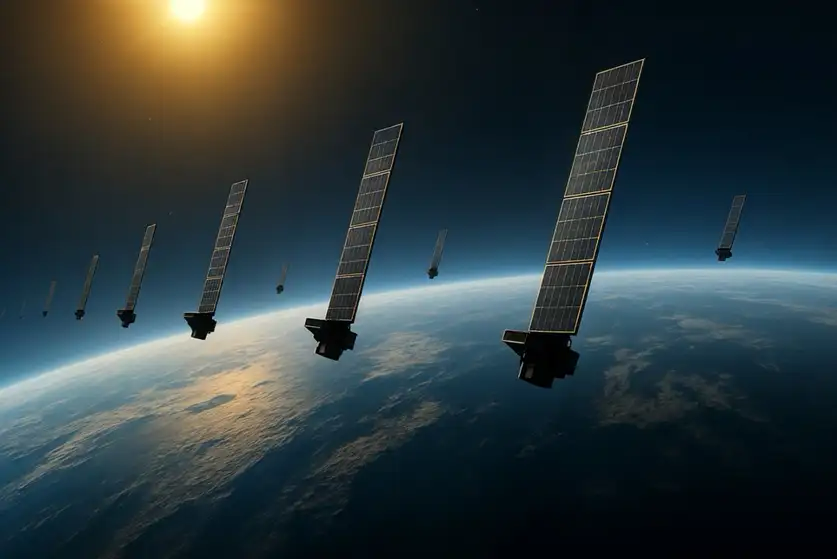
SpaceX achieved a significant milestone on March 16, 2026, when the Starlink constellation reached 10,000 satellites in orbit. The achievement marks another step in the company’s ambitious plan to provide global broadband internet coverage from low Earth orbit, fundamentally altering both the satellite communications industry and the orbital environment itself. The rapid deployment, accomplished in just over six years since the first operational satellites launched, represents an unprecedented rate of satellite construction and launch activity.

The Starlink network provides internet service to customers worldwide, with particular impact in remote and underserved regions where traditional infrastructure remains impractical. Subscribers use a small satellite dish to connect to passing satellites, receiving data directly from space rather than relying on undersea cables or terrestrial networks. The service has gained particular relevance following natural disasters that destroy ground-based infrastructure, providing emergency connectivity when cellular towers and power grids fail.

The constellation’s growth has not proceeded without controversy. Astronomers have raised persistent concerns about satellite brightness affecting ground-based observations of the night sky. The large number of reflective objects in low Earth orbit creates trails in telescope images that can obscure distant celestial objects. SpaceX has implemented various mitigation measures, including darkening treatments on newer satellites and experimental VisorSat designs intended to reduce reflectivity. However, the astronomical community remains divided on whether these efforts adequately address the concerns.

The 10,000-satellite milestone comes as SpaceX continues to expand service capabilities. The company has received regulatory approval to operate nearly 12,000 satellites in the initial constellation and has applied for authorization to add another 30,000 beyond that. Each generation of satellite incorporates improvements in communications bandwidth, onboard processing, and operational lifetime. The most recent versions feature laser inter-satellite links that allow data to hop between satellites without passing through ground stations, reducing latency and expanding coverage to polar regions and oceans far from gateway antennas.

Orbital debris concerns accompany every addition to the constellation. With thousands of satellites operating in similar orbital shells, the risk of collisions increases. SpaceX has equipped its satellites with autonomous collision avoidance systems that calculate potential conjunctions and execute avoidance maneuvers when necessary. The company has also implemented controlled deorbiting procedures, using remaining fuel to direct satellites into Earth’s atmosphere at end of life rather than leaving them as derelict objects. This approach aims to maintain sustainable use of low Earth orbit for future generations.

The commercial success of Starlink has prompted competitors to pursue similar constellation concepts. Amazon’s Project Kuiper, OneWeb, and other companies have announced plans for large satellite networks, though none have reached operational scale. SpaceX’s head start, combined with the company’s vertically integrated launch capability through its Falcon 9 rocket, has created significant competitive advantages that prove difficult for rivals to overcome. The 10,000-satellite milestone underscores how SpaceX has fundamentally changed the economics and scale of satellite communications.

Operating thousands of satellites in coordinated orbits presents unique engineering challenges. Each satellite must maintain precise timing synchronization to enable efficient handoffs as ground terminals transition between coverage areas. The satellites communicate with ground terminals using Ku-band and Ka-band frequencies, with newer generations adding V-band capabilities for increased bandwidth. The challenge lies in managing interference between satellites operating in similar frequency bands while maintaining service quality for millions of simultaneous users.

The constellation operates in shells at various altitudes, typically between 500 and 600 kilometers for polar-orbiting satellites. This altitude provides a balance between coverage area and orbital decay rates, requiring periodic station-keeping maneuvers to maintain altitude. At these altitudes, atmospheric drag remains significant enough that satellites require regular reboosting, consuming propellant that ultimately limits operational lifetime. SpaceX’s newer satellites incorporate improved thruster efficiency to maximize operational duration.