


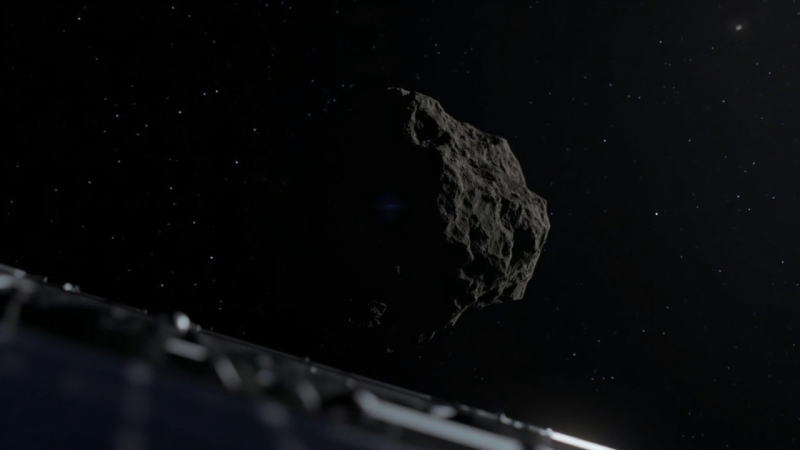
A small, jagged rock tumbling through space about 20 million kilometers from Earth just had its portrait taken. On July 6, 2026, the China National Space Administration released the first close-range images of (469219) Kamoʻoalewa, captured by the Tianwen-2 spacecraft from roughly 20 kilometers away on July 2. The pictures are grainy, low-resolution, slightly fuzzy at the edges. They are also the only close-up views humans have ever gotten of Earth’s most stable known quasi-satellite, and they sharpen a debate that has dragged on for nearly a decade about where this object came from. The rock’s elliptical path around the Sun takes it between roughly 0.1 and 0.3 AU closer and farther from Earth’s orbit, depending on where in the multi-decade cycle you sample it. From a ground-based telescope on any given night, Kamoʻoalewa is a faint dot moving against the stars: too small for any existing instrument to resolve as a disk, but bright enough that sensitive CCDs can pin down its spectrum and its rotation period. Both numbers have mattered for the past decade’s argument.
Kamoʻoalewa (a Hawaiian name meaning “oscillating celestial object”) was discovered in 2016 by the Pan-STARRS survey at Haleakalā Observatory in Hawaii (JPL Small-Body Database). Estimates put it somewhere between 16 and 40 meters across, it rotates once every 27 minutes, and it shadows Earth in a peculiar gravitational dance. Not a true moon, but a small body trapped in a 1:1 mean-motion resonance with our planet, looping the Sun in an orbit nearly identical to ours. From Earth’s perspective, the rock traces a slow, bean-shaped path that drifts between leading and trailing horseshoe configurations on timescales of decades. For at least the past hundred thousand years, give or take an order of magnitude, it has been Earth’s quiet companion. At some point it will leave.
For most of that history, nobody could get close enough to study it. Ground-based spectroscopy showed a spectrum that resembled space-weathered lunar regolith, with a weak 1.0 μm absorption band and a steep red slope that closely matched samples returned by Apollo 14 and the Chang’E-5 lander (Zhang et al., Nature Communications, May 2026). That match suggested the asteroid might be a piece of the Moon, blasted off by a relatively recent impact and gently nudged into a co-orbital path. But other groups showed that heavily weathered LL chondrite powder could produce a similar spectrum, and a Flora-family origin in the main belt remained plausible. Without a sample in hand, the question stayed open.
Tianwen-2 launched on May 29, 2025 from the Xichang Satellite Launch Center on a Long March 3B rocket, carrying 11 scientific instruments and a sample-return capsule designed for two distinct collection methods: a Hayabusa-style touch-and-go to grab regolith kicked up by a small thruster pulse, and an anchor-and-attach approach using robotic arms to clamp onto boulders and retrieve larger fragments. The spacecraft’s primary target was Kamoʻoalewa; an extended mission will later send it onward to main-belt comet 311P/PANSTARRS using a lunar gravity assist, with arrival in 2035.
The cruise phase took just over a year. Tianwen-2 first detected Kamoʻoalewa on June 6, 2026 at a range of 30,000 kilometers and refined the asteroid’s ephemeris from kilometer-scale uncertainty down to tens of meters (CNSA, July 2026). By June 19 it had closed to 2,000 km. Two weeks later, the framing camera returned the first resolved frames: a small, asymmetrical, jagged fragment, rotating visibly between exposures. The shape, in early analysis, looks more like a single competent block than the loose rubble pile some pre-arrival models had predicted.
The clincher will be the samples themselves, scheduled for collection later this year and return to a landing site near Jiuquan in late 2027. Tianwen-2 is the third mission in a decade-long run of asteroid sampling attempts, after JAXA’s Hayabusa2 (returned 5.4 g from Ryugu in December 2020) and NASA’s OSIRIS-REx (returned 121 g from Bennu in September 2023). Both of those targets were bigger than this one — Ryugu at about 900 m, Bennu at about 500 m — and both had escape velocities of tens of centimeters per second. Tianwen-2 is operating at a scale where escape velocity drops to a few centimeters per second, which puts the spacecraft closer to the asteroid in gravitational terms than a hang glider is to a hillside.
A new Nature Communications paper from Zhang and colleagues, published May 27, 2026, lays out what Tianwen-2’s near-approach spectroscopy already tells us about composition. The body’s reflectance spectrum matches the Itokawa-like LL chondrite class but with deeper space-weathering features than Hayabusa2 saw on its target. That tilts the evidence away from the lunar-ejecta hypothesis and toward a main-belt origin, but does not settle it. Samples in hand will.
Sampling on a 27-minute rotator is not trivial. A touch-and-go sequence has to compensate for the asteroid’s rotation, surface translation, and the very weak gravitational field — escape velocity from a 27-meter rocky body is on the order of a few centimeters per second. The Tsiolkovsky rocket equation, Δv = v_e * ln(m_0 / m_f), governs the maneuver budget for the descent burn. With a hydrazine thruster exhausting at roughly 2.2 km/s, Tianwen-2 has only a few hundred meters per second of total Δv available for the rendezvous, descent, sampling, and escape sequence combined. Each kilogram of mass the spacecraft sheds by venting or by jettisoning a sampling arm after contact translates directly into extra Δv headroom on the way home.
The anchor-and-attach method sidesteps some of that timing pressure. The arms can latch onto a boulder and ride the rotation with the asteroid for one full spin, giving the sampling drill time to work without the spacecraft having to hover. For both methods, the engineering constraint is the same: a few hundred grams of regolith, in a sealed capsule, must survive the return trip.
After the samples are sealed, Tianwen-2 will swing by the Moon for a gravity assist — adding roughly 1 km/s of heliocentric velocity for a negligible fuel cost — and aim for an Earth return in November 2027. If the capsule lands intact, the lab work begins: isotope ratios, cosmic-ray exposure ages, mineralogy. For the lunar-ejecta camp, the smoking gun would be a sample’s oxygen isotope signature falling outside the range of known meteorites and inside the range of lunar rocks. For the Flora-family camp, the clincher would be cosmic-ray exposure ages older than any plausible lunar crater’s age.
Either answer is interesting. A confirmed lunar origin would make Kamoʻoalewa the first known natural sample of the Moon without ever landing there, and would let planetary scientists calibrate impact-ejection dynamics with real data rather than simulations. A confirmed main-belt origin would rewrite the textbook on how quasi-satellites are captured and how space weathering proceeds on small bodies. By late 2028, with luck and a soft landing in Inner Mongolia, we will know which way the cosmic dice rolled when this little fragment came tumbling into Earth’s neighborhood. Until then, the new images are already doing their job: they have made an abstract orbital curiosity into a place with a shape, a spin, and a surface.
 Subscribe to our RSS feed









There are no comments.
Add A Comment