


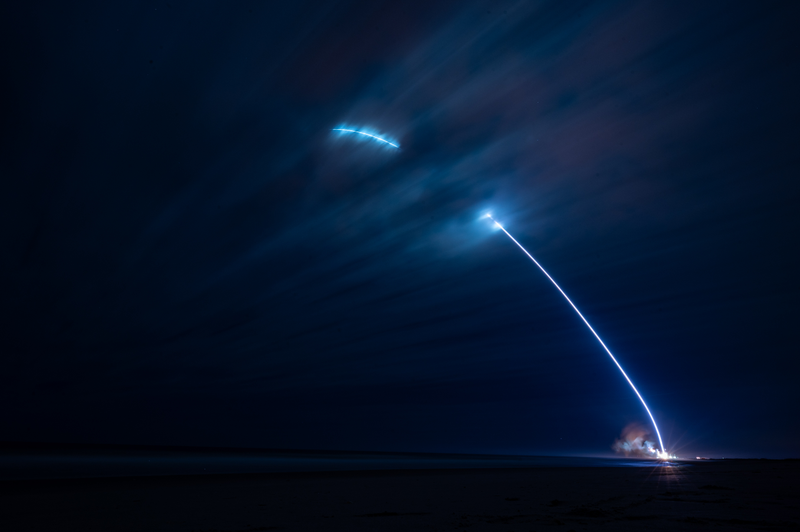
About 9 p.m. on the evening of May 28, 2026, a fully stacked New Glenn rocket at Launch Complex 36A began its final countdown. The vehicle stood 98 meters tall, taller than the Statue of Liberty on a pedestal, with seven BE-4 engines ringing its base. Around it, the propellant farm that had fueled the booster for its January 2025 maiden flight sat intact. The transporter-erector that had lifted the rocket onto its launch table four weeks earlier stood at the ready. By 9:07 p.m., both were gone.
This was not a launch. It was a hotfire test — the routine procedure in which a fully fueled rocket is ignited while held to the ground, its engines throttling up to validate the full countdown sequence without a real liftoff. Static fires have a good safety record. They are also where the most informative failures happen, because the rocket is fully instrumented and engineers can usually retrieve most of the wreckage.
The pattern is older than the modern launch industry. On September 1, 2016, a Falcon 9 loaded with the AMOS-6 communications satellite detonated at Space Launch Complex 40 during a pre-launch propellant load. The cause was a composite-overwrapped helium pressure vessel inside the second-stage LOX tank; cold helium had pooled liquid oxygen in a buckle in the aluminum liner, the trapped oxygen ignited, and the COPV failed. Total elapsed time from first anomaly to loss of vehicle: 93 milliseconds (SpaceX 2017 final investigation report). SpaceX’s fleet was grounded for four months, and the company rebuilt SLC-40 from its concrete mat upward.
Both events are symptoms of the same era: a commercial orbital industry large enough that ground-test failures are national news, and that schedules them into customer manifests years in advance. The May explosion cost Blue Origin its primary launch table, transporter-erector, one of two lightning towers, and a vehicle weeks away from carrying 48 Amazon Leo internet satellites. It delayed the Blue Moon MK1 lunar cargo lander from late 2026 into early 2027, forced NASA to revisit the Artemis V manifest, and gave Amazon Project Kuiper a fresh reminder that a single launch provider is a single point of failure.
Blue Origin had rolled the New Glenn stack out to LC-36A on May 22, six days after the FAA cleared the rocket to resume flights following an April anomaly on NG-3’s upper stage. According to Blue Origin’s initial public statements, the anomaly originated in the aft section of the first stage — the part that contains the seven BE-4 engines, their turbopumps, and the dense plumbing that feeds liquid oxygen at roughly 90 K and liquefied natural gas at roughly 112 K into the combustion chambers.
Within hours, Blue Origin CEO Dave Limp publicly committed to a return-to-flight target of “before the end of 2026,” and within weeks the company had completed debris clearance. The investigation is still open, but two facts are doing the heavy lifting. First, the BE-4 has been a reliable engine in flight: it has propelled ULA’s Vulcan to four national security missions since March 2025 (with two recent anomalies lying in Northrop Grumman’s GEM-63XL solid boosters, not the BE-4s), and the same engine has now completed three New Glenn flights with three first-stage recoveries on the droneship Jacklyn. Second, NG-3 in April was a reflight of the booster “Never Tell Me The Odds” — the first New Glenn first stage ever to fly twice — and that booster’s engines performed cleanly through ascent and the boost-back burn.
The booster itself, built around a 7-meter composite fairing that dwarfs Falcon 9’s 5.2-meter shell, had landed cleanly on the droneship Jacklyn during both NG-2 in November 2025 and NG-3 in April. Jacklyn is sized for that scale: 116 meters long and 46 meters wide, with a hydraulically actuated landing fixture and a 375-foot Liebherr crane for vertical-to-horizontal breakover. Whatever happened on the pad in May, the engines that actually reach orbit have already shown they can do it more than once.
The BE-4 is what Blue Origin calls a “medium-performing version of a high-performance architecture.” Each engine burns liquid oxygen and liquefied natural gas in an oxygen-rich staged-combustion cycle. A portion of the LOX is burned with a portion of the methane in a preburner to drive a single turbopump that feeds both propellants into the main combustion chamber at roughly 14 megapascals — about twice the chamber pressure of Merlin and roughly half the 26 to 35 megapascals that SpaceX extracts from Raptor’s full-flow staged-combustion cycle (Blue Origin BE-4 specifications, 2024).
What the BE-4 trades in chamber pressure it tries to win back in reusability. The turbopump spins on hydrostatic bearings — thin films of propellant fluid that bear the load between rotating and stationary parts — rather than on ball or roller bearings that wear under every start cycle. A contact-free bearing eliminates the failure mode that has historically dominated rocket turbopumps, where rotor-stator rubbing generates friction heat in a high-energy-density oxygen-rich environment and a single hot particle can ignite adjacent propellant feed lines.
The Tsiolkovsky rocket equation still rules the design: Δv = v_e * ln(m_0 / m_f), where v_e is the exhaust velocity (roughly 3,400 m/s for BE-4 in vacuum). Reaching low Earth orbit requires about 9.4 km/s of Δv, of which gravity and drag losses consume roughly 1.5 to 2.0 km/s, leaving the engines to deliver around 7.5 km/s. A first stage that needs about 3.5 km/s of its own Δv with v_e ≈ 3,400 m/s requires a mass ratio R = exp(3,500 / 3,400) ≈ 2.8, meaning about 64% of the fueled first-stage mass is propellant.
When aft-section failures do occur, the failure modes cluster in a small list. Rotor-stator contact, often initiated by bearing degradation or cavitation-induced vibration, is one. Turbine-blade fracture, which throws high-energy debris into propellant feed lines, is another. Seal failures that allow LOX and LNG to mix at incompatible temperatures, or cavitation instabilities in the inducer stage of the LOX pump, are others. In most paths the first symptom is a vibration signature through the turbopump housing; a properly instrumented static-fire test records it in hundreds of channels at kilohertz sampling rates. Engineers can usually reconstruct the chain of events within weeks — though identifying the root cause that should be redesigned to prevent recurrence is what takes months.
What Blue Origin is now doing at LC-36 is its own engineering story. Rather than rebuild the same transporter-erector, the company is accelerating a horizontal-to-vertical hybrid integration concept originally planned for LC-36B. Stages are mated horizontally inside the adjacent Integration Facility, then rolled to the pad, where a crane performs a vertical “breakover” — the inverse of the operation used to offload a recovered booster from Jacklyn — and lifts the vehicle onto a refurbished launch table. The architecture eliminates the transporter-erector as a single point of failure and gives Blue Origin a common concept of operations across both pads.
The May 28 explosion did not invalidate New Glenn. The vehicle has now completed three flights, two booster recoveries on Jacklyn, and one reflight. The engines that power it have completed dozens of Vulcan flights for the U.S. Space Force. But the incident exposed a single point of fragility that SpaceX had already learned about in 2016: the ground systems beneath a rocket are as important as the rocket itself. Blue Origin’s recovery plan converts the loss of one transporter-erector into a permanent architectural improvement — horizontal mating, vertical breakover, common CONOPS across two pads — that, if it works, will outlast any single vehicle lost on the pad.
For NASA, the lesson is schedulable. Blue Moon MK1 slips to early 2027; Artemis V, which depends on Blue Moon MK2 launching from a recovered New Glenn, slips with it. For Amazon, the first of 24 contracted New Glenn Leo launches slips along the same curve, though Kuiper has Atlas V and Vulcan capacity to bridge the gap. For Blue Origin, the lesson is the one every second-to-fly vehicle has had to learn: the rocket equation forgives inefficiency, but never a customer whose manifest has nowhere else to go.
 Subscribe to our RSS feed









There are no comments.
Add A Comment