


On 15 June 2026, at 15:24 CEST, a spacecraft 100 million kilometers from Earth received a single command through ESA’s Estrack deep-space antennas: stop firing. After almost eight years of nearly continuous thrust, the four QinetiQ T6 ion engines on the Mercury Transfer Module shut down for the last time. With that, the European/Japanese BepiColombo mission crossed an invisible line. From that moment, the spacecraft was on a ballistic trajectory, coasting with no propulsion toward the deepest gravity well in the inner Solar System. Mercury orbit insertion is scheduled for 21 November 2026 (ESA BepiColombo mission timeline, July 2026 update). What used to be a braking problem became a falling problem, and falling problems don’t have throttle knobs.
Mercury is the least explored planet in the inner Solar System, and the hardest one to reach without surrendering. It sits deep inside the Sun’s gravity well, moving at 47 km/s on average, more than three times Earth’s orbital speed. To fall into orbit around it rather than whip past it, a spacecraft must shed almost all of the kinetic energy it gained falling toward the Sun from Earth. NASA managed the trick with Mariner 10 in 1974 and MESSENGER in 2011. The Soviets never made it. The Japanese never tried. If BepiColombo succeeds, it will be only the third spacecraft in history to enter orbit around Mercury, and the first from Europe or Japan (ESA BepiColombo overview).
The mission also carries the heaviest scientific payload ever sent to Mercury, sixteen instruments distributed across two orbiters stacked on a propulsion bus. The trajectory they are flying is, by itself, an engineering demonstration: a multi-year, multi-flyby spiral through nine planetary encounters that uses gravity assists from Earth, Venus, and Mercury itself to bleed off energy without spending propellant.
BepiColombo launched from Kourou on 19 October 2018 aboard Ariane 5, lifting a 4,100-kilogram composite spacecraft into a series of looping escape orbits. The plan was, in spirit, simple: spiral inward. In practice, the MTM had to do most of the braking. Its four T6 ion thrusters, each producing only about 145 millinewtons of thrust (about the weight of a sheet of paper resting on a hand), fired almost continuously for years, accumulating more than 15 kilometers per second of total delta-v.
Then, in April 2024, the system lost a fight with itself. A short circuit in the MTM power conditioning unit reduced available thrust to roughly 90 percent of nominal. The original December 2025 arrival was no longer reachable. ESA’s flight dynamics team at ESOC in Darmstadt had to rebuild the entire interplanetary approach from the ground up, slicing flyby altitudes closer to Mercury by about 35 kilometers to recover the energy deficit through sharper gravity assists. The sixth and final Mercury flyby, on 8 January 2025, came in at just 295 kilometers above the night-side surface. Close enough that the spacecraft’s M-CAM monitoring cameras caught permanently shadowed craters at the north pole that may hold frozen water (ESA, January 2025 flyby report).
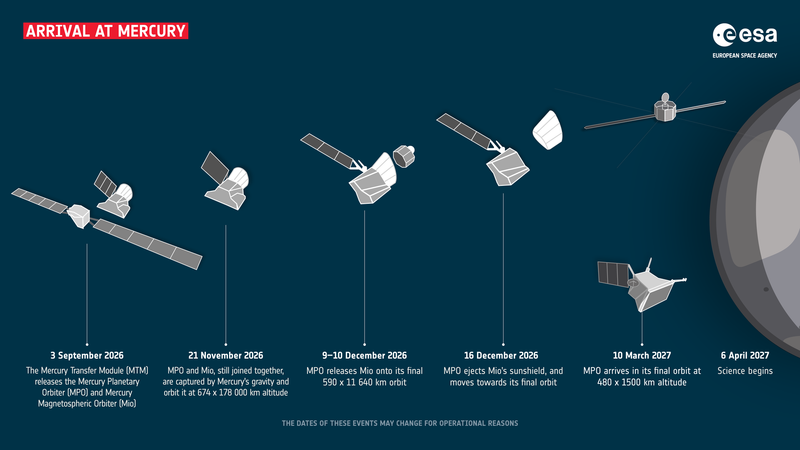
What happens between now and April 2027 is a four-stage separation sequence that ESA’s infographic captures cleanly. On 3 September 2026, still on approach, the MTM detaches and falls away, its job done and its xenon tanks empty. On 21 November 2026, a stack of two science orbiters fires a chemical-propellant braking burn and is captured into a high-altitude polar orbit. On 9–10 December 2026, ESA’s Mercury Planetary Orbiter (MPO) ejects the shielded Japanese Mio spacecraft onto its own elliptical polar trajectory. On 16 December 2026, MPO jettisons Mio’s protective sunshield (MOSIF). Over the next three months, MPO uses its own thrusters to lower itself to its working orbit of roughly 400 by 1,500 kilometers, arriving on 10 March 2027. Routine science begins on 6 April 2027 (ESA BepiColombo arrival timeline, July 2026).
The propulsion architecture is the story. The T6 ion thruster, built by QinetiQ Space in the UK, ionizes xenon and accelerates the ions through a grid biased at roughly 2,000 volts. Specific impulse runs around 4,300 seconds, about five times better than the best chemical bipropellant engine on the spacecraft. The trade is brutal: thrust is so low that BepiColombo had to spiral inward for eight years to make the maneuver work. The reward is propellant efficiency. The MTM carried only about 580 kilograms of xenon, and that modest tank delivered the equivalent delta-v of tens of metric tons of hydrazine.
Once the MTM separates, MPO has to handle the rest of the braking with its own chemical propulsion: a hydrazine-based system capable of producing about 1,000 newtons of total thrust across four 22-newton thrusters. To enter Mercury orbit, MPO must dissipate roughly 1.8 km/s of hyperbolic excess velocity in a series of maneuvers spread over weeks. Because Mercury’s gravity well is so deep, an error of even one meter per second in the insertion burn propagates into hundreds of kilometers of orbital drift by the end of the commissioning phase.
The two orbiters work at very different altitudes on purpose. Mio, the JAXA Mercury Magnetospheric Orbiter (formerly MMO), sits in a highly elliptical 400 by 12,000 kilometer orbit that swings it through the magnetosphere to sample solar wind interactions. MPO, in a tighter near-circular polar orbit, holds its instruments nadir-pointed at the surface. Eleven instruments on MPO and five on Mio together cover imaging (SIMBIO-SYS), X-ray fluorescence (MIXS), gamma-ray and neutron spectroscopy (MGNS), laser altimetry (BELA), magnetometry (MERMAG), and exospheric sampling (SERENA, PHEBUS). Temperatures range from about -180°C on the night side to +430°C on the day side, so most optical and infrared instruments sit behind thermal blankets and, where needed, gold-coated mirrors.
The water-in-shadow question is one of the cleaner open cases. Earth-based radar returns from Mercury’s polar craters are consistent with volatile ices buried under regolith. BepiColombo’s MGNS and MIXS instruments should, in principle, detect hydrogen directly through neutron moderation and detect elemental composition through characteristic X-ray emission. The permanently shadowed craters (Prokofiev, Kandinsky, Tolkien, and Gordimer at the north) were imaged by M-CAM 1 during the January 2025 flyby. Their rims just catch the sun, while their floors stay below 100 K year-round.
Three months from now, an interplanetary spacecraft that has spent almost a quarter of its life quietly thrusting through the inner Solar System is going to fall into the smallest planet’s gravity well. Whether the chemical insertion burn works depends on years of trajectory redesign, on the integrity of a 90-percent-power propulsion system that engineers coaxed across nine planetary encounters, and on a separation sequence that has to be executed cleanly four times in two months. If it works, BepiColombo will spend the next several Earth years mapping an airless, 430-degree-Celsius world whose permanently shadowed craters might, just maybe, hold enough water to matter for human exploration later this century.
If it doesn’t work, the spacecraft will whip around Mercury on a flyby trajectory, and the data already gathered by M-CAM during the six gravity assists will have to carry more of the mission’s scientific weight. As ESOC mission operators Ignacio Tanco and Nacho Clerigo have stressed in briefings, the arrival phase is not a single event but a six-month sequence of one-of-a-kind operations, each of which has to go right in the right order.
 Subscribe to our RSS feed









There are no comments.
Add A Comment