


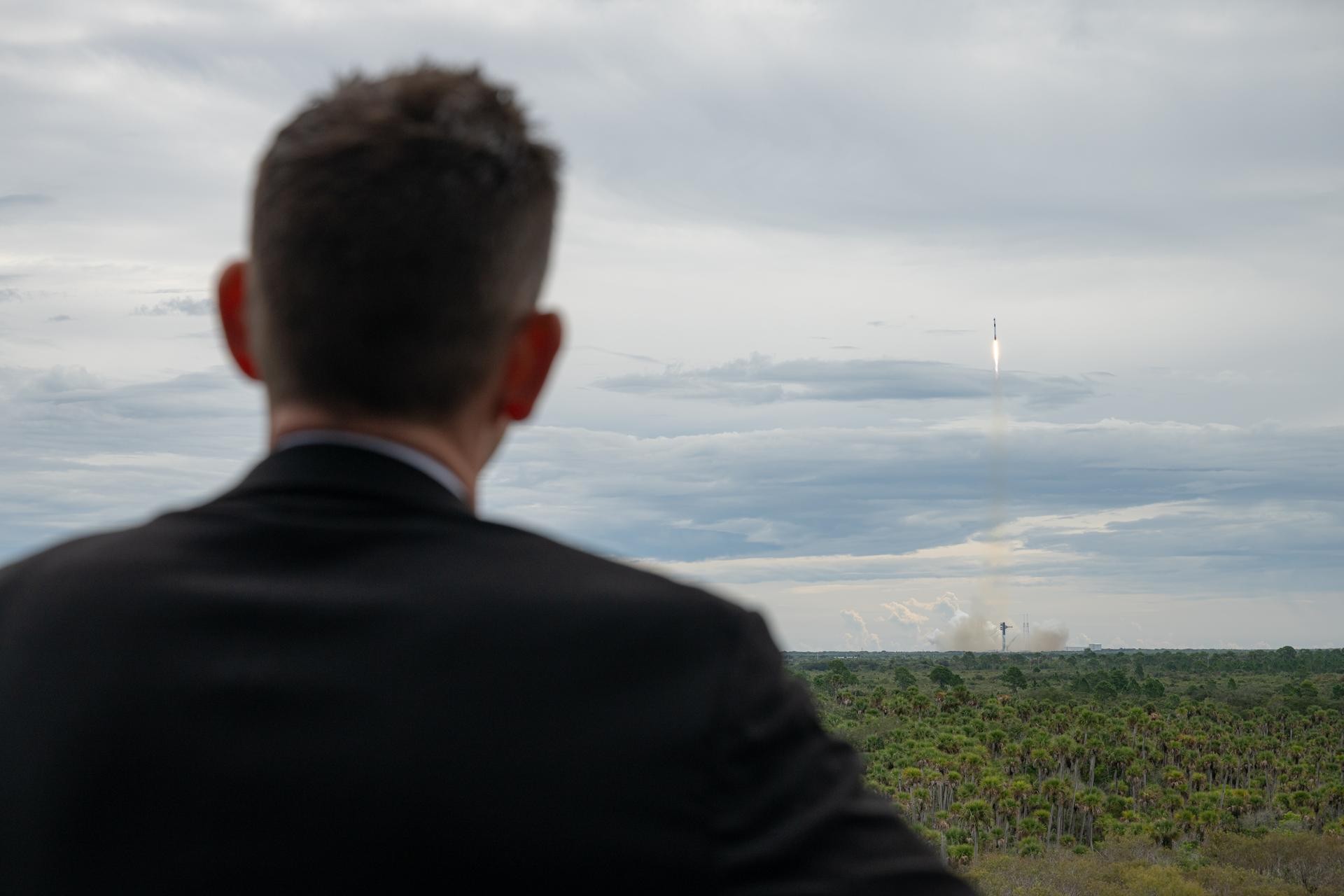
Image source: NASA Image and Video Library. Photograph by NASA/Joel Kowsky, public domain.
A SpaceX Falcon 9 lifted off from Space Launch Complex 40 at Cape Canaveral Space Force Station at 11:10 AM Eastern time on Thursday, October 1, carrying four astronauts on NASA’s Crew-13 mission to the International Space Station. About seven hours and fifty minutes after launch, Crew Dragon Grace is expected to dock autonomously to the forward port of the station’s Harmony module at approximately 7:00 PM Eastern. NASA’s launch-day release described the planned transit as a record-setting flight duration for any U.S. spacecraft heading to the station.
The four crew members are Jessica Watkins and Luke Delaney of NASA, Joshua Kutryk of the Canadian Space Agency, and Sergey Teteryatnikov of Roscosmos. Watkins commands the mission and is flying her second spaceflight, becoming the first NASA astronaut to fly twice on a SpaceX Dragon. Delaney pilots in his first spaceflight; Kutryk and Teteryatnikov are mission specialists, each also on a first flight. The launch was originally targeted for September 12 and was delayed by a propellant oxidizer leak discovered on the Dragon before that attempt. The crew entered final quarantine on September 17 and waited out the slip until the October 1 window, which weather officials rated at 70 percent go.
This is the thirteenth NASA Commercial Crew rotation flight, and the twenty-first time a Crew Dragon has carried a crew to orbit. The mission will run approximately six months, ending with a Pacific Ocean splashdown no earlier than March 2027. Once aboard, the four crew members will join Expedition 75 alongside Anil Menon of NASA and Pyotr Dubrov and Anna Kikina of Roscosmos, who are already on the station. After a brief handover, NASA’s SpaceX Crew-12 mission — astronauts Jessica Meir and Jack Hathaway of NASA, Sophie Adenot of ESA, and Andrey Fedyaev of Roscosmos — will return to Earth, restoring the station to a seven-person complement.
The crew backgrounds are deliberately diverse. Watkins is a geologist who previously flew on SpaceX Crew-4 in 2022; her second flight makes her the first NASA astronaut to ride a Dragon twice. Delaney is a former U.S. Navy aviator; Kutryk is a Royal Canadian Air Force fighter pilot; Teteryatnikov is a Russian submariner. Kutryk’s flight is a small but real first: he is the first Canadian to fly as part of NASA’s Commercial Crew Program. The earlier Canadian on a Dragon was Mark Pathy, who flew privately on Axiom Mission 1 in 2022.
NASA announced the crew assignments on April 23, 2026. The pairing of an experienced commander with three first-time flyers, including two from agencies that have not previously flown on Commercial Crew, is consistent with how NASA has used early-rotation flights to broaden the program. A Roscosmos backup crew member, Harutyun Kviryan, was assigned to the mission and remains in crew-support rotation on the ground.
The science planned for the six-month expedition leans heavily on microgravity biology. The crew will work with human stem-cell-derived tissues, an area of research NASA has invested in heavily in the last several expedition cycles, with the goal of building disease models and pharmaceutical testbeds that are hard to assemble on Earth. The crew will also work with a mostly autonomous plant-growth system to test crop production outside dedicated growth facilities — an effort aimed at the longer question of feeding crews on deep-space missions. Two additional threads continue work from earlier expeditions: studies of how blood-flow regulation responds to microgravity, and a hand-held diagnostic device intended to give crews more autonomy on long flights.
The mission comes at a transitional moment for the U.S. human-spaceflight program. NASA’s commercial crew cadence has settled into a roughly twice-yearly rhythm, and Crew-13 is the third operational mission of 2026. At the same time, the agency is preparing for the next test of its deep-space crewed vehicle: Orion, which flew its second crewed mission in April. Crew-13’s fast rendezvous profile reflects improvements in Dragon’s on-orbit phasing software and ground-control procedures; the previous record for a U.S. crewed launch-to-ISS-docking transit was set on Crew-4 in 2022 at roughly seventeen hours.
The launch comes three days after SpaceX’s first orbital Starship flight on September 28. NASA’s launch administrator, Jared Isaacman, framed the back-to-back events in his remarks at Kennedy Space Center. He called Crew-13 “another demonstration of America’s unmatched capability in human spaceflight,” and credited the agency and SpaceX teams for the launch. Dr. Lori Glaze, NASA’s associate administrator for the Human Spaceflight Mission Directorate, tied the mission into the broader exploration narrative: the ISS is “sustaining our presence in Earth’s orbit and sharpening the tools we’ll take forward to the Moon and Mars.”
Docking is scheduled for 7:00 PM Eastern. NASA’s live arrival coverage begins at 5:20 PM Eastern for the rendezvous, docking, and hatch-opening sequence, after which the four astronauts will change out of their spacesuits, transfer cargo, and open the hatch into Harmony. The handover period between Crew-13 and Crew-12 is expected to run roughly a week, with Crew-12’s return targeted for later in October.
The Crew Dragon capsule flying this mission is named Grace. That name is not on NASA’s standard naming rotation for Crew Dragon; it was applied for this specific vehicle. The choice has not been widely discussed publicly, but the spacecraft’s flight record makes the name appropriate: Grace flew this mission after a propellant leak in late August forced a multi-week delay, and the recovery from that delay is what the crew and ground teams are credited with in NASA’s launch-day release.
Once Crew-13 is aboard, the station will continue its mixed program of microgravity research, maintenance spacewalks, and visiting-vehicle traffic through the spring of 2027. NASA’s next crewed flight of any kind is expected to be the second lunar-flyby mission of the Orion program, currently in late-stage processing at Kennedy. Crew-14, the next operational Crew Dragon rotation, has not yet been publicly assigned.
 Subscribe to our RSS feed









There are no comments.
Add A Comment