


Image source: NASA Image and Video Library. Photograph by NASA, public domain.
Crew Dragon Grace docked to the forward port of the International Space Station’s Harmony module at 7:05 PM Eastern time on Thursday, October 1, completing the fastest launch-to-ISS-docking transit in the history of U.S. human spaceflight. The four Crew-13 astronauts — NASA’s Jessica Watkins and Luke Delaney, Canadian Space Agency astronaut Joshua Kutryk, and Roscosmos cosmonaut Sergey Teteryatnikov — arrived at the orbital outpost seven hours and fifty-five minutes after their Falcon 9 lifted off from Cape Canaveral, with the spacecraft traveling 263 miles above the northeastern Pacific Ocean at contact. A welcome ceremony at the station’s hatch followed at 8:45 PM Eastern.
The fast-rendezvous profile is the headline. Most Crew Dragon flights to the ISS take 24 to 28 hours and complete roughly eighteen orbits before contact; the typical transit requires Dragon to make a series of calculated engine burns to gradually raise its orbit to match the station’s altitude and phase. The Crew-13 profile completed the same work in fewer orbits by setting Dragon’s initial orbit to a period slightly shorter than the station’s, allowing Dragon to catch up faster — a more propellant-intensive but faster approach. Spaceflight Now noted in pre-launch coverage that the choice of profile depends on orbital geometry at launch time, and that the specific 11:10 AM Eastern launch window was selected in part because it put the ISS in the right relative position to support the short rendezvous. NASA’s launch-day release called the transit the fastest launch-to-docking by a U.S. spacecraft in ISS history; the previous mark was set on Crew-4 in 2022 at roughly seventeen hours.
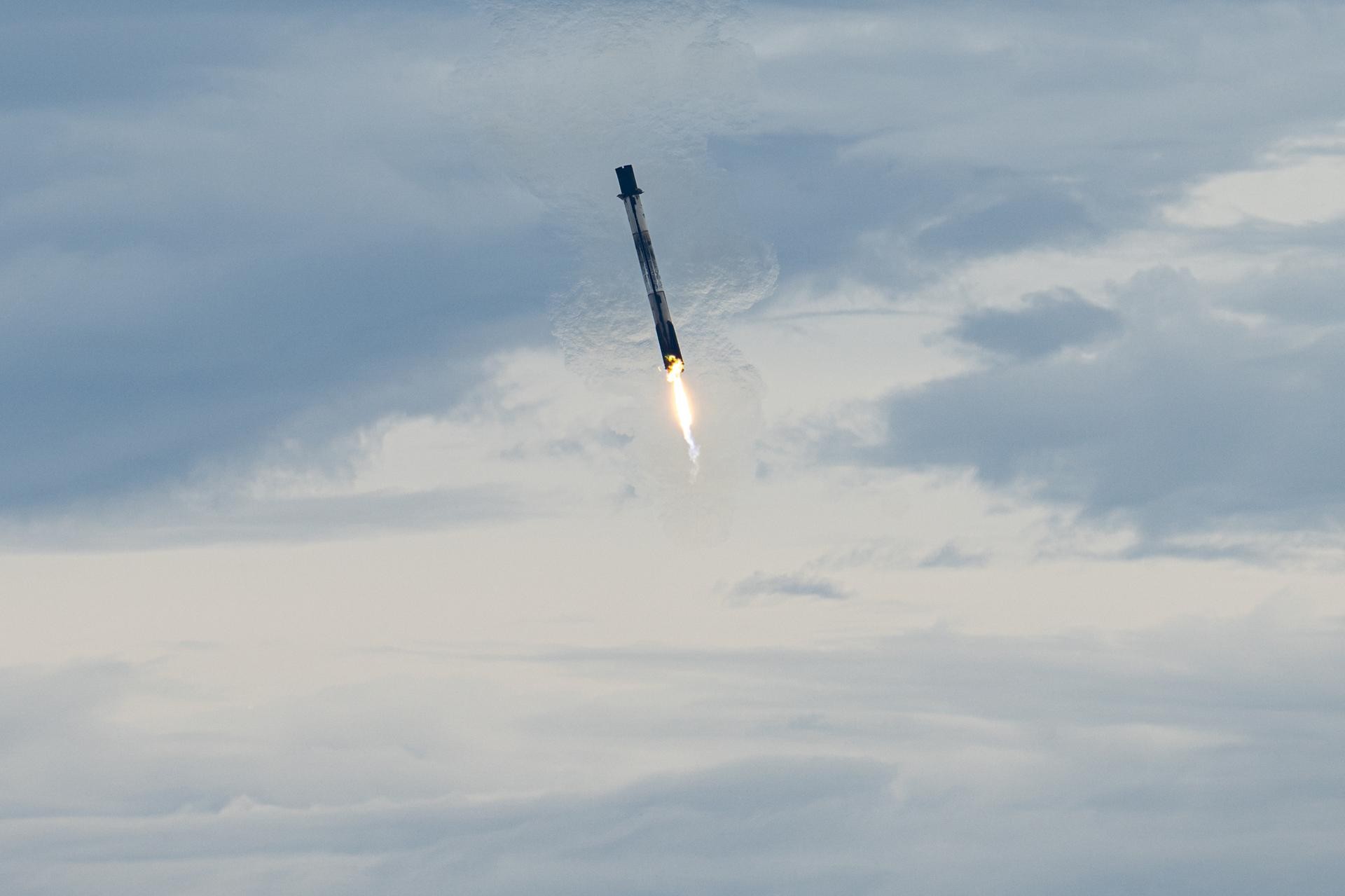
The booster that lofted Grace into orbit made its own contribution to SpaceX’s reusability ledger. B1101 returned to Cape Canaveral and touched down at Landing Zone 40 less than eight minutes after launch — the seventh landing at LZ-40 and SpaceX’s 664th Falcon booster landing overall. The booster was on its third flight: it had previously launched the Starlink 6-88 mission and Crew-12 in February 2026. B1101’s reuse profile, plus the use of a previously-flown Crew Dragon capsule, continues to be one of the structural arguments SpaceX makes for its pricing. Recent Dragon crew rotation flights cost NASA approximately $288 million per mission, or roughly $72 million per seat. Boeing’s Starliner was priced at roughly $90 to $99 million per seat under its original contract.
The flight carried more than just crew to orbit. Grace (tail number C-213) had flown before — she was the same Dragon that flew NASA’s SpaceX Crew-4 mission in April 2022, the mission on which Watkins made her first trip to space. SpaceX’s design certification for Crew Dragon, last reviewed against the manifest in 2024, allows each capsule to be reflown up to fifteen times across its service life. The Crew-13 mission flew with no public announcement of any hardware change to the capsule. The SpaceX contract for the flight did, however, expand: in a May 2026 announcement, NASA formally added six more Dragon commercial crew missions to its Commercial Crew Program manifest, replacing flights that had originally been awarded to Boeing’s Starliner. That addition, combined with a separate $946 million contract for three flights, means SpaceX now holds contracts for all remaining NASA ISS crew rotation missions through the station’s planned retirement around 2030.
The single-source-of-supply arrangement is not what NASA’s planners wanted. The original Commercial Crew Program was structured to fund two providers — SpaceX and Boeing — so the U.S. would not be wholly dependent on a single company for crew transport. That redundancy is now absent because of Boeing’s 2024 Crew Flight Test failure. In February 2026, NASA formally classified that failure as a “Type A mishap,” the agency’s most serious category, after multiple propulsion anomalies during transit — most notably a string of helium leaks in the service module and the failure of five of eight reaction-control thrusters in quick succession. NASA returned the vehicle uncrewed and brought the test crew home on a Dragon in March 2025. Boeing’s next Starliner mission is currently targeted as an uncrewed cargo flight no earlier than the fourth quarter of 2026, but Boeing’s own SEC filings describe NASA discussions as having an “uncertain” outcome.
Once aboard the ISS, Crew-13 will join Expedition 75 alongside the crew already on station. The handover will play out over the next week, after which Crew-12 — NASA’s Jessica Meir and Jack Hathaway, ESA’s Sophie Adenot, and Roscosmos’s Andrey Fedyaev — will board Dragon Freedom for the trip back to Earth. Watkins, Delaney, Kutryk, and Teteryatnikov are then expected to stay aboard through approximately next March and April, rotating through Expedition 75 and 76 as the station hands off twice during their stay. Their science agenda includes biology, materials science, Earth observation, and human physiology studies — including work that will feed into the cardiovascular, bone-density, vision, and immune-function research programs that inform Artemis-era lunar surface planning.
One piece of context that isn’t in NASA’s release but does change how the mission should be read: Grace is, according to a separate secondary-outlet report published today, the fifth and final Dragon capsule SpaceX has built. The company is not planning to construct another. The implication for ISS operations is significant — every operational NASA crew rotation to the station through 2030 will use one of those five Dragons, including a capsule that has been aloft for some of its life cycle. NASA’s Commercial Crew Program and Boeing’s recovery of Starliner will both be factors in how that plays out, but the operational constraint is set: there are five Crew Dragons, and there will be no more.
The next major event in the Crew-13 timeline is the handover, which is expected to take about a week and concludes when Crew-12 departs. NASA’s next crewed launch of any kind is currently scheduled to be the second lunar-flyby Orion mission, in late-stage processing at Kennedy. Crew-14 has not yet been publicly assigned.
For the moment, though, the four Crew-13 astronauts are aboard. Hatch opened at approximately 8:45 PM Eastern. The welcome ceremony was broadcast on NASA TV.
 Subscribe to our RSS feed









There are no comments.
Add A Comment