OrbitalHub

Where curiosity reaches escape velocity.

Domain is for sale. $50,000,000.00 USD. Direct any inquiries to contact@orbitalhub.com.


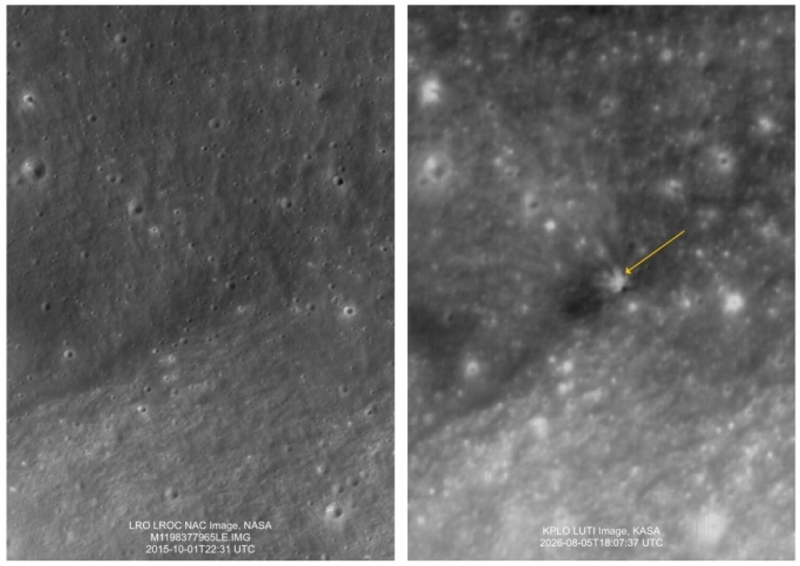
Before-and-after comparison of the Falcon 9 upper stage impact site near Einstein crater, imaged by LRO in October 2015 (left) and Danuri's LUTI camera on August 6, 2026 (right). Credit: NASA, KASA, KARI.


At 06:34 UTC on August 5, 2026, a hollow aluminum cylinder weighing roughly 3,900 kilograms crossed the last few hundred kilometers between Earth and the Moon at 2.43 km/s and stopped existing. The spent second stage of a SpaceX Falcon 9, cataloged as 2025-010D, slammed into the lunar surface near Einstein crater on the western limb and excavated a crater somewhere between 17 and 30 meters across. Almost no one on Earth saw it. The flash lasted less than a second, the impact site was on the sunlit side of the Moon during morning twilight for European and American observers, and the Sun-corona glare swamped any amateur telescope hoping to catch a thermal signature.

Eleven days later, the picture is clearer. South Korea’s Danuri orbiter published the first before-and-after images of the crater. Astronomers at Boston University working with the European Southern Observatory’s Very Large Telescope in Chile pulled a sodium and lithium line out of the ejecta plume. NASA’s Lunar Reconnaissance Orbiter is planning a follow-up pass that should image the fresh crater at half-meter resolution. For the first time in lunar science, the community has a controlled, predicted, multi-instrument observation of an artificial impact on the Moon.

The Chang’e 5-T1 third stage hit the Moon in March 2022 and the community was surprised by the double crater it left, because the shape implied more mass at the front of the rocket than the published payload would account for. The Falcon 9 stage is the second confirmed unintentional lunar impact, and the first that was on the near side, on the sunlit side, and watched in advance. About 100 lunar missions are planned over the coming decade, and each one leaves a spent upper stage in cislunar space unless the operator deliberately disposes it. SpaceX’s pre-impact statement was honest: on a translunar injection, almost all the propellant goes to the payload, and a controlled deorbit burn is not always possible. Solar radiation pressure and Earth-Moon perturbations then nudge the stage for months or years. The Falcon 9 stage launched in January 2025 carrying Firefly’s Blue Ghost-1 and ispace’s Hakuto-R Resilience; it took nineteen months for the Moon to catch it.

Most of the cameras were not pointed at the right pixel at the right fraction of a second. Jose Maria Madiedo at the Astrophysics Institute of Andalusia in Spain did publish ground-based video the next day, showing a faint plume rising above the lunar limb, but the impact point was hidden behind the Moon’s edge from his vantage. The VLT sodium and lithium detection came from Carl Schmidt, a Boston University planetary astronomer whose thesis work was on Mercury’s sodium exosphere. He had the right high-resolution spectrograph on the right telescope at the right time, and he caught a falloff of sodium and lithium emission extending tens of kilometers above the impact for five to ten minutes. The lithium is the smoking gun: the upper stage’s aluminum-lithium alloy tankage is the only plausible source.

The more satisfying story is Danuri’s. The Korean orbiter made a deliberate maneuver in mid-July to clear a worrying close approach with the incoming stage, then returned to its nominal orbit in time to take a pre-impact image at 3:01 p.m. KST on August 5, thirty-three minutes before the strike. Seven more imaging sessions followed over the next fifteen hours. The before-and-after comparison, released through the Korea Aerospace Administration on August 12, shows an unambiguous change in surface texture around the impact coordinates and a darker patch of ejecta extending some distance from the new crater. The LUTI camera has a resolution of a few meters per pixel, and the new crater is roughly the size of a single pixel or slightly larger.

The finer imaging will come from LRO. Mark Robinson, the LRO Camera principal investigator, told Inside Outer Space that the orbiter’s clean pass over the impact region on August 11 closed the acquisition cycle, with the crater in view at the LROC Narrow Angle Camera’s native 50-centimeter resolution. The high-resolution LROC imagery is expected to be published once the data is processed.

The science starts with the energy budget. A 3,900-kilogram object hitting the Moon at 2.43 km/s carries KE = 0.5 * m * v^2 ≈ 11.8 gigajoules of kinetic energy, equivalent to roughly 2.8 tons of TNT. By the standard point-source crater scaling for competent regolith, this corresponds to a transient crater about 17 meters in diameter and a final crater in the 20-30 m range once the walls have slumped, matching the predictions published by Fernando and colleagues (arXiv:2607.14625) and by Jo and colleagues at UT Austin (arXiv:2607.23904). The latter paper predicted an ejecta curtain extending 15-20 km above the surface, a central spike reaching 75-100 km, and a lateral spread of about 183 km. The central spike is the part that briefly exceeded the lunar escape velocity and would have scattered fine dust into cislunar space.

The interesting engineering question is what the hollow impactor did to the standard crater-scaling law. A spent Falcon 9 stage is mostly an empty propellant tank with a single Merlin Vacuum engine hanging off one end. Schmidt’s lithium detection is direct evidence that the stage broke up during entry rather than punching through as a coherent cylinder, because the lithium is locked inside the aluminum-lithium alloy of the tank bulkhead and would have vaporized before reaching the surface if the stage had stayed intact. The Chang’e 5-T1 double crater in 2022 told a similar story: a hollow rocket body, a mass distribution front-to-back that nobody had published, and a crater shape that surprised the modellers. Artificial impactors are not point masses.

The cislunar tracking problem is the bigger engineering gap. Ground-based optical and radar observations lose accuracy past about 0.1 AU because the radar return on a tumbling aluminum cylinder is weak and the optical signal is dominated by the Earth’s background. The Falcon 9 stage’s final weeks were tracked primarily by amateur astronomers using the Bill Gray Project Pluto pipeline and a handful of university observatories. The successful prediction and observation of this impact is a useful stress test of that network, and it came through. The next test, with about a hundred more lunar missions in the queue, will not be optional.

The Moon now has a second confirmed artificial crater, a fresh cislunar debris benchmark, and the first multi-instrument dataset of its kind. The VLT sodium and lithium detection is the cleanest engineering fingerprint of an artificial impact ever recorded, and Danuri’s images give crater-scaling models a calibration point they have not had before. LRO’s high-resolution pass on August 11 is expected to close the loop once the imagery is processed.

The less comfortable lesson is that cislunar traffic management is still a volunteer effort. The Falcon 9 stage was tracked, modeled, and observed by a coalition of amateur astronomers, two national space agencies, and academic research groups. There is no equivalent of the FAA for the volume of space between Earth and the Moon. As lunar launch cadence rises, that will have to change, because the next artificial impact will probably not be a quiet one with a known stage and a predicted trajectory. It will be a piece of hardware nobody realizes has drifted into the wrong orbit, and the only way to notice it in time is to be looking.
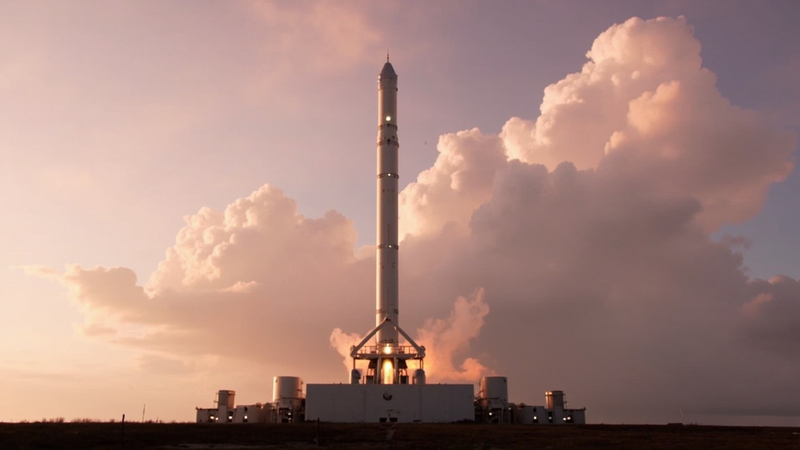


An illustration of a fully stacked Starship and Super Heavy standing on a Starbase launch pad at sunrise, the configuration Ship 41 and Booster 21 will take once stacking for Flight 14 is complete


Twenty-six Starlink V3 satellites are bound for the payload bay of Ship 41 at Starbase, Texas, on a flight that has not yet left the ground. SpaceX is now targeting Monday 28 September 2026 for Starship Flight 14, with the window opening at 7:15 a.m. Central Time, 12:15 UTC, from Pad B. That is the fourth date set for this mission: attempts on 15, 18 and 22 September were each stood down, and the 28 September slot is still pending final regulatory approval. Ship 41 has completed its cryogenic proof testing and its static fire campaign, and Booster 21 has been moved to the pad for stacking. If the count reaches zero, Booster 21 will lift Ship 41 off the pad and, for the first time in the program’s three-year test campaign, hand a Starship upper stage enough velocity to circle the planet. The flight, designated IFT-14, would be the first orbital mission of the world’s largest operational rocket. Every previous Starship test, including the successful Flight 13 on 24 July 2026, was flown on a deliberately suborbital arc that splashed down either in the Indian Ocean or the Pacific (SpaceX, September 2026).

What changes because of this is the shape of the test program itself. For thirteen flights, SpaceX used the upper stage’s engines to push it downrange without ever crossing the orbital velocity threshold of roughly 7.8 km/s. The result was a “passively safe” trajectory that guaranteed reentry and splashdown at a known point even if all vehicle control was lost (Ars Technica, 15 September 2026). To stay on a closed orbit around Earth, Ship 41 will have to perform two burns in space, a coast phase of nearly ten hours, and a controlled deorbit burn at the end of the mission, all while carrying real revenue payload. That last detail is why SpaceX Chief Financial Officer Bret Johnsen told the Goldman Sachs Communacopia and Technology Conference audience on 10 September 2026 that this is “a revenue-generating flight” (TeslaNorth, 10 September 2026). No previous Starship test ever carried satellites that were intended to serve paying customers.

The procurement story behind the announcement starts with Starlink V3 itself. Each V3 satellite adds about 1 Tbps of downlink capacity and 160 Gbps of uplink capacity to the constellation, roughly ten times faster on the downlink and twenty-two times faster on the uplink than a V2 mini Starlink (PCMag via BaseNor, 15 September 2026). Twenty-six of them on Flight 14 will add a combined 26 Tbps of capacity in a single mission, more than ten times what a Falcon 9 V2 mini launch delivers (TeslaNorth, 16 September 2026). V3 satellites are too large to fit inside a Falcon 9 fairing; they can only reach orbit on Starship (SpaceX IPO filing, May 2026; azmth.space, 15 September 2026). The first batch of twenty V3s flew inside Ship 40 on Flight 13 in late July. This is the second and larger batch, with three of the twenty-six modified to carry cameras aimed back at the ship’s heat shield during deployment.

The engineering choices that make the orbit possible begin with Booster 21’s hardware fix. On Flight 13, Booster 20 had successfully used all thirty-three of its Raptor 3 engines during boostback, the first time a Block 3 Super Heavy had done so, before the terminal phase of the landing burn went wrong. Three of the thirteen center engines showed signs of ice clogging and triggered an early shutdown, leaving only eight engines to complete the burn before the booster splashed down hard in the Gulf of Mexico (Tech Times, 16 September 2026). The cause was straightforward. Liquid oxygen, stored at roughly −183 °C, draws moisture into propellant feed lines and filters where it can freeze into crystals. The center engines of the booster feed from a dedicated liquid-oxygen header tank used only during terminal deceleration, and that header tank’s filters were not sized to keep the contamination out under flight loads. Booster 21 carries redesigned filters on the propellant path between the header tank and the center cluster, along with new software for relight reliability (SpaceX, 15 September 2026). A successful landing burn on Flight 14 will be the qualification event for that change before SpaceX attempts the first tower catch of a Block 3 booster on Flight 15.

Ship 41’s heat shield is the second engineering story of the day. SpaceX recovered Ship 40 from the Indian Ocean in early August largely intact, harvested two of its ceramic heat-shield tiles, and plans to refly them on Ship 41 (Ars Technica, 15 September 2026). Three upgrades followed. Stronger retention mechanisms on tiles in regions at highest risk of shedding during ascent. Additional shielding against plasma flow paths behind the tile field. And a curved tile design that has shown it can reduce heating in the gaps between individual tiles. Three of the twenty-six V3 satellites carry cameras pointed back at the ship’s flank during their deployment sequence, so the mission returns not just operational spacecraft but a heat-shield health dataset from inside the bay.

The trajectory is also new. All earlier Starship flights followed ballistic arcs aimed at splashdown zones west of the Bahamas, in the Indian Ocean, or, in the case of the catch attempts, at Starbase itself. Flight 14 will splash Ship 41 down in the Pacific Ocean west of Chile, the geometry forced by a true orbital insertion at 275 km altitude. The booster will attempt a controlled splashdown in the Gulf of America on its own landing burn, not a tower catch (SpaceX, 15 September 2026). SpaceX has not yet received regulatory approval for an upper-stage tower catch in this campaign; that step is reserved for later flights.

The numbers underneath are what make the orbital geometry work. A Block 3 Super Heavy at liftoff carries 3,650 tonnes of methalox propellant across its two stages, with the booster delivering 89.5 Meganewtons of thrust from thirty-three Raptor 3 engines and the upper stage pushing six engines of its own, three of them Raptor Vacuum variants with a vacuum specific impulse of 380 seconds (Wikipedia, SpaceX Starship; SpaceX, 2024). The orbital velocity target of 7.8 km/s, multiplied by the natural logarithm of the mass ratio, gives the rocket equation Δv = v_e * ln(m_0 / m_f) that Tsiolkovsky wrote in 1903 and that every orbital mission since has had to satisfy. For a single-stage-to-orbit architecture, the ratio m_0 / m_f must clear roughly twenty. Two stages let Starship keep both ratios smaller, with Booster 21 shedding its structure shortly after its boostback burn and Ship 41 climbing to operational orbit on its own.

The mission control plan adds one explicit safety gate. Ship 41 will execute the burn to enter orbit only after the flight control team has confirmed “sufficient redundancy on hardware critical” to the later deorbit burn (SpaceX, 15 September 2026). If the ship is not healthy enough to come back down on command, it stays on its initial suborbital trajectory and splashes down in the Pacific regardless. The decision is made in flight, after launch and stage separation, rather than at any point in the ground count.

What’s next is the catch. Musk confirmed in mid-September 2026 that Flight 15 will attempt the first Block 3 booster tower catch, building directly on the Flight 14 landing burn (Starlust, 15 September 2026). From there, SpaceX’s published roadmap points toward higher flight cadences, larger payloads of up to sixty V3 satellites per launch, and the eventual test of orbital propellant transfer, the unproven technology that still gates every Mars mission. Flight 14 is not the destination. It is the flight that would end Starship’s run as a suborbital demonstrator and finally make it what it was always meant to be: a vehicle that goes around.


SpaceX has set no earlier than May 19, 2026, for the first flight of Starship in its Version 3 configuration, a significant step in the development of the vehicle that NASA has contracted to land astronauts on the Moon and that SpaceX intends to use for missions to Mars. The upcoming flight, designated Flight 12, will lift off from Starbase in South Texas with a window opening around 5:30 to 6:30 p.m. ET, with a backup opportunity on May 20 if weather or technical issues require it.

The Version 3 configuration represents the most capable iteration of the Starship and Super Heavy system yet built. The vehicle stands approximately 150 meters tall with the upper stage stacked on the booster, making it the largest flying object ever constructed. The Super Heavy booster carries 33 Raptor engines — the full complement — compared to the 33-engine configuration that flew in earlier tests, but V3 introduces upgraded engines with higher thrust output and improved longevity. The upper stage, Ship 39, carries the same engine count as its predecessors but benefits from the thermal protection and reusability improvements that the SpaceX team has refined through the program’s rapid iteration cycle.

On May 11 and 12, SpaceX completed a full launch rehearsal that included propellant loading and a 33-engine static fire of Booster 19 with Ship 39 stacked on top. The test was the first time V3 hardware had been subjected to a full-duration static fire with all engines firing simultaneously, and it verified the vehicle’s readiness for flight conditions. The rehearsal included loading cryogenic propellants — liquid oxygen and liquid methane — into both stages, a process that takes hours and involves managing thermal gradients and boil-off rates that are significantly more complex for a vehicle of Starship’s scale than for any prior rocket.

The May 19 target has been in development for several weeks. SpaceX had originally planned an earlier V3 debut but chose to extend the testing and validation phase after discovering a hardware issue during pre-flight inspections. The conservative approach reflects a pattern the company has followed throughout the Starship program: when something does not look right, the team stops, diagnoses, and fixes rather than proceeding and hoping for the best. The strategy has produced a flight rate that is slower than early projections suggested, but it has also produced a vehicle that, by the time it flies, has been tested against the conditions it will actually face.

Flight 12 will be the first Starship flight of 2026 and the twelfth overall test flight in the program’s history. SpaceX has been flying approximately one Starship mission every few months as the vehicle matures, with each flight serving as both a test of new hardware and a demonstration of capabilities that have been validated in previous flights. The Version 3 hardware will attempt to complete the full mission profile: a full-duration burn of both stages, a controlled descent of the booster back toward the launch site where it will be caught by the mechanical arm system, and an upper stage that will perform a controlled splashdown in the Indian Ocean after completing one or more orbits of Earth.

The vehicle’s role in NASA’s Artemis program gives the program a significance that extends beyond SpaceX’s own ambitions. The Human Landing System contract that NASA awarded to Starship requires the vehicle to demonstrate crewed lunar landing capability before astronauts from the Artemis III mission descend to the lunar surface. That demonstration is years away, but the hardware being tested in the V3 flights is the same hardware that will eventually attempt the lunar descent. Each test flight, even if it ends in a loss of vehicle, produces data that refines the engineering and reduces the risk of the crewed mission later.

The May 19 window is specific enough that it suggests the team has high confidence in the timeline, but not so specific that it implies a guarantee. SpaceX has shown, repeatedly, that it will delay a launch rather than fly a vehicle it has reason to doubt. For a rocket program that has redefined what rapid iteration means in aerospace, the patience to wait for the right conditions is not a contradiction — it is the discipline that makes the iteration sustainable.

Super Heavy’s 33-engine first stage is a study in the engineering trade-offs that define modern launch vehicle design. Each Raptor engine produces a specific thrust at sea level, and the total thrust at liftoff is the sum of all 33 engines burning simultaneously. The challenge is not generating that thrust but managing the physical interactions between engines, the structure, and the propellant flow at the scale Super Heavy requires.

The Raptor engine uses a full-flow staged combustion cycle, which means that all of the fuel and oxidizer are gasified before they enter the combustion chamber. This approach produces very high efficiency — specific impulse in the range of 380 seconds at sea level — but it requires turbomachinery that can handle extreme temperatures and pressures without failing. The engineering challenge is not just the performance but the durability: an engine that will be fired multiple times must maintain its tolerances across many cycles of heating and cooling, which is why the V3 engines include upgrades to materials and cooling passages that extend engine life.

At liftoff, the structural loads on Super Heavy are enormous. The vehicle weighs approximately 4,000 metric tons at full propellant, and the acceleration from zero to thousands of meters per second in a few minutes requires structural integrity in the airframe that can withstand both the axial loads along the body and the bending moments produced by the aerodynamic forces acting along the vehicle’s length. The stainless steel construction that SpaceX chose for Starship is not a cost-cutting measure but an engineering decision that trades away the weight efficiency of carbon composites for the fracture toughness and reusability of a material that can survive the thermal and structural extremes of repeated flights without developing the microcracks that compromise composite structures over time.

The catch mechanism — the mechanical arms at the launch tower that are designed to catch the returning booster rather than landing it on legs — remains one of the more ambitious elements of the Starship reusability architecture. The system requires precise trajectory control during descent, a structure on the booster that can interface with the catcher arms, and software that can execute the maneuver reliably at the end of a ballistic arc. The May 19 flight will be the first V3 attempt at this catch, and whether the system works on the first try or requires iteration will define the timeline for the operational reusability that SpaceX has designed the vehicle around.


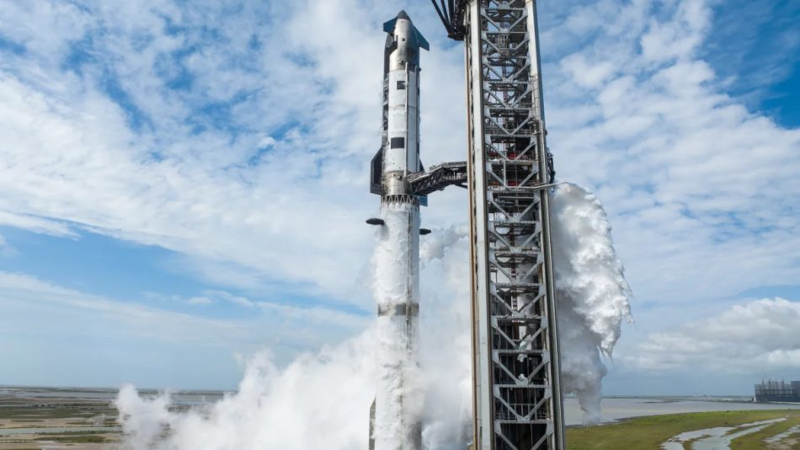
The next integrated test of Starship is positioned as a configuration transition rather than a routine increment. Flight 12, targeting early to mid-May 2026 from Starbase Orbital Launch Pad 2, is the first mission planned to use Version 3 (Block 3) hardware. The flight stack—Super Heavy Booster 19 and Starship Ship 39—incorporates design changes intended to improve propulsion performance, structural efficiency, and overall system reliability.

Pre-flight validation has centered on static fire testing. On April 15, 2026, Booster 19 executed a full-duration ignition of all 33 engines at the McGregor test facility. This was the first complete integrated test of the updated propulsion configuration using Raptor 3 engines. The preceding day, Ship 39 conducted a static fire of its six engines, including vacuum-optimized variants. These tests are designed to verify ignition sequencing, thrust vector control response, propellant flow stability, and structural load handling prior to flight.

The propulsion system is the primary area of change in Version 3. The Raptor engine operates on a full-flow staged combustion cycle using liquid methane and liquid oxygen. In this cycle, both propellants are fully gasified in separate preburners before entering the main combustion chamber. This approach allows for high chamber pressures and improved efficiency relative to simpler cycles, but it requires precise control of turbomachinery and flow balance. The Raptor 3 iteration focuses on simplification and integration. External plumbing has been reduced, and thermal management features are incorporated more directly into the engine structure. The intent is to decrease part count, reduce mass, and improve manufacturability while maintaining or increasing performance.

For Booster 19, the use of 33 engines introduces additional system-level considerations. Engine-out capability, thrust balancing, and control authority must be validated under conditions where all engines are firing simultaneously. The static fire provides data on pressure stability across the propellant manifolds, synchronization of ignition timing, and the response of the thrust vector control system. Structural loads transmitted through the thrust puck and into the booster’s primary structure are measured and compared against design predictions.

Ship 39’s propulsion configuration includes both sea-level and vacuum-optimized engines. The vacuum engines use larger expansion ratio nozzles to increase exhaust velocity in low-pressure environments. This improves specific impulse, which is a measure of propulsion efficiency. The trade-off is that these nozzles are not suitable for operation at sea level due to flow separation risks. The combined configuration allows the vehicle to operate efficiently across ascent and in-space phases. Static fire testing of Ship 39 validates ignition reliability, mixture ratio control, and thermal behavior of the extended nozzles.

Beyond propulsion, Version 3 hardware reflects iterative changes in structure and systems integration. Starship’s primary structure is composed of stainless steel, chosen for its strength at cryogenic temperatures and its ability to tolerate high thermal loads during reentry. Modifications in weld patterns, ring structures, and internal tank geometry are aimed at improving load distribution and reducing mass. These changes must be validated through both ground testing and flight data, as structural margins are closely tied to vehicle performance and reusability goals.

Propellant management is another area of focus. The vehicles use subcooled liquid methane and liquid oxygen, which require careful handling to maintain density and prevent cavitation in turbopumps. Tank pressurization systems must ensure consistent flow to the engines while accommodating changes in acceleration and orientation during flight. Static fire tests provide an opportunity to observe these systems under controlled conditions, including the behavior of autogenous pressurization, where gaseous propellants are used to maintain tank pressure.

The planned flight profile for Flight 12 remains suborbital, consistent with previous integrated tests. This allows the program to evaluate ascent performance, stage separation, and initial reentry behavior without committing to a full orbital insertion. Data collected during ascent will include engine performance metrics, structural loads, and aerodynamic response. Stage separation dynamics are of particular interest, as they involve complex interactions between the booster and upper stage, including plume effects and transient forces.

Reentry testing focuses on thermal protection and guidance. Starship uses a combination of passive and active systems to manage heat loads. The vehicle’s geometry distributes heating across the windward surface, while thermal protection tiles provide insulation. Guidance algorithms control the vehicle’s orientation to maintain a stable descent profile, balancing drag and lift to manage deceleration. Flight 12 is expected to provide additional data on tile performance, attachment reliability, and thermal gradients across the structure.

The integration of these systems reflects a broader engineering approach centered on rapid iteration. Design changes are implemented, tested, and refined in successive vehicles. Static fire campaigns serve as gate checks, confirming that major subsystems perform as expected before flight. The transition to Version 3 hardware indicates that the program has reached a stage where incremental improvements are being consolidated into a more mature configuration.

From a systems engineering perspective, Flight 12 is a validation of integration rather than a demonstration of isolated components. Propulsion, structure, guidance, and thermal systems must operate together under dynamic conditions. The objective is to reduce uncertainty in how these systems interact, providing data that informs future design decisions and operational procedures.

The significance of this flight lies in its role as a configuration baseline. If Version 3 hardware performs as intended, it establishes a reference point for subsequent vehicles, supporting the program’s goal of achieving full reusability. This includes rapid turnaround between flights, consistent performance across missions, and the ability to scale production.

Starship Flight 12 represents a transition to a more integrated and refined vehicle configuration. The static fire tests of Booster 19 and Ship 39 have validated key aspects of the propulsion system and supporting infrastructure. The upcoming flight will extend this validation into operational conditions, providing data on ascent, separation, and reentry. The outcome will determine the effectiveness of the Version 3 design changes and their contribution to the overall development of the launch system.


SpaceX filed confidentially with the U.S. Securities and Exchange Commission in early April 2026, setting in motion a process that could result in the largest initial public offering in market history. The filing, reported on April 1 by Bloomberg, Reuters, and CNBC, confirmed months of speculation about the timing of SpaceX’s transition from private to public ownership. The company, privately held since its founding in 2002, has grown into the world’s dominant commercial launch provider while operating as a closely controlled enterprise with no external public shareholders.

The confidential nature of the filing is standard procedure for companies testing the waters before a formal public offering. SpaceX submitted the paperwork under Jumpstart Our Business Startups Act provisions that allow emerging growth companies to keep their S-1 registration statements private during the SEC review period. The approach gives the company time to gauge institutional investor interest before committing to the full disclosure required for a public listing. The initial public filing is expected to become public between late April and mid-May 2026, with the roadshow to pitch the company to investors projected for early June.

The scale of the offering, if reports prove accurate, would be unprecedented in the aerospace sector. SpaceX is targeting a valuation between $1.75 trillion and $2 trillion, with plans to raise $50 to $75 billion in new capital. By comparison, Saudi Aramco’s 2019 IPO raised $29.4 billion at a valuation of approximately $1.7 trillion, making it the largest in history. The numbers reflect the extraordinary growth trajectory of a company that generated an estimated $16 to $18 billion in revenue during 2025, driven primarily by the Starlink satellite internet constellation that now serves millions of subscribers worldwide.

Financial details emerging from the preparation phase reveal a business that has transformed from a launch provider into an integrated space services company. Starlink revenue reportedly grew 842 percent over two years, reaching approximately $4.4 billion in the most recent annual period, according to data cited in multiple financial reports. The launch services division, while profitable, represents a smaller share of revenue than the constellation business, which has scaled to over 7,000 operational satellites and coverage across dozens of countries. SpaceX refinanced $20 billion in debt ahead of the IPO filing, positioning the balance sheet for public market scrutiny.

The ownership structure preserves founder Elon Musk’s control over the company after the IPO. SpaceX will issue super-voting shares that give Musk and insider investors effective control over board decisions, allowing the company to maintain its “controlled company” status under stock exchange rules. This structure is common in technology companies where founders seek public capital without surrendering operational authority. Musk’s other company, Tesla, operates under a similar dual-class structure that has kept Musk as the dominant voice in corporate governance despite owning a minority of shares.

The decision to go public arrives at a time when SpaceX’s operational momentum is at a peak. The company has conducted over 60 orbital launches already in 2026, with the Falcon 9 fleet achieving reuse milestones that validate the economic model underlying the IPO valuation. Booster B1067 reached 34 flights in late March 2026, demonstrating that hardware can sustain repeated use far beyond initial design expectations. Starship, the next-generation heavy-lift vehicle, continues its test program, with Flight 12 targeting early May 2026 from Starbase in Texas using the first Block 3 hardware configuration.

The integration of xAI into SpaceX, completed in February 2026, adds another dimension to the IPO narrative. The merger, reportedly valued at $60 billion, brings together SpaceX’s launch and satellite infrastructure with xAI’s artificial intelligence capabilities. The combined entity positions itself as an integrated space and intelligence company, potentially serving both commercial and government customers with combined hardware and AI services. Whether public market investors will assign premium valuations to this combination remains to be seen.

For the aerospace industry broadly, a public SpaceX could reshape competitive dynamics. United Launch Alliance, Blue Origin, and Rocket Lab all operate as private companies, and the success or failure of SpaceX’s public offering will signal whether capital markets view space infrastructure as a growth sector worthy of mainstream investment. The company’s stated intentions include 100 Starship launches per year, a Starlink constellation expansion to tens of thousands of satellites, and eventual crewed missions to Mars. The capital requirements for these ambitions are measured in tens of billions of dollars, which a public equity offering could help address.

The timeline for the actual listing remains subject to market conditions. The roadshow and SEC review process typically span several months, and market volatility could push the debut to late 2026 or 2027. The company has not confirmed specific listing dates, and reports from anonymous sources cited in financial coverage carry the caveat that plans can shift based on regulatory feedback or changing market sentiment. Investors seeking pre-IPO exposure have limited options through secondary markets, but those platforms trade at prices that imply valuations already near the reported IPO targets.

SpaceX’s IPO valuation rests substantially on the economics of rocket reusability, a concept that the company has spent a decade turning from theoretical to operational. The Falcon 9 booster fleet has now accumulated over 600 successful landings and 560 reflights, demonstrating that the same hardware can sustain multiple missions with periodic refurbishment. Each reflight avoids the cost of manufacturing a new booster, estimated at 30 to 40 percent of the approximately $74 million launch price.

The marginal cost of each additional reflight reflects declining refurbishment needs as the fleet matures. Early boosters required extensive inspections and part replacements after each flight. Current boosters, with thousands of flights of operational data, have undergone multiple design iterations that reduce wear and extend service life. The Merlin engines, which experience the most severe thermal and mechanical stress, have been modified between flights to reduce carbon buildup and improve tolerance to repeated firing cycles.

Starlink revenue changes the economic calculus by providing a captive launch customer that reduces dependence on external commercial contracts. When SpaceX launches Starlink satellites, it does so at internal cost rather than market price, effectively subsidizing constellation growth with launch profits from external customers. The combined business allows SpaceX to grow both its infrastructure and its customer base simultaneously, something that has not been possible for traditional launch providers constrained by smaller manifest sizes.

The valuation multiples implied by the reported IPO targets exceed those of comparable aerospace and satellite companies by substantial margins. Traditional aerospace companies trade at price-to-revenue ratios of 1.5 to 3 times, reflecting slow growth and dependent on government contracts. SpaceX’s reported revenue and growth rates, if accurate, suggest a multiple closer to technology companies than traditional aerospace. Whether public markets will sustain that multiple depends on whether the Starlink growth curve continues and whether Starship achieves the operational scale the company has projected.


There are moments in engineering when progress is obvious. A machine becomes larger, more powerful, more complex. New systems are added, performance improves, and the path forward feels incremental. And then there are moments when progress looks like subtraction—when engineers begin removing things instead of adding them. The result can feel almost unsettling, as if the machine has been stripped down to something too simple to be possible. The Raptor 3 engine belongs to that second category.

At first glance, the numbers alone are enough to command attention. A rocket engine producing roughly 280 tons of thrust while weighing just over 1.5 metric tons occupies a regime where performance approaches the practical limits of chemical propulsion. But what makes Raptor 3 remarkable is not just its thrust-to-weight ratio. It is the way that performance has been achieved—through the systematic elimination of complexity.

To understand why this matters, one must step back into the fundamentals of rocket propulsion. A rocket engine is, in essence, a device that converts chemical energy into directed momentum. Propellants are mixed, burned, and expelled at high velocity, producing thrust through Newton’s third law. The efficiency of this process depends on how completely and how rapidly the chemical energy can be converted into kinetic energy in the exhaust.

Most high-performance engines rely on staged combustion cycles to achieve this efficiency. In such a system, propellants are partially burned in preburners to drive turbopumps, and the resulting gases are then fed into the main combustion chamber. This approach allows for high chamber pressures and improved efficiency, but it comes at a cost. The plumbing required to route propellants, the thermal shielding needed to protect components, and the structural complexity of the system all add mass and potential failure points.

Earlier generations of engines embraced this complexity. Tubes, manifolds, valves, and cooling lines formed intricate networks across the engine’s surface. Each component served a purpose, but together they created a system that was difficult to manufacture, maintain, and scale.

Raptor 3 takes a different path. Instead of refining complexity, it removes it. External tubing is minimized or eliminated. Components that were once separate are integrated into unified structures. Thermal management is no longer an afterthought wrapped around the engine, but a core part of its design. The result is an engine that appears almost monolithic, as if it were carved rather than assembled.

This approach is made possible by advances in materials and manufacturing. Modern superalloys and high-temperature metals allow components to operate closer to their thermal limits without failure. Additive manufacturing enables geometries that would be impossible with traditional machining, integrating cooling channels directly into structural elements. These internal channels allow cryogenic propellants—liquid methane and liquid oxygen in the case of Raptor—to flow through the engine walls, absorbing heat and preventing structural degradation.

This technique, known as regenerative cooling, is not new. What is new is the extent to which it has been integrated into the engine’s architecture. In Raptor 3, cooling is not a separate system; it is inseparable from the structure itself. The walls of the combustion chamber and nozzle are both load-bearing elements and thermal management systems. By merging these functions, engineers reduce the need for additional components, lowering mass while improving reliability.

The elimination of external plumbing also has implications for fluid dynamics. Every bend, junction, and valve in a propellant line introduces pressure losses and potential instability. By simplifying flow paths and embedding them within the engine, Raptor 3 reduces these losses, allowing for more efficient delivery of propellants to the combustion chamber. This contributes to higher chamber pressures, which in turn increase exhaust velocity and overall engine performance.

Chamber pressure is one of the key parameters in rocket engine design. Higher pressures generally lead to higher efficiency, but they also place greater demands on materials and structural integrity. The fact that Raptor 3 operates at extremely high pressures while maintaining a relatively low mass is a testament to the precision of its design. It reflects a deep understanding of how to balance competing constraints—thermal, mechanical, and fluid—within a single system.

Another aspect of the engine’s design is its use of full-flow staged combustion, a cycle in which both the fuel and oxidizer are fully gasified before entering the main chamber. This approach maximizes efficiency and reduces thermal stress by ensuring more uniform combustion conditions. However, it also requires precise control of turbomachinery and flow rates, as both propellant streams must be carefully balanced to maintain stability.

In Raptor 3, the integration of systems extends into this domain as well. Turbopumps, preburners, and injectors are designed to operate as part of a cohesive whole rather than as discrete subsystems. The boundaries between components blur, creating an engine that behaves less like an assembly of parts and more like a single, continuous machine.

The implications of this design philosophy extend beyond performance metrics. By reducing the number of parts and simplifying assembly, the engine becomes more amenable to mass production. This is a critical factor for a company like SpaceX, whose ambitions rely on building large numbers of engines for vehicles like Starship. Manufacturing efficiency, reliability, and cost all become intertwined with the engine’s physical design.

There is also a psychological dimension to this shift. Traditional engineering often equates complexity with capability. More components, more systems, more layers of redundancy—these are seen as signs of sophistication. Raptor 3 challenges that notion. It suggests that true sophistication may lie in reduction, in the ability to achieve more with less.

This does not mean the engine is simple. On the contrary, its simplicity is the result of extraordinary complexity hidden within its design and fabrication. The absence of visible components is not an absence of engineering, but a concentration of it. Complexity has not been removed; it has been internalized.

In the broader context of rocket development, Raptor 3 represents a maturation of chemical propulsion. It pushes the limits of what can be achieved with known physics, approaching the theoretical boundaries of efficiency and performance. It does not introduce a new propulsion paradigm, but it refines the existing one to a degree that was previously unattainable.

And yet, there is something more subtle at work. When engineers begin to remove rather than add, they are often approaching a kind of asymptote—a point where further improvements become increasingly difficult, where each gain requires disproportionate effort. Raptor 3 may be approaching that boundary, where the remaining inefficiencies are not easily eliminated.

If that is the case, then the engine stands as both an achievement and a marker. It shows how far chemical propulsion can be pushed, and it hints at the need for new approaches beyond it—fusion, electric propulsion, or entirely new concepts that operate on different principles.

For now, though, Raptor 3 is a demonstration of what is possible when engineering is driven not by accumulation, but by refinement. It is a machine that achieves its power not through visible complexity, but through the quiet removal of everything that is not essential.

In that sense, it is not just an engine. It is a statement about the nature of progress—that sometimes, the most advanced designs are the ones that appear to have almost nothing left.