OrbitalHub

Where curiosity reaches escape velocity.

Domain is for sale. $50,000,000.00 USD. Direct any inquiries to contact@orbitalhub.com.


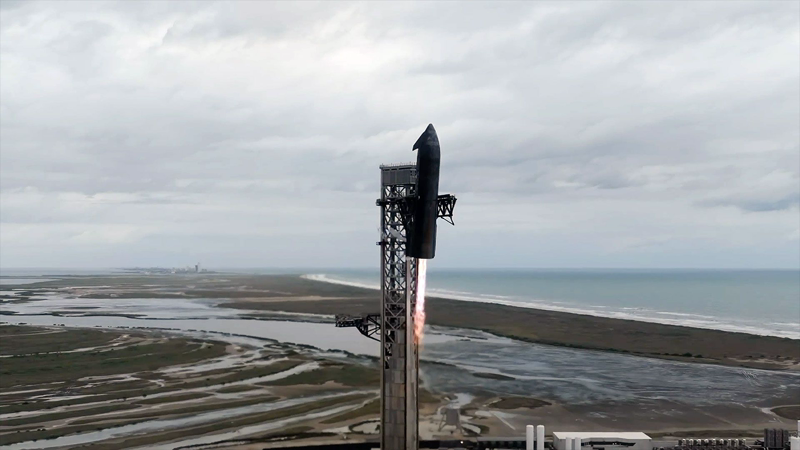
Ship 42 held upright between the arms of Orbital Launch Tower 2 at Starbase, the landing burn still burning beneath the vehicle as the catch completes on 14 November 2026.

The upper stage settles into the tower arms after its first return from orbit.


At 3:20 in the afternoon, Texas time, on Saturday, a Starship came down through the overcast above Boca Chica and stopped. It did not settle onto a drone ship or splash into the ocean. It hung there instead, upright between the two steel arms of the launch tower it had left a day earlier, its landing engine still lit as the arms closed around the vehicle. Ship 42 had been in orbit for 22 hours and 32 minutes by then, and no one had ever done what it had just done. SpaceX’s own reaction, posted on X, began: “Mechazilla catches Starship!” Dan Huot, the company’s spokesperson, was less restrained on the landing webcast. “That was the missing link,” he said, calling the maneuver “the holy grail of spaceflight.” He described what the vehicle had just done as “plummeting through fire to be snatched out of the air by steel,” and added that “We caught a Starship, and now everything changes.” Jessie Anderson, another of the company’s presenters, called it one of the most incredible and historic engineering feats of all time, and a good number of employees had gone outside to watch. The broadcast soundtrack was “Baby Come Back.”

The upper stage has always been the hard half of this problem. SpaceX has caught Super Heavy boosters three times before, on flights 5, 7 and 8, the most recent in March 2025. A booster comes home from a few kilometres up at speeds the tower arms can handle. A ship that has been to orbit comes home from orbital velocity, with a heat shield that has to survive the trip and a shape steady enough for a tower arm to find. Every Starship before Ship 42 ended in the ocean or was destroyed on the way down. The comparison is with Falcon 9, which lands its booster on almost every flight and throws its second stage away every time. Catching Ship 42 does not by itself make the economics work, but it removes the objection that the top half of the vehicle is a consumable. That matters for Starlink V3 satellites, each expected to carry about ten times the download capacity of a V2 Mini, for a network that already has more than 11,000 satellites in it. Starmind, the orbital data centre network Musk has described as a million spacecraft, matters more. NASA has its own stake in it, because Starship is the Artemis lunar lander and reaching the Moon means refilling ships in orbit with tanker flights, which means vehicles that can fly again soon. Morgan Stanley’s Adam Jonas wrote before the flight that a catch of both stages would probably be “a material positive” for SpaceX stock.

The flight itself began the way these things now do, with paperwork arriving late and a regulator saying go in the afternoon. The FAA issued Revision 10 of the launch licence on the day itself, hours before the window opened, explicitly covering both the booster catch and a ship return that overflies populated ground. Liftoff came at 22:47 UTC on 13 November from Pad 2 at Starbase, during a nationwide ground stop issued by the FAA that afternoon, CNN reported. Ship 42 inserted itself into a 276 by 278 kilometre orbit and spent the next twenty-one hours coasting through fourteen revolutions, moving at about 26,442 km per hour. The payload went out through the door: 26 Starlink V3 satellites over roughly 42 minutes, three of them carrying cameras pointed back at the ship so that the heat shield could be inspected from orbit. Ground cameras and satellite imagery together convinced flight controllers the tiles were in good shape. Three return checks were built into the flight plan, one over Hawaii an hour and a half in, one off Chile around the seven-hour mark and a final one over Hawaii near the twenty-hour mark, each one a point where the ship could have been told to ditch in pre-cleared water instead of coming home. All three passed. A ten-second single-engine deorbit burn at T+21:35 put it on a path out over the Pacific and around the Gulf, using its flaps to steer clear of populated areas of northern Mexico and southern Texas. Entry came at T+22:10, the vehicle went transonic at T+22:29 and subsonic a half-minute later, and the landing burn started at T+22:32:16. The flip followed two seconds after that, three engines dropped to two and then to one, and the burn shut down at T+22:32:28 as the arms took the weight. The published flight plan also had the ship banking on final approach rather than flying straight in, and the final go call came with only two minutes to spare before contact.

The other half of Flight 15 did not go the same way, and the explanation took most of Saturday to settle. Super Heavy 22 was the first Block 3 booster to attempt a return to the tower, and it aborted itself. Its boostback burn started 32 of 33 engines successfully, the landing burn ran from T+06:10 to T+06:35, and then guidance decided it was not in the right position to be caught and turned the vehicle out to sea. Kate Tice said the early indications were that the booster had ended its boostback burn early on a low fuel mass alarm, and that its guidance then detected it was out of position and diverted it to an offshore water landing. Dan Huot, who had first described the abort as a guidance, navigation and control problem, walked that back on Saturday and said the system had performed as expected. The vehicle hovered over the Gulf with its engines down before the flight termination system took it out shortly before the water. Musk, who has been more forthcoming about hardware than his engineers, put it down to the engines themselves. They underperformed slightly, he wrote, and the fix is better consistency from Raptor V3.2 plus a flight software change to cut the engines “about one second earlier” so enough propellant survives for the trip home. The booster loss, he added, does not change SpaceX’s timeline for high-volume fully reusable flights. The investigation is still open, which is worth remembering when the celebratory photographs start circulating.

A catch does not make a vehicle fly again. Ship 42 now sits at Pad 2 where it landed, and it has to be inspected, refurbished and refuelled before anyone knows how long the turnaround actually is. SpaceX has said that returning both stages to the launch site is what speeds up inspection and refurbishment, which is the point. No caught Starship has yet flown a second time, and the number of days on the ground between flights remains the open variable behind Musk’s claim of a weekly launch cadence in the first half of 2027. The next test will presumably try to catch both stages at once, which has not been done since the block of hardware changed. The booster side of that is still unfinished: no Block 3 Super Heavy has ever been caught. The programme is also spreading. SpaceX expects to start launching Starships from Kennedy Space Center within a few months, and NASA has restructured Artemis so that next year’s flight is a docking demonstration in Earth orbit with Orion and Blue Origin’s Blue Moon, pushing the crewed landing to Artemis IV as early as 2028. There is a footnote in the vehicle’s name, too. Ship 42 is 42 for the same reason it carries a “Don’t Panic” inscription, both references to Douglas Adams, and one of the heat shield tiles on this flight was installed and signed by the YouTube streamer MrBeast. The ship that flew furthest and was caught by a tower was also a piece of SpaceX’s outreach. Whether it gets back on a pad is the next thing to find out.
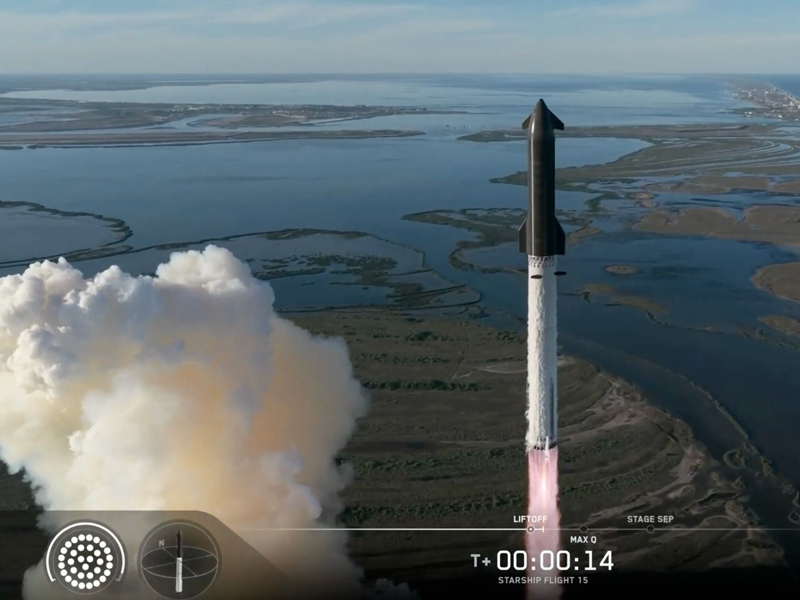


Starship climbing away from the Starbase launch pad on 13 November 2026, the flight computer overlay showing liftoff and the staging timeline.

Flight 15 clears the tower with the vehicle’s own telemetry laid over the image.


Friday night, for the first time, SpaceX tried to bring both halves of an orbital rocket home with the mechanical arms of a launch tower. About six and a half minutes after Starship lifted off from Starbase in South Texas, the catch was called off with the booster already on its way back to the tower it had just left. Super Heavy Booster 22 was falling back, engines lit, when the order came through to divert it into the Gulf of Mexico instead of a catch between the arms. The booster splashed down, and the double catch became a single catch: Ship 42 kept climbing, reached orbit, and is now on the first day of a coast that ends with a return to the same tower at about 21:20 UTC on Saturday. SpaceX’s own account of the decision ran to one sentence, posted a couple of minutes later: Super Heavy has diverted to an offshore splashdown in the Gulf. No cause was given. Dan Huot, the company’s spokesperson, said only that the team would dig into what caused the abort during the booster’s flight back to the tower.

A wave-off is not a failure, and SpaceX has one built into the flight plan on purpose. Every booster that flies carries the option of returning to the tower or coming down in the water, and that second option has already saved a vehicle once. On Flight 6 in November 2024 the tower took damage during liftoff and the booster was diverted to an ocean splashdown instead of attempting a catch on hardware that might have been damaged. The company had caught three Super Heavy boosters before Flight 15, all of them first generation vehicles, and had reflown two of them. It had never caught an upper stage. Flight 15 was the first attempt at a Block 3 booster return, and Block 3 has a poor record so far: the boosters on Flights 12 and 13 were both lost during landing attempts, and on Flight 14 the company skipped the catch entirely and put Booster 21 down in the Gulf. The half of the double catch that did not happen was also the harder half to pull off, on a booster generation that had never been caught.

Flight 15 lifted off at 22:47 UTC on Friday, two minutes into a 75 minute window, pushing more than 18 million pounds of thrust from 33 Raptor 3 engines. The stack passed Max Q a minute in, shut down most of those engines a little after two minutes, and left Ship 42’s own engines to take over the push, clearing the upper stage in the hot staging that follows. One booster engine failed to relight for the boostback burn, which the flight record scores as a partial success. The booster was still tracking back toward Starbase when the catch was called off. Long range cameras caught the Super Heavy coming down under a shroud of steam, then in a fireball as residual propellant ignited, and the vehicle made a controlled splashdown off the Texas coast. The ship had its own longer day ahead of it. It shut its six engines down a little over eight minutes in and coasted on a suborbital trajectory while controllers checked it over. At the 26 minute mark it fired a single Raptor for about 20 seconds, enough to push itself into a 275 km orbit, the second orbit Starship has ever reached. Starlink deployment began at the 35 minute mark and ran for roughly 40 minutes, and by early Saturday SpaceX confirmed that all 26 Starlink V3 satellites were in orbit. Each one adds a terabit of capacity according to SpaceX’s own mission outline, so the batch is worth about ten Falcon 9 flights of V2 Mini satellites, and the ship has roughly 21 hours of coasting ahead of it before a deorbit burn.

The most interesting engineering on Flight 15 is hidden in the payload. Three of the 26 Starlink V3s flying on Ship 42 carry cameras, and during deployment the ship rotates slowly so one of those satellites can turn around and photograph the heat shield tiles on the upper stage’s belly. Those images decide whether the ship gets to come home at all. SpaceX has said this flight’s tiles carry extra retention hardware in the areas most likely to shed during ascent, that it has closed some of the flow paths where plasma could slip behind the tiles, and that a large part of the shield now uses a curved tile design that has shown lower heating in the gaps between tiles. One of the tiles was installed by Mr. Beast, the YouTube streamer, which says something about how the programme now reaches an audience well beyond the launch site. Whatever the cameras find, the ship does not get to argue with it.

The catch itself is mechanical and unforgiving. The booster comes home on three engines, and the arms close below it. The ship has to come home at orbital speed, survive reentry on the same heat shield, then flip from a belly first attitude to tail first in the seconds before the landing burn. The published timeline puts the landing burn at 22 minutes and 32 seconds after liftoff, with three engines dropping to two and then one as the vehicle descends between the arms. Three checkpoints sit between orbit and the deorbit burn: one over Hawaii about an hour and a half in, one off Chile near the middle of the coast, and a last one over Hawaii roughly twenty hours after launch. Miss any of them and the ship comes down in a pre-cleared zone instead, with the Gulf held open for a late reentry failure. The FAA licence issued on launch day covers the return of both stages, including the ship’s flight back over populated areas.

Saturday’s real test is the ship, which has to survive reentry and hit a tower that has never caught anything larger than a booster, at about 21:20 UTC, a little over 22 hours after liftoff. The other thing worth watching is what SpaceX eventually says about Friday. The company’s record on booster aborts mixes hardware trouble, such as the tower damage on Flight 6 and the engine failures on Flights 12 and 13, with deliberate go or no-go calls. An automatic abort that fires without a published explanation is a reasonable thing to be sceptical about on a vehicle generation whose boosters have never been caught. Booster 22 came down in the Gulf instead, which is the cheap outcome. The expensive one is still ahead, and it is the part nobody has done before.


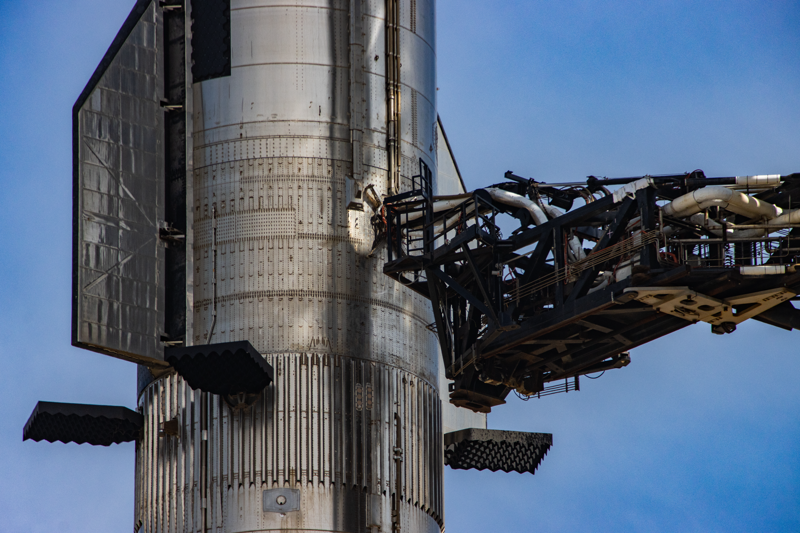
Close view of a stainless steel Starship stage at Starbase, with the launch tower's black quick disconnect arm and its insulated cryogenic piping reaching in from the right (Wikimedia Commons, CC BY-SA 4.0)

The quick disconnect arm is the fitting that practice refuelings are rehearsed with, the same class of hardware a fleet of V4 tankers would need on orbit.


Late on Friday night, Elon Musk posted a single sentence about the next version of Starship on X, and it was about how tempting it would be to fit a 500-ton-thrust Raptor 4 into the booster’s outer ring, replacing the Raptor 3 that sits there now. It came with no schedule and no commitment. Underneath that musing sits Starship’s next major upgrade. V4 is the version due to fly in 2027, and it is the version the Artemis IV architecture rests on, whether or not anyone at the agency has put it in those words.

The arithmetic behind that is not complicated. A crewed lunar landing needs a depot in low Earth orbit, and one recent model of that fill puts it at roughly 1,200 tonnes of propellant. Tankers have to supply it. At the 100 tonnes per tanker used in that model, that takes about twelve flights. Musk has been saying that six to eight will do, and the reason his number is smaller is that he is counting on a different rocket. Divide the same 1,200 tonnes by the 200 tonnes that a V4 tanker is projected to carry and you land on six, which is close to the figure he has been using. The lower manifest rests on a fleet of V4 ships and V4 boosters flying V4 Raptors, plus close to zero boiloff while the depot sits in orbit for weeks. NASA’s own safety advisory panel is working from 22 flights instead. That count is built on the capabilities of the rocket that exists today and on thin data about how fast cryogenic methane and oxygen leak away from an unshielded tank in sunlight. An analysis of the boiloff problem puts both numbers side by side. Both are in circulation, and the gap between them comes down to which of the two versions of Starship you are counting on.

Getting to V4 means getting through V3, which is where the programme stands. Flight 14 on September 28 was the first Starship to reach orbit, and it deployed 26 Starlink V3 satellites on the way up. It did not finish as planned. An early engine shutdown, which Musk attributed to a fault in the engines’ flight software, forced an early return, and both stages ended up in the ocean rather than on the tower. Flight 15, the next attempt, is the one the reuse case depends on, and SpaceX is targeting Friday November 13. Kiko Dontchev, the company’s vice president of launch, gave that date at the UP.Summit. That made it the first target to come straight from a SpaceX executive rather than from air traffic planning slides. The mission plan is a dual catch. The Super Heavy booster returns to the launch tower, as it has done three times already, and then the Ship comes home from orbital velocity and gets caught by the same arms, which has never been attempted. Booster 22 fired all 33 of its Raptors for a full-duration static fire on October 25. Ship 42 followed with a single-engine burn on October 26 and a 60-second firing of all six engines on October 27. The hardware is ready. The Federal Aviation Administration has not yet published a Flight 15 licence, and Gwynne Shotwell has said she expects it to cover a return to the launch site and tower catches for both stages. Teslarati has the details.

The vehicle on that pad is a V3, and the changes SpaceX described for V3 show how the company works from one version to the next. Propulsion was reworked around Raptor 3, a higher-flowing engine that now sits on both stages. The Ship carries new docking adapters, which are the fittings a future propellant transfer needs. The booster’s fuel transfer tube, the large metallic structure that runs cryogenic methane and liquid oxygen down to the engines, was redesigned. Super Heavy picked up an integrated hot stage, more vent area, and three grid fins in place of four, each half again as large and strong enough for lifting and catching the vehicle. V4 continues that logic rather than replacing it. Wikipedia’s Starship entry now lists Block 4 at an estimated 142 metres, or 466 feet, against 124.4 metres for Block 3, with payload to low Earth orbit of an estimated 200 tonnes against 100. Thirty-nine Raptors fly today, 33 on the booster and six on the Ship; V4 stretches the Ship and takes the count to 42, and is expected to debut in 2027.

The engine is where the performance comes from, and the Raptor line has bought thrust without buying mass at every step. Raptor 1 delivered 185 metric tons of thrust on an engine weighing about 2,080 kilograms. Raptor 2 raised that to 230 tons while cutting the mass to roughly 1,630 kilograms. Raptor 3 is flight-rated at 250 tons at sea level and 275 tons in vacuum, with the engine mass down to 1,525 kilograms and a stated target of 280 tons. The thrust-to-weight ratio of the family has climbed from 88.9 to 141.1 to 163.9. In late October Musk said Raptor 4 should reach 300 tons at sea level at roughly the mass of Raptor 3. Thirty-three engines at that rating would amount to about 9,900 tons of liftoff thrust, close to three times what the Saturn V produced from its five F-1 engines. Wikipedia tracks the engine’s history and Teslarati covers the Raptor 4 target. Sea-level thrust is the number that matters. The stack is heaviest and still deep in the gravity well at the moment it leaves the pad, where every extra second of climbing spends propellant against gravity rather than against orbit. The booster’s engine count is fixed by its 9-metre diameter and by how densely the engines pack around it, so thrust per engine is the cheapest way to raise liftoff performance without redesigning the booster. That is the logic behind the outer ring in Musk’s post. Whether a 500-ton engine ever reaches the pad is a separate question from the direction of travel.

What to watch is dated and physical. The first tells are the licence that authorises Flight 15 on November 13 and whether the Ship comes home from orbit and gets caught by the tower. The deeper tell is whether SpaceX can hold the Raptor 4 promise of 300 tons at Raptor 3’s mass, since every tanker flight saved in the Artemis manifest is paid for by engine performance. If the 500-ton outer-ring engine stays a musing, the six-flight manifest stays a target rather than a plan, and V4 still arrives as a 142-metre stack with 42 Raptors and roughly twice the payload of the vehicle flying today. The Flight 15 licence is still unpublished, and no Starship upper stage has ever been caught.


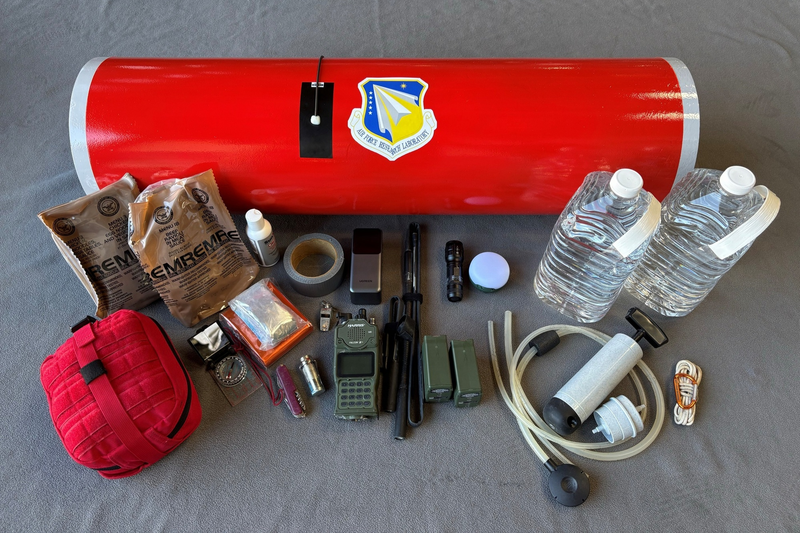
An orange Air Force Research Laboratory agile cargo pod laid out with the survival gear it carried on the Starfall flight, including ration boxes, water, a radio, batteries and a tracker (U.S. Air Force Research Laboratory, courtesy SpaceX)


At 7:04 a.m. Eastern on 20 October 2026, a Falcon 9 lifted off from Space Launch Complex 40 at Cape Canaveral Space Force Station carrying more than thirty small satellites and one squat, uncrewed cylinder. The cylinder was a Starfall reentry capsule, and it belonged to the Air Force. Inside sat orange cargo pods holding the sort of gear you would want if the supply chain stopped working: military ration boxes, water, batteries, a hand-crank radio, a flashlight, a GPS tracker and a satellite beacon. The pods rode as a passenger on a commercial rideshare mission called Bandwagon-5, and when the capsule came back down in the Pacific a few weeks later, engineers would crack them open and see what the ride had done to the contents (AFRL, 20 October 2026; Air & Space Forces Magazine, 26 October 2026).

For five years the Air Force Research Laboratory has been trying to make a strange proposition look obvious: that the fastest way to move freight to a place with no runway is to put it in orbit first. The program, Rocket Cargo, began in 2021 with a fact sheet that set out the doctrine plainly. The lab would not build rockets. It would “leverage commercial rocket capabilities as a leased service,” and its stated goal was “up to 100 tons of cargo to be delivered anywhere on the planet within tactical timelines” (AFRL Rocket Cargo fact sheet AFRL-2021-1732, June 2021). SpaceX took the first contract in 2022, five years and $102 million (Air & Space Forces Magazine, 26 October 2026). AFRL now works with Blue Origin, Rocket Lab, Sierra Space, Anduril, Inversion Space and Outpost Space alongside SpaceX (AFRL, 20 October 2026).

What came back out of the Pacific was an experiment rather than a delivery. The pods splashed down inside the capsule and were recovered, each carrying sensors that logged temperature, shock and vibration through launch, a spell in orbit and a controlled reentry (AFRL on X, 26 October 2026). The lab also fitted a UNI-PAC III life raft inside the capsule to see how it fits, in preparation for carrying one on later flights. “Any day you launch a rocket is a good day, but today was more than just another big rocket launch,” said Brig. Gen. Douglas P. Wickert, who commands AFRL and serves as the Air Force’s technology executive officer (AFRL, 20 October 2026).

Starfall is new hardware, but the machinery around it is not. The Federal Aviation Administration’s May 2026 environmental assessment for the vehicle describes a squat cylinder about 0.75 metres tall and 3.1 metres across, with an empty mass near 2,100 kilograms, room for roughly 1,000 kilograms of payload, and a maximum reentry mass around 3,100 kilograms (FAA Final Environmental Assessment, May 2026, as summarized by Gunter’s Space Page). It has no propulsion of its own, survives the trip down under parachutes, and settles in the water roughly 700 nautical miles west of the United States coast, in international waters outside the economic zones of both the United States and Mexico. The FAA’s licence modification covers reentry of two such vehicles: a licence for two flights rather than for a fleet.

This is where the engineering gets interesting, because point-to-point cargo has to solve two problems at once: leaving orbit without cooking itself, and coming back with enough of its payload still working. The deorbit is unglamorous arithmetic. To drop from a circular orbit of radius r_a down to a perigee of r_p, the minimum retrograde burn is Δv = v_c * (1 - sqrt(1 - e)), where v_c = sqrt(mu / r_a) and the eccentricity of the new orbit is e = (r_a - r_p) / (r_a + r_p). From a 400-kilometre orbit, something like 90 to 120 metres per second buys a perigee low enough for the atmosphere to finish the job. That is a trivial amount of propellant, which is why the rocket is the expensive part of this system and the capsule is the cheap part.

Heat is the harder problem, and the numbers get worse fast. Convective heating on a blunt-body reentry goes roughly as q = k * sqrt(rho / R_n) * v^3, with rho the atmospheric density at the peak-heating point, R_n the nose radius and v the entry speed. The velocity term is cubed, so a vehicle that sheds a little speed early pays for it many times over. Low Earth orbit entry runs near 7.7 km/s. A lunar trajectory arrives at about 11 km/s, and the heating rate climbs with the cube. The work-around is a blunt forebody that stands off a detached bow shock, pushing the heat away from the vehicle, combined with an ablative shield that chars and erodes away, carrying the energy with it. SpaceX has already flown that trick at scale: Dragon’s forebody shield uses PICA-X, a phenolic-impregnated carbon ablator developed at NASA Ames from the material first flown on the Stardust sample-return capsule in 2006 (NASA Ames). Starfall’s own shield has not been published, so the physics of entry is well understood while the vehicle’s performance envelope is not.

What the lab was actually measuring decides whether any of this survives contact with commerce. Cargo is not a satellite. It is a wrench, a water purifier, a blood bag, a radio that has to work when nothing else does. The lab’s list of monitored items is a list of things with electronics and moving parts that do not forgive heat, shock or vibration: a reverse osmosis desalinator, batteries, a satellite-communications tracker, emergency medical equipment. A capsule that arrives intact but shakes a desalinator into scrap has not solved point-to-point delivery. The pods are a payload wrapped inside a payload.

The ride itself is what quietly changed. Bandwagon-5 launched more than thirty separate spacecraft for paying customers alongside the Air Force’s capsule (Gunter’s Space Page, 20 October 2026). The capsule did not buy a rocket; it bought a seat on someone else’s rocket. AFRL’s fact sheet was explicit that the program would not fund rocket development, only lease it, and a rideshare manifest is exactly that kind of lease. It divides the most expensive minute in the program, the launch, across three dozen customers, and leaves the reentry capsule as the only genuinely reusable piece of the chain. Drag the capsule’s cost per kilogram down far enough and the arithmetic stops looking like airlift.

The bottleneck is no longer hardware. It is airspace, and the paperwork. On 17 September 2026 the FAA released a draft programmatic environmental assessment that would streamline licensing for up to 70 capsule reentries a year in the Pacific, 22 in the Gulf of America and 10 in the Atlantic (FAA, 17 September 2026). Reentry has become a traffic problem, and traffic needs rules, airspace closures and a coast guard on the line. That paperwork moves slower than a rocket, and it now stands between a demonstration and a service.

Expect more of this rather than less. Starfall’s first demonstration flight in June 2026 was a vehicle test with no Air Force payload aboard; the October flight carried the cargo pods and the life raft, and the next round will carry more of both (Gunter’s Space Page; AFRL, 20 October 2026). At some point in that sequence the capsule stops being a capsule and becomes a truck. The version of this story that matters is the dull one: a pod comes down in the Pacific every week, gets unloaded by a machine onto a barge, and goes inland by road. The interesting part was always the question of who pays for the rocket.


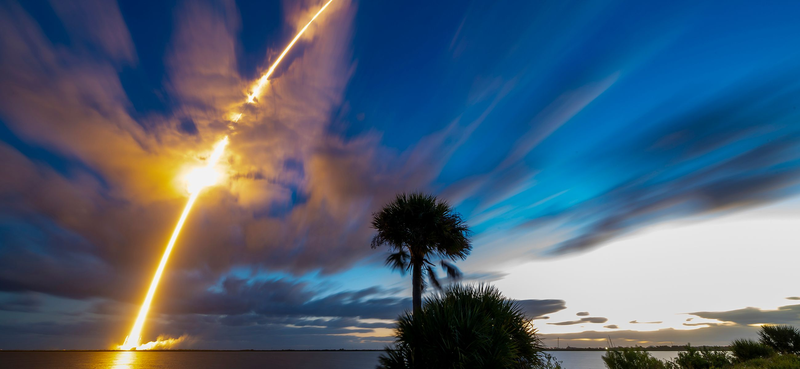
A long-exposure photograph of a SpaceX Falcon 9 climbing through the pre-dawn sky from Cape Canaveral, the exhaust plume forming a bright diagonal streak through scattered cloud above silhouetted palm trees. Source: SpaceX, via the Bandwagon-5 mission page. Full-size file: https://sxcontent9668.azureedge.us/cms-assets/assets/20261020_CC_Band_5_DSC_0759_desktop_81035d0e4c.jpg


At 7:04 a.m. EDT on Tuesday, October 20, a Falcon 9 lifted off from Space Launch Complex 40 at Cape Canaveral carrying 32 payloads. The one that mattered most to the company flying it was its own hardware. Starfall, a broad, uncrewed reentry capsule, went up for the second time in its life and left the rocket last, separating from the second stage two hours and 48 minutes after liftoff, once the commercial satellites were gone (Space.com). By 8:45 a.m. EDT SpaceX had confirmed every customer payload was deployed (Spaceflight Now). What the company did not say, and has not said since, is what Starfall carried, how long it stayed up, or what happened on the way down. The same company that publishes booster flight counts to the digit has treated this vehicle with the discretion usually reserved for something it does not want competitors reading.

The most detailed public description of the capsule is not a SpaceX document. It is the environmental assessment the company filed with the Federal Aviation Administration in May to get permission for the flight, and that document treats Starfall as infrastructure rather than as a spacecraft demonstration. The filing gives two reasons for the program: moving urgent cargo point to point, and building an orbital manufacturing economy by selling time in microgravity and vacuum with a ride home, what the assessment calls safe return from orbit as a service at scale. Each unit is a short cylinder about 0.75 meters tall and 3.1 meters across, roughly 2,100 kilograms empty, rated to carry 1,000 kilograms of payload down to the surface, for about 3,100 kilograms with a load aboard. A graphic shown in SpaceX’s initial public offering roadshow material appears to depict a satellite bus with slots for as many as four capsules, labelled for manufacturing in orbit (Spaceflight Now on the June debut). Whether that bus ever flies is a different question from whether the capsules do. The permission itself is small: the assessment covers two reentries into a Pacific recovery zone, which means the flights that have happened are the entire scope of what SpaceX currently has authorization for. A service business needs a licensing footprint built well ahead of the first customer invoice, and there is no public sign of that footprint yet.

The manner of the June debut is the best explanation for the current reticence. SpaceX kept the payload off the public manifest until close to flight, shared a rendering rather than hardware photography, and cut its public timeline after the booster landing so that neither the upper stage nor the capsule appeared in the broadcast. When deployment was confirmed that morning, the company had not disclosed how many capsules were aboard. On October 20 the capsule again rode to orbit among dozens of unrelated smallsats, again last to separate, again without a stated payload. Two flights in, the public record describes the vehicle’s architecture in detail and its missions not at all.

The ride itself was routine by SpaceX standards and the manifest was not. The launch had been scrubbed the previous morning over weather in the booster recovery zone, and the 45th Weather Squadron gave the Tuesday window a 90 percent chance of acceptable conditions. The rocket flew southeast, and booster B1085, on its nineteenth flight, came down on the droneship A Shortfall of Gravitas about nine minutes after liftoff. Twenty of the thirty-one commercial payloads were manifested by Exolaunch, among them four radio-frequency monitoring satellites for HawkEye 360, four communications satellites for the Finnish firm Iceye, and six navigation satellites for Xona Space Systems. Planet flew an Earth-observation satellite called Pelican-12. Portal Space Systems used the ride to demonstrate Starburst-1, a 260 kg spacecraft with room for a 50 kg customer payload, with commercial flights advertised from 2027, a mix the company describes on its Bandwagon-5 mission page as cubesats and microsats (Spaceflight Now).

The most interesting neighbor on that manifest was Varda’s W-Series 7 capsule, about three times smaller than Starfall, carrying a cancer drug called Protac to test whether microgravity produces crystal forms with better solubility. The flight was Varda’s ninth capsule launched despite the number in its name, following W-8 and W-9 on the Transporter-18 mission earlier in October. Two returning capsules on one rocket, one of them operated by a startup that has been doing this routinely while SpaceX works quietly on its own, tells you something about where the industry actually sits. Bandwagon is the quieter of SpaceX’s two rideshare programs. Transporter has flown eighteen missions, and the first in January 2021 delivered 143 payloads in a single launch, a record that still stands.

The design is where the vehicle stops looking like a spacecraft and starts looking like a product, and the constraints live there too. According to the FAA assessment, Starfall carries no main propulsion system. It has an attitude control system that uses inert gas to orient the craft, which means it can point itself but cannot perform a deorbit burn, so it cannot shorten its own stay in orbit or choose where it comes down (Spaceflight Now). With no engine to light, the only brake available is atmosphere, which makes the capsule’s blunt shape less a styling choice than the thing that lets it survive the trip: a wide body presents a lot of area to slowing air, and the assessment notes the capsules can fly either a low Earth orbit or a suborbital profile, on a Falcon 9 or on Starship. Orbital energy sets the heat load, so the shape that handles the steepest possible reentry is the one that can also handle the shallowest. The capsule is built in two pieces that separate after reentry: an aluminum top plate partially wrapped in thermal protection material, about 1,400 kilograms, and a carbon-fiber heat shield of roughly 700 kilograms holding two large compressed nitrogen bottles of 151 liters each plus several smaller auxiliary bottles. Lifting the top plate exposes the parachute, and there are three of them, a drogue, a pilot and a main, attached at four reinforced points. Recovery happens in the Pacific, the same ocean used for Dragon. The June flight reportedly validated the capsule’s autonomous guidance before a targeted splashdown (SatNews).

Two flights is a test program, not a service. What SpaceX has not established is the cadence, the price, or whether any paying customer has boarded, and the absence of a named payload on the second flight suggests the answer to the last question is still no. The competitors are not standing still: Varda has flown nine capsules and is running pharmaceutical experiments on them, and Portal is building a vehicle that does the same orbital delivery job for small payloads. What would move Starfall from demonstration to business is not a third flight but the paperwork that follows one, since the current authorization covers exactly two reentries. Until SpaceX files for more and names a customer, the accurate description of the capsule is the one the company keeps declining to give.


A Falcon Heavy rocket climbs off Launch Complex 39A at night, its 27-engine plume glowing bright orange against the dark Florida sky and reflecting off the water beside the pad.


A Falcon Heavy lifted off from Launch Complex 39A at NASA’s Kennedy Space Center at 11:54 p.m. EDT on Thursday, October 1, 2026 (0354 UTC on October 2), carrying the NROL-97 mission into orbit for the National Reconnaissance Office, the U.S. agency that builds and operates the country’s spy satellites. It was the first time the NRO has flown a payload on Falcon Heavy rather than on a single-stick Falcon 9, and it was the first national-security mission procured under the National Security Space Launch Phase 3 Lane 2 contract that the U.S. Space Force awarded in 2025.

The mission was the third SpaceX launch in a thirteen-hour stretch that also saw a Falcon 9 carry the Crew-13 astronauts to the International Space Station from the Cape at 11:10 a.m. ET and another Falcon 9 send 130 smallsat payloads into sun-synchronous orbit on the Transporter-18 rideshare from Vandenberg at 11:32 a.m. PT, per Spaceflight Now’s launch report. The triple-header ended with four booster landings inside a single calendar, the first time SpaceX has brought that many first stages back in twenty-four hours.

Falcon Heavy is the three-booster variant of the Falcon 9: a single core stage flanked by two strap-on boosters that are themselves flight-proven Falcon 9 first stages. Twenty-seven Merlin 1D engines fire at liftoff, producing roughly 22,800 kilonewtons of thrust, and the side boosters separate from the core about two and a quarter minutes into flight before flipping, boosting back toward Cape Canaveral, and returning to land. The Heavy flew for the first time in February 2018, made its second flight in April 2019 carrying the Arabsat-6A satellite, and reached its fourteenth flight on the NROL-97 mission, according to the SpaceX official NROL-97 mission page and the launch archive.

The two side boosters that flew NROL-97 had both flown before. The NRO mission reused them just a month after their last flight, which lofted NASA’s Nancy Grace Roman Space Telescope to L2 in early September 2026. B1104 made its second flight and B1072 its fourth. The new core stage, B1106, was brand new and was expended on the NROL-97 mission; the trajectory required the core to do a disposal burn that did not bring it back to a landing site. After stage separation, the side boosters made their way back. Both returned to Landing Zones 1 and 2 at Cape Canaveral Space Force Station, and the landings produced the audible sonic booms that anyone in central Florida heard three minutes before midnight local time. SpaceX had returned LZ-1 to service for this mission after that pad had been replaced for a stretch of LZs at Space Launch Complex 40, and the SLC-40 landing pad was used earlier in the day by the booster returning from the Crew-13 mission.

Little about the payload itself is public, which is the standard posture for NRO missions. The NRO rarely publishes technical details beyond launch and landing confirmations, and the live SpaceX broadcast carried only the standard hazard area and trajectory notes. It was the first NRO mission to launch under the new procurement structure the agency adopted. The agency bought the launch in 2025 through the competitive NSSL Phase 3 Lane 2 process, and that contract structure is the mechanism the U.S. Space Force uses to buy launches for the majority of its national-security payloads. Lane 2 covers the medium-to-heavy class of missions for which Falcon Heavy is now the baseline ride. ULA’s Vulcan rocket and Blue Origin’s New Glenn are the other Lane 2 providers, and the contract split is the reason Falcon Heavy (rather than first-class Vulcan) flew this payload.

The payload fairing had flown before as well. SpaceX and the NRO confirmed the fairing was previously used on the NROL-95 mission in July, another example of the steady refurbishment and reuse pattern that SpaceX has applied across the Falcon 9 fleet and is now extending into the more delicate fairing hardware. The cost model on a mission like NROL-97 is unusual for the agency context, because the contract is fixed-price rather than cost-plus: the U.S. Space Force’s published Lane 2 task order values run into the hundreds of millions of dollars per mission, with Falcon Heavy missions priced in the $97 million range per the NextSpaceflight launch entry, although the actual NRO contract value has not been disclosed for NROL-97 specifically. The economic argument for the NRO in choosing Falcon Heavy over the alternatives is the standard one in the launch market right now: it is the cheapest heavy-lift rocket that already has a flight history, and the side boosters are reused flight-proven hardware that has already amortized its development cost.

The mission is the third Falcon Heavy launch of 2026, which is shaping up to be a relatively slow year for the rocket compared to 2024 and 2025, both of which saw the vehicle fly close to a head-to-head cadence with the rest of the Falcon fleet. The pace has been limited by payload availability more than by launch capability; the heavy-lift market is dominated by geostationary communications satellites, NASA flagship missions like Roman and Europa Clipper, and a small number of national-security payloads, and there are simply not that many of those missions in any given year. Looking at SpaceX’s published manifest for the rest of 2026 and the early months of 2027, the company has only a couple more Falcon Heavy launches booked in that window [unverified], which would put the rocket on track for one of its quietest years since 2021 so far. The NROL-97 mission is the kind of flight Falcon Heavy exists to handle, and the fact that it was the NRO’s first choice of the rocket suggests that 2027 and 2028 will see the cadence pick up further as the Lane 2 contract awardees ramp their flight rates.

The triple-header that ended with NROL-97 also gave SpaceX a small operational benchmark. Three Falcon-family launches inside thirteen hours, four booster recoveries, two different launch complexes (SLC-40 for Crew-13, LC-39A for NROL-97, and SLC-4E at Vandenberg for Transporter-18), and three different mission profiles (crewed, rideshare, classified heavy-lift), per the Space.com launch report. It was the operational shape of the Falcon program in late 2026, and it was the first NROL mission ever to ride on a Heavy rocket. The next national-security mission on the manifest is likely to be a Lane 1 contract (meaning a Vulcan or a National Rocket), unless the Space Force decides to push more Lane 2 weight onto Falcon Heavy next year. That decision will tell us whether NROL-97 was a one-off or a real sign of the future for the agency’s Falcon Heavy launcher.