OrbitalHub

Where curiosity reaches escape velocity.

Domain is for sale. $50,000,000.00 USD. Direct any inquiries to contact@orbitalhub.com.

Archive for the Launchers category


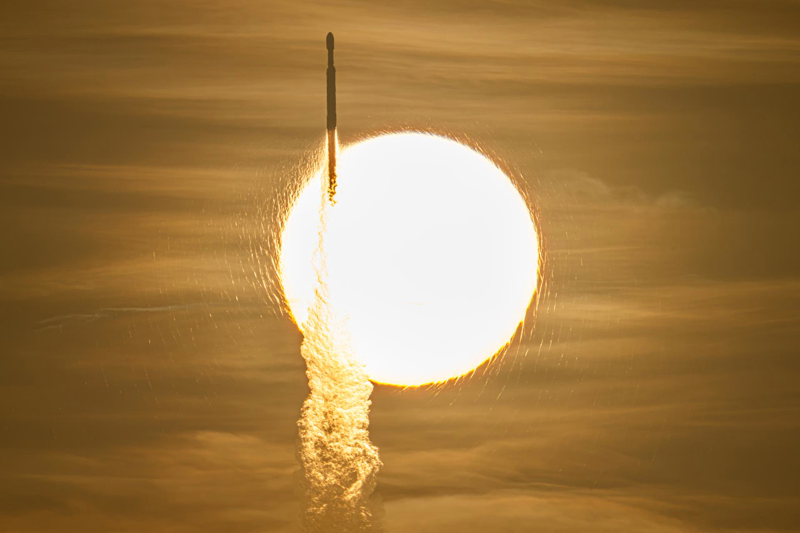
A SpaceX Falcon Heavy with NASA's Roman Space Telescope transiting the rising Sun, captured by photographer John Kraus during the August 30, 2026 launch from Kennedy Space Center Launch Complex 39A. (NASA/John Kraus source image)


A SpaceX Falcon Heavy climbed off Launch Complex 39A at 7:26 a.m. EDT on Sunday, August 30, 2026, with NASA’s Nancy Grace Roman Space Telescope pinned under its shroud. About seven minutes later, the ground team at Goddard Space Flight Center received the first telemetry, and 31 minutes after liftoff the second stage separated cleanly from the observatory. Photographers caught the moment the rocket transited the rising Sun (Figure 1), the exhaust plume drawing a line straight through the disk as the booster climbed through the morning sky over Kennedy Space Center. Roman is now on a three-month cruise to a halo orbit around the second Sun-Earth Lagrange point, about 1.5 million kilometers from Earth, where it will start a five-year infrared survey of the universe that NASA Administrator Jared Isaacman said was delivered “ahead of schedule and on budget”.

The launch marks the start of an observatory that has been on the astronomy community’s wish list since 2010. Roman will look for the same physics the Nancy Grace Roman mission was conceived to probe: dark energy, dark matter, and planets in other star systems. Three of the things it does best, drawing on a 2.4-meter primary mirror donated by the National Reconnaissance Office in 2012 and an infrared camera that the same NASA press release puts at 300 megapixels, have not been done by any previous space telescope in this combination.

The headline number is the field of view. Roman’s Wide Field Instrument images 0.28 square degrees per pointing, more than a hundred times the sky area Hubble’s cameras can capture in a single exposure. Roman is expected to survey the same area roughly a thousand times faster than Hubble, according to NASA’s press kit, which is what enables a five-year mission that returns 1.4 terabytes of data every day, a rate NASA calls the highest of any astrophysics mission. The WFI also runs 18 4K-scale infrared detectors, each about the size of a saltine cracker, which gives the instrument enough resolution to both find exoplanets via gravitational microlensing and map the same patches of deep field at multiple wavelengths.

The trade-off is one the Wide Field Infrared Survey Telescope (WFIRST) study teams accepted as long ago as 2012, when the National Reconnaissance Office offered two spare 2.4-meter reconnaissance telescopes to NASA. The optics have the same diameter as Hubble but a much shorter focal length, so the optical design supports a wide field of view, per the Wikipedia summary of the AFTA-era concept. That same optical design is what makes the coronagraph possible. The Coronagraph Instrument will demonstrate starlight suppression at the part-per-billion level, the kind of technology that a future Habitable Worlds Observatory would need to actually image Earth-like planets rather than infer them from transits.

The mission sits in a quiet but real moment for cosmology. The original WFIRST concept was the top recommendation of the National Research Council’s 2010 Decadal Survey, and Congress funded it across multiple administrations despite at least one cancellation attempt. The 2026-08-30 launch closes that arc.

Sunday’s countdown ran cleanly. The Falcon Heavy lifted off at 11:26:04 UTC from Pad 39A, per the Wikipedia entry’s launch parameters, separating the observatory 31 minutes into the flight. The ground controllers at Goddard received the first telemetry packet seven minutes after launch, and the booster recovery proceeded normally, with the two side boosters returning to the Cape for refurbishment. About an hour and 23 minutes after liftoff, the spacecraft confirmed that its solar panels and the lower instrument sun shade had deployed.

The Near Space Network’s ground stations and relay satellites carried the first part of the flight, and about 70 minutes in the Deep Space Network took over, picking up Roman’s signal first at the Canberra Deep Space Communication Complex in Australia and then handing off to Madrid and Goldstone, according to NASA’s August 30 press release. Roman’s high-gain antenna, the deployable aperture cover, the first mid-course correction and the Coronagraph Instrument’s power-on are queued up over the next several days. The Wide Field Instrument will activate a few weeks into the mission.

The mission is the fourth primary payload SpaceX has launched for NASA on a Falcon Heavy, according to the same release, and the agency moved the date up to fit the telescope’s early completion. After the in-space commissioning window, NASA expects the first science images in early 2027. The institute partners listed in the press release include the Space Telescope Science Institute (STScI) in Baltimore, NASA’s Jet Propulsion Laboratory, Caltech/IPAC in Pasadena, BAE Systems, L3Harris and Teledyne, with contributions from ESA, JAXA, the French CNES and the Max Planck Institute for Astronomy.

Roman shares most of its optical structure with an older mission. The 2.4-meter primary, the same diameter as Hubble’s, was originally built by Harris Corporation for a reconnaissance satellite and was offered to NASA in 2012 for the WFIRST-AFTA study. The optical design is a three-mirror anastigmat with an f/7.9 focal ratio and a wavelength range of 0.48 to 2.30 micrometers, spanning visible blue into near-infrared, per the Wikipedia infobox on the telescope. That range covers most of the light that escapes from distant galaxies, so a wide-field infrared survey has the same statistical power per square degree that Hubble got with smaller exposures.

The Wide Field Instrument is the instrument that actually does the survey. Its focal plane is a 4×4 array (with two corners intentionally blank) of 18 H4RG-10 mercury-cadmium-telluride detectors built by Teledyne, as described in the mission history. The detectors deliver 300.8 megapixels at 0.11 arcsecond resolution. The filter wheel carries eight science filters plus one wide band and two slitless spectroscopy elements (a grism and a prism), which means the same exposure can be used for photometry or for low-resolution spectra.

The Coronagraph Instrument is the new piece. It operates between 575 and 825 nanometers, with two deformable mirrors and a focal-plane mask to suppress starlight. The instrument targets a 1e-9 contrast ratio, the most aggressive starlight suppression NASA has flown, with the goal of imaging Jupiter-like planets at angular separations as small as 0.15 arcseconds from their host stars. The early-2010s orbit trade study left L2 as the eventual choice for thermal stability and a calmer radiation environment, per the mission history. Communications run over S-band for command and Ka-band for science downlink at 290 Mbit/s.

The first science images arrive in early 2027, after about three months of calibration and instrument commissioning at L2. Astronomers will get their first look at the three Core Community Surveys (the High-Latitude Wide-Area, High-Latitude Time-Domain, and Galactic Bulge Time-Domain Surveys), which were selected by the Roman Observatory Telescope Allocation Committee in April 2025. Citizen scientists and machine-learning pipelines will help triage the 1.4 terabyte per day stream that NASA expects once the mission is operational, since no human team can read that volume in real time.

NASA’s Roman team has set hard follow-up milestones: deployable aperture cover, high-gain antenna and the first mid-course correction are due in the first week; the Coronagraph Instrument’s power-on is the early-September checkpoint; the Wide Field Instrument activates a few weeks into the cruise. Watching those deployments land is the first thing to look for in the coming weeks, with first light as the second.
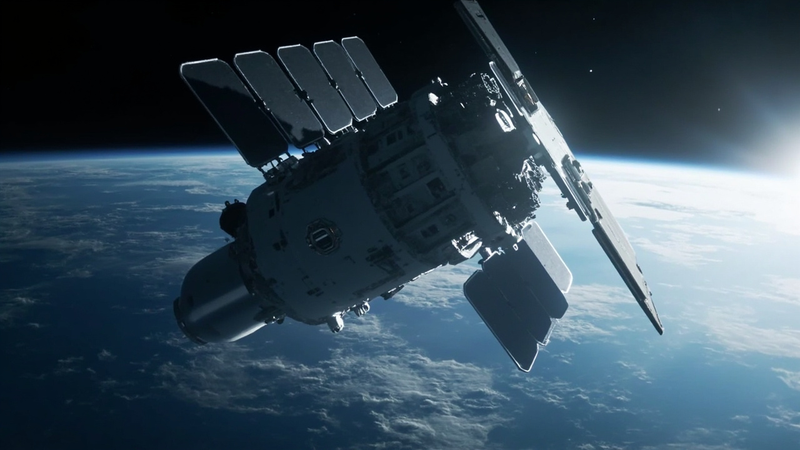


A boxy communications satellite carrying flat panel antennas and solar arrays flies above a cloud-covered Earth.


The launch looked ordinary. On July 16, 2026, at 1:32 p.m. Pacific, a Falcon 9 lifted off from Space Launch Complex 4E at Vandenberg Space Force Base carrying 21 identical flat-panel satellites. The first stage — booster B1103 on its fourth flight — flipped, glided back, and set down on the drone ship Of Course I Still Love You about 8.5 minutes later, logging SpaceX’s 639th successful booster recovery. Routine, until you remember that for nine months before that afternoon, no Tranche 1 satellite of any kind had flown.

The 21 satellites, built by York Space Systems, were the third batch of the U.S. Space Development Agency’s Tranche 1 Transport Layer. They joined 42 others already on orbit. Together those 63 spacecraft form the spine of a network the Pentagon does not quite have a clean phrase for: an internet, of sorts, designed for warfighters, running roughly 1,000 kilometers up in near-polar shells that pass over the equator twice an orbit. By the time the constellation reaches its full Tranche 1 size of 126 satellites, expected by mid-2027, the network will be the largest dedicated military LEO relay ever deployed.

For decades, tactical communications for U.S. and allied forces have run through a handful of heavy, expensive, geostationary satellites. The Advanced Extremely High Frequency (AEHF) constellation carries strategic command traffic in protected, anti-jam channels at $1.8 billion per spacecraft. The Wideband Global SATCOM (WGS) system pipes bulk data to aircraft and ships. Both architectures are excellent when they work. They also depend on a few high-value nodes, parked at fixed slots 36,000 km up, that an adversary can identify, jam, or try to maneuver-kill with a direct-ascent antisatellite weapon.

The SDA’s counter-move borrows a page from commercial internet engineering. Distribute the network across hundreds of small, cheap, replaceable nodes in low orbit, route traffic around any node that gets cut, and refresh the constellation every five years. Multiply the count, distribute the risk, accept a per-satellite ceiling that buys commodity parts rather than bespoke gold boxes. The trade-off is bandwidth per node — geostationary birds carry more — but for tactical purposes where latency and resilience matter more than peak throughput, the math works out differently. The Department of Defense has projected the broader Proliferated Warfighter Space Architecture at roughly $35 billion through fiscal 2029, with about $11 billion already obligated since 2020 (SDA, 2026; GAO-26-107085).

The SDA itself is barely seven years old. Established inside DoD in 2019 to break up a slow, monolithic acquisition culture, the agency set out to demonstrate that a small office in the Pentagon could buy satellites the way a startup buys servers: in tranches, every two years, with each tranche a deliberate step up in capability. Tranche 0, the experimental precursor, flew 28 small satellites between 2023 and 2024 built by York and Lockheed Martin. Those birds proved that optical crosslinks could pass data in low orbit, but a Government Accountability Office report (GAO-26-107085, January 28, 2026) concluded that Tranche 0 never demonstrated an integrated “sensor-to-shooter” loop — partly because the planned capstone demo was reduced after on-orbit calibration ran long.

Still, by the time GAO went to print, the agency had already committed about $9.9 billion in Tranche 1 and Tranche 2 contracts with Lockheed Martin, Northrop Grumman, York, L3Harris, and Sierra Space — roughly fifteen times the Tranche 0 budget of $657 million — before Tranche 0 had fully proven its architecture end-to-end. That decision became the cornerstone of GAO’s headline finding: the risk to delivering missile warning and tracking in Tranche 1 is high.

The first operational Tranche 1 batch, T1TL-A, launched September 10, 2025 with 21 York satellites. T1TL-B followed October 15, 2025 with 21 Lockheed-built satellites. Then the agency paused. Nine months of software fixes, hardware rework, and propulsion diagnostics: a stuck-key scenario in the xenon-feed valve cycling, intermittent glitches in the cryptographic unit, and a series of attitude-control loop instabilities that did not show up on the ground. T1TL-E on July 16 was the resumption, not a clean start. By that afternoon, York had confirmed telemetry from all 21 new spacecraft within five hours of separation; engineers were still working through enabling the optical mesh.

What makes this constellation unusual is the radio underneath it. The rest is plumbing.

Link 16 is the tactical data waveform most Western military aircraft, surface ships, and air-defense batteries already speak. Originally designed for line-of-sight use among fighter jets, it hops pseudorandomly across 51 frequencies in the 969–1,206 MHz L-band at 38,000 hops per second, giving it a built-in jam-resistance that older UHF systems lack. Terrestrial Link 16 is horizon-limited. At typical F-35 cruise altitude, the radio horizon is roughly 800 km, which means a U.S. Navy cruiser off Hainan cannot directly talk to a Patriot battery in Taipei. They need a third party, or a satellite relay.

A relay at 1,000 km altitude can see a circular footprint of radius about 3,300 km. Two or three satellites in polar planes spaced around the globe give near-global skip coverage that does not depend on where the target ships happen to be. The T1TL satellite’s phased-array antennas listen on multiple Link 16 channels simultaneously, retransmitting the digital bits either down to another ground radio or across the next hop.

The crosslinks between the satellites themselves are optical, not radio. Each York-built satellite carries two Mynaric CONDOR Mk3 terminals operating at the 1,550 nm wavelength used by telecom fiber networks. The photon budget over a 5,000 km link works out like this: a 1-watt average laser, a 5 microradian beam divergence, and an 8 cm receiver aperture set a practical on-off-keying rate around 10 Gbps. The Shannon-style capacity ceiling for a wide-deviation DPSK signal at 5 GHz of detector bandwidth and a signal-to-noise of about 18 dB is in the same neighborhood:

C ≈ B * log2(1 + SNR)

With B = 5 GHz and SNR ≈ 18 dB, C ≈ 30 Gbps of theoretical clean-air capacity — the deployed 10 Gbps leaves headroom for pointing loss, atmospheric scintillation on the downlinks, and convolutional coding with 7/8 rate.

Two engineering choices that do not make the press releases deserve a closer look.

In a moving mesh at roughly 7.5 km/s, the optical path between any two satellites changes by tens of meters per second. The crosslink protocol bakes a pseudo-random ranging code into the optical packets so the constellation can resynchronize its symbol clocks to within a few nanoseconds on each handoff. And the routers inside each T1TL satellite run a simple link-state protocol that updates roughly every five seconds; if one node drops out, the network rebuilds its spanning tree in milliseconds. The whole point is that no single loss should matter.

Tranche 1’s remaining satellites will arrive over roughly the next 18 months, with the Tracking Layer — 28 infrared-sensor satellites for hypersonic missile warning — flying in parallel. SDA’s stated initial-operational-capability date is early 2027, though GAO has warned that integration risk may push capability back. The next concrete milestone to watch is the first demonstration in which two Link 16 radios, on either side of the world, exchange a live tactical packet through the optical mesh with humans-in-the-loop on both ends. That has not yet happened on orbit.

Meanwhile, July 16 was a quiet milestone for the architecture. Sixty-three satellites in a near-polar mesh, talking to radios that have been waiting forty years to be heard from space.


August 3, 2026

The pad that learned twice

Posted by


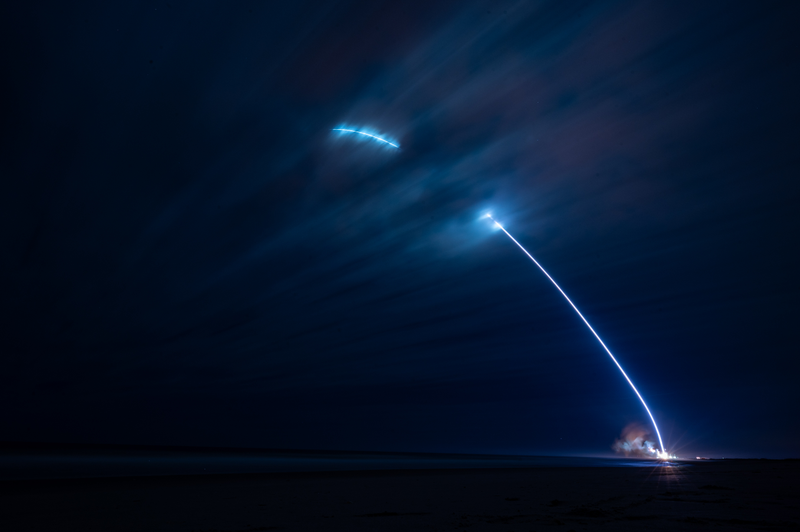
A long-exposure night photograph traces a rocket's ascent as a bright white arc climbing away from a coastal launch pad, with a second detached arc burning higher in the sky.


About 9 p.m. on the evening of May 28, 2026, a fully stacked New Glenn rocket at Launch Complex 36A began its final countdown. The vehicle stood 98 meters tall, taller than the Statue of Liberty on a pedestal, with seven BE-4 engines ringing its base. Around it, the propellant farm that had fueled the booster for its January 2025 maiden flight sat intact. The transporter-erector that had lifted the rocket onto its launch table four weeks earlier stood at the ready. By 9:07 p.m., both were gone.

This was not a launch. It was a hotfire test — the routine procedure in which a fully fueled rocket is ignited while held to the ground, its engines throttling up to validate the full countdown sequence without a real liftoff. Static fires have a good safety record. They are also where the most informative failures happen, because the rocket is fully instrumented and engineers can usually retrieve most of the wreckage.

The pattern is older than the modern launch industry. On September 1, 2016, a Falcon 9 loaded with the AMOS-6 communications satellite detonated at Space Launch Complex 40 during a pre-launch propellant load. The cause was a composite-overwrapped helium pressure vessel inside the second-stage LOX tank; cold helium had pooled liquid oxygen in a buckle in the aluminum liner, the trapped oxygen ignited, and the COPV failed. Total elapsed time from first anomaly to loss of vehicle: 93 milliseconds (SpaceX 2017 final investigation report). SpaceX’s fleet was grounded for four months, and the company rebuilt SLC-40 from its concrete mat upward.

Both events are symptoms of the same era: a commercial orbital industry large enough that ground-test failures are national news, and that schedules them into customer manifests years in advance. The May explosion cost Blue Origin its primary launch table, transporter-erector, one of two lightning towers, and a vehicle weeks away from carrying 48 Amazon Leo internet satellites. It delayed the Blue Moon MK1 lunar cargo lander from late 2026 into early 2027, forced NASA to revisit the Artemis V manifest, and gave Amazon Project Kuiper a fresh reminder that a single launch provider is a single point of failure.

Blue Origin had rolled the New Glenn stack out to LC-36A on May 22, six days after the FAA cleared the rocket to resume flights following an April anomaly on NG-3’s upper stage. According to Blue Origin’s initial public statements, the anomaly originated in the aft section of the first stage — the part that contains the seven BE-4 engines, their turbopumps, and the dense plumbing that feeds liquid oxygen at roughly 90 K and liquefied natural gas at roughly 112 K into the combustion chambers.

Within hours, Blue Origin CEO Dave Limp publicly committed to a return-to-flight target of “before the end of 2026,” and within weeks the company had completed debris clearance. The investigation is still open, but two facts are doing the heavy lifting. First, the BE-4 has been a reliable engine in flight: it has propelled ULA’s Vulcan to four national security missions since March 2025 (with two recent anomalies lying in Northrop Grumman’s GEM-63XL solid boosters, not the BE-4s), and the same engine has now completed three New Glenn flights with three first-stage recoveries on the droneship Jacklyn. Second, NG-3 in April was a reflight of the booster “Never Tell Me The Odds” — the first New Glenn first stage ever to fly twice — and that booster’s engines performed cleanly through ascent and the boost-back burn.

The booster itself, built around a 7-meter composite fairing that dwarfs Falcon 9’s 5.2-meter shell, had landed cleanly on the droneship Jacklyn during both NG-2 in November 2025 and NG-3 in April. Jacklyn is sized for that scale: 116 meters long and 46 meters wide, with a hydraulically actuated landing fixture and a 375-foot Liebherr crane for vertical-to-horizontal breakover. Whatever happened on the pad in May, the engines that actually reach orbit have already shown they can do it more than once.

The BE-4 is what Blue Origin calls a “medium-performing version of a high-performance architecture.” Each engine burns liquid oxygen and liquefied natural gas in an oxygen-rich staged-combustion cycle. A portion of the LOX is burned with a portion of the methane in a preburner to drive a single turbopump that feeds both propellants into the main combustion chamber at roughly 14 megapascals — about twice the chamber pressure of Merlin and roughly half the 26 to 35 megapascals that SpaceX extracts from Raptor’s full-flow staged-combustion cycle (Blue Origin BE-4 specifications, 2024).

What the BE-4 trades in chamber pressure it tries to win back in reusability. The turbopump spins on hydrostatic bearings — thin films of propellant fluid that bear the load between rotating and stationary parts — rather than on ball or roller bearings that wear under every start cycle. A contact-free bearing eliminates the failure mode that has historically dominated rocket turbopumps, where rotor-stator rubbing generates friction heat in a high-energy-density oxygen-rich environment and a single hot particle can ignite adjacent propellant feed lines.

The Tsiolkovsky rocket equation still rules the design: Δv = v_e * ln(m_0 / m_f), where v_e is the exhaust velocity (roughly 3,400 m/s for BE-4 in vacuum). Reaching low Earth orbit requires about 9.4 km/s of Δv, of which gravity and drag losses consume roughly 1.5 to 2.0 km/s, leaving the engines to deliver around 7.5 km/s. A first stage that needs about 3.5 km/s of its own Δv with v_e ≈ 3,400 m/s requires a mass ratio R = exp(3,500 / 3,400) ≈ 2.8, meaning about 64% of the fueled first-stage mass is propellant.

When aft-section failures do occur, the failure modes cluster in a small list. Rotor-stator contact, often initiated by bearing degradation or cavitation-induced vibration, is one. Turbine-blade fracture, which throws high-energy debris into propellant feed lines, is another. Seal failures that allow LOX and LNG to mix at incompatible temperatures, or cavitation instabilities in the inducer stage of the LOX pump, are others. In most paths the first symptom is a vibration signature through the turbopump housing; a properly instrumented static-fire test records it in hundreds of channels at kilohertz sampling rates. Engineers can usually reconstruct the chain of events within weeks — though identifying the root cause that should be redesigned to prevent recurrence is what takes months.

What Blue Origin is now doing at LC-36 is its own engineering story. Rather than rebuild the same transporter-erector, the company is accelerating a horizontal-to-vertical hybrid integration concept originally planned for LC-36B. Stages are mated horizontally inside the adjacent Integration Facility, then rolled to the pad, where a crane performs a vertical “breakover” — the inverse of the operation used to offload a recovered booster from Jacklyn — and lifts the vehicle onto a refurbished launch table. The architecture eliminates the transporter-erector as a single point of failure and gives Blue Origin a common concept of operations across both pads.

The May 28 explosion did not invalidate New Glenn. The vehicle has now completed three flights, two booster recoveries on Jacklyn, and one reflight. The engines that power it have completed dozens of Vulcan flights for the U.S. Space Force. But the incident exposed a single point of fragility that SpaceX had already learned about in 2016: the ground systems beneath a rocket are as important as the rocket itself. Blue Origin’s recovery plan converts the loss of one transporter-erector into a permanent architectural improvement — horizontal mating, vertical breakover, common CONOPS across two pads — that, if it works, will outlast any single vehicle lost on the pad.

For NASA, the lesson is schedulable. Blue Moon MK1 slips to early 2027; Artemis V, which depends on Blue Moon MK2 launching from a recovered New Glenn, slips with it. For Amazon, the first of 24 contracted New Glenn Leo launches slips along the same curve, though Kuiper has Atlas V and Vulcan capacity to bridge the gap. For Blue Origin, the lesson is the one every second-to-fly vehicle has had to learn: the rocket equation forgives inefficiency, but never a customer whose manifest has nowhere else to go.


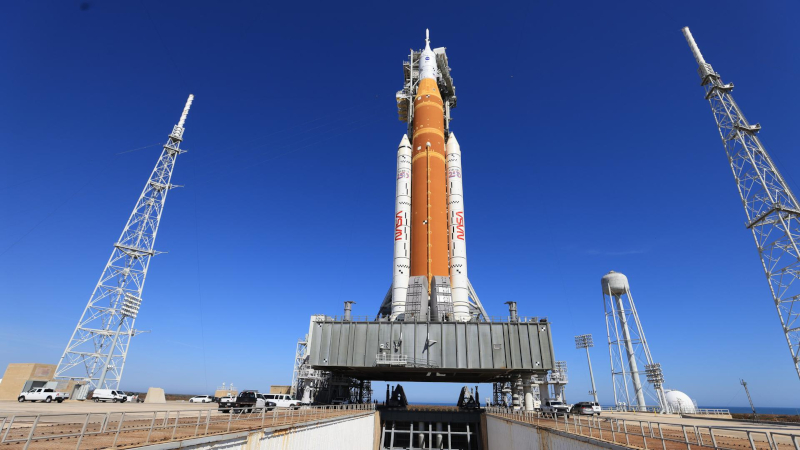
On May 13, 2026, NASA published new details about the Artemis 3 mission and the changes were striking enough to warrant attention not for what they added, but for what they removed. The mission, originally planned as the first crewed lunar landing since Apollo 17, will now send four astronauts to low Earth orbit aboard the Space Launch System and have them dock with prototype lunar landers. No landing. No lunar surface. The Moon is gone from the mission.

The agency confirmed that Artemis 3 will launch from Kennedy Space Center’s Launch Complex 39B no earlier than late 2027, and that the SLS rocket will fly without its usual upper stage. Instead of the Interim Cryogenic Propulsion Stage, the upper stage that has carried Orion to the Moon on previous flights, NASA will install an inert structural spacer — essentially a hollow cylinder with the same mass, dimensions, and interface geometry as the ICPS. The spacer preserves the rocket’s aerodynamic and structural characteristics without consuming propellant that could be allocated elsewhere.

The reason for the change is straightforward: the lunar landers are not ready. SpaceX’s Starship Human Landing System and Blue Origin’s Blue Moon have both experienced development delays. A crewed lunar landing requires those vehicles to perform rendezvous and docking in lunar orbit, execute a descent to the surface, support a stay of variable duration, and then launch back to rendezvous with Orion. Each step involves systems that have not yet been demonstrated in the configuration needed for crewed operations. NASA, having learned hard lessons from the heat shield anomalies encountered on the Artemis 2 flight in April 2026, decided it would not also accept the risk of an unproven lander.

The restructured Artemis 3 instead serves as what the agency describes as a dress rehearsal — similar in concept to Apollo 9, which tested the lunar module in Earth orbit before the first Moon landing. Four astronauts will launch on the Block 1 SLS configuration, which consists of the core stage and twin solid rocket boosters. Orion will separate from the stack and the crew will spend extended time aboard the spacecraft, testing rendezvous and docking with one or both lander prototypes in the relatively safe environment of low Earth orbit, approximately 463 kilometers above Earth at a 33-degree inclination. The European Service Module that powers Orion will handle orbital raising and maneuvering, with the ICPS being preserved for Artemis 4.

The hollow spacer solution was driven in part by hardware availability. The supply of ICPS stages is limited, having been built for the first three Artemis missions, and transitioning to the Exploration Upper Stage on later Block 1B configurations is still years away. Using the final ICPS on Artemis 4 rather than consuming it on an Earth-orbit test mission makes sense from a launch vehicle economics perspective. The spacer, being fabricated at NASA’s Marshall Space Flight Center in Huntsville, Alabama, maintains the structural interface between the Orion stage adapter and the launch vehicle stage adapter while costing nothing in propellant mass.

Artemis 4 remains targeted as the first crewed lunar landing, currently scheduled for no earlier than 2028, and will use the first ICPS from the original batch. The lander situation will need to be resolved by then. SpaceX is expected to conduct an uncrewed Starship HLS test flight before committing a crewed variant. Blue Origin is targeting an end-of-2026 launch of its Blue Moon Pathfinder MK1, an uncrewed cargo mission to validate the BE-7 engine, precision landing systems, and surface operations. Both companies face continued schedule pressure, and the May 2026 grounding of Blue Origin’s New Glenn rocket following an April 19 second-stage failure adds a further complication for Blue Moon’s path to orbit.

The decision to strip the landing from Artemis 3 drew predictable criticism from observers who saw it as another in a long series of delays. But the engineering logic is sound. Artemis 2’s heat shield erosion, traced to an arc-jet test anomaly and now requiring a redesigned thermal protection system for the Orion capsule, consumed program schedule margin. Adding a lunar landing with unproven vehicles on top of a heat shield redesign would have compounded risk in a domain where the cost of failure is measured in human lives. Moving the landing to Artemis 4 preserves schedule integrity for the test flight while keeping the lunar surface objective alive.

The Artemis program has always been a慢 exercise in managed ambition. The original Constellation program was canceled in 2010. The SLS was ordered to replace shuttle hardware that did not exist. The lunar landing has been pushed back repeatedly as funding, politics, and engineering complexity have collided. Stripping Artemis 3 to an Earth-orbit test is not a sign of weakness. It is a sign that the program has decided, perhaps for the first time, to let engineering reality set the schedule rather than politics.


SpaceX has set no earlier than May 19, 2026, for the first flight of Starship in its Version 3 configuration, a significant step in the development of the vehicle that NASA has contracted to land astronauts on the Moon and that SpaceX intends to use for missions to Mars. The upcoming flight, designated Flight 12, will lift off from Starbase in South Texas with a window opening around 5:30 to 6:30 p.m. ET, with a backup opportunity on May 20 if weather or technical issues require it.

The Version 3 configuration represents the most capable iteration of the Starship and Super Heavy system yet built. The vehicle stands approximately 150 meters tall with the upper stage stacked on the booster, making it the largest flying object ever constructed. The Super Heavy booster carries 33 Raptor engines — the full complement — compared to the 33-engine configuration that flew in earlier tests, but V3 introduces upgraded engines with higher thrust output and improved longevity. The upper stage, Ship 39, carries the same engine count as its predecessors but benefits from the thermal protection and reusability improvements that the SpaceX team has refined through the program’s rapid iteration cycle.

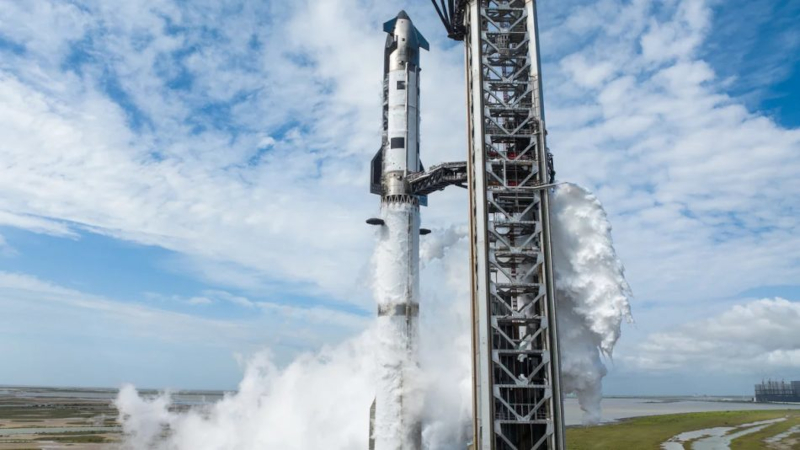
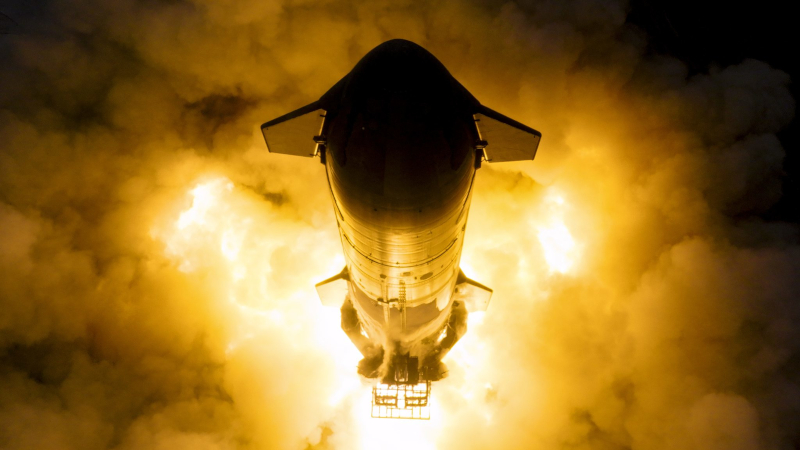
On May 11 and 12, SpaceX completed a full launch rehearsal that included propellant loading and a 33-engine static fire of Booster 19 with Ship 39 stacked on top. The test was the first time V3 hardware had been subjected to a full-duration static fire with all engines firing simultaneously, and it verified the vehicle’s readiness for flight conditions. The rehearsal included loading cryogenic propellants — liquid oxygen and liquid methane — into both stages, a process that takes hours and involves managing thermal gradients and boil-off rates that are significantly more complex for a vehicle of Starship’s scale than for any prior rocket.

The May 19 target has been in development for several weeks. SpaceX had originally planned an earlier V3 debut but chose to extend the testing and validation phase after discovering a hardware issue during pre-flight inspections. The conservative approach reflects a pattern the company has followed throughout the Starship program: when something does not look right, the team stops, diagnoses, and fixes rather than proceeding and hoping for the best. The strategy has produced a flight rate that is slower than early projections suggested, but it has also produced a vehicle that, by the time it flies, has been tested against the conditions it will actually face.

Flight 12 will be the first Starship flight of 2026 and the twelfth overall test flight in the program’s history. SpaceX has been flying approximately one Starship mission every few months as the vehicle matures, with each flight serving as both a test of new hardware and a demonstration of capabilities that have been validated in previous flights. The Version 3 hardware will attempt to complete the full mission profile: a full-duration burn of both stages, a controlled descent of the booster back toward the launch site where it will be caught by the mechanical arm system, and an upper stage that will perform a controlled splashdown in the Indian Ocean after completing one or more orbits of Earth.

The vehicle’s role in NASA’s Artemis program gives the program a significance that extends beyond SpaceX’s own ambitions. The Human Landing System contract that NASA awarded to Starship requires the vehicle to demonstrate crewed lunar landing capability before astronauts from the Artemis III mission descend to the lunar surface. That demonstration is years away, but the hardware being tested in the V3 flights is the same hardware that will eventually attempt the lunar descent. Each test flight, even if it ends in a loss of vehicle, produces data that refines the engineering and reduces the risk of the crewed mission later.

The May 19 window is specific enough that it suggests the team has high confidence in the timeline, but not so specific that it implies a guarantee. SpaceX has shown, repeatedly, that it will delay a launch rather than fly a vehicle it has reason to doubt. For a rocket program that has redefined what rapid iteration means in aerospace, the patience to wait for the right conditions is not a contradiction — it is the discipline that makes the iteration sustainable.

Super Heavy’s 33-engine first stage is a study in the engineering trade-offs that define modern launch vehicle design. Each Raptor engine produces a specific thrust at sea level, and the total thrust at liftoff is the sum of all 33 engines burning simultaneously. The challenge is not generating that thrust but managing the physical interactions between engines, the structure, and the propellant flow at the scale Super Heavy requires.

The Raptor engine uses a full-flow staged combustion cycle, which means that all of the fuel and oxidizer are gasified before they enter the combustion chamber. This approach produces very high efficiency — specific impulse in the range of 380 seconds at sea level — but it requires turbomachinery that can handle extreme temperatures and pressures without failing. The engineering challenge is not just the performance but the durability: an engine that will be fired multiple times must maintain its tolerances across many cycles of heating and cooling, which is why the V3 engines include upgrades to materials and cooling passages that extend engine life.

At liftoff, the structural loads on Super Heavy are enormous. The vehicle weighs approximately 4,000 metric tons at full propellant, and the acceleration from zero to thousands of meters per second in a few minutes requires structural integrity in the airframe that can withstand both the axial loads along the body and the bending moments produced by the aerodynamic forces acting along the vehicle’s length. The stainless steel construction that SpaceX chose for Starship is not a cost-cutting measure but an engineering decision that trades away the weight efficiency of carbon composites for the fracture toughness and reusability of a material that can survive the thermal and structural extremes of repeated flights without developing the microcracks that compromise composite structures over time.

The catch mechanism — the mechanical arms at the launch tower that are designed to catch the returning booster rather than landing it on legs — remains one of the more ambitious elements of the Starship reusability architecture. The system requires precise trajectory control during descent, a structure on the booster that can interface with the catcher arms, and software that can execute the maneuver reliably at the end of a ballistic arc. The May 19 flight will be the first V3 attempt at this catch, and whether the system works on the first try or requires iteration will define the timeline for the operational reusability that SpaceX has designed the vehicle around.


The next integrated test of Starship is positioned as a configuration transition rather than a routine increment. Flight 12, targeting early to mid-May 2026 from Starbase Orbital Launch Pad 2, is the first mission planned to use Version 3 (Block 3) hardware. The flight stack—Super Heavy Booster 19 and Starship Ship 39—incorporates design changes intended to improve propulsion performance, structural efficiency, and overall system reliability.

Pre-flight validation has centered on static fire testing. On April 15, 2026, Booster 19 executed a full-duration ignition of all 33 engines at the McGregor test facility. This was the first complete integrated test of the updated propulsion configuration using Raptor 3 engines. The preceding day, Ship 39 conducted a static fire of its six engines, including vacuum-optimized variants. These tests are designed to verify ignition sequencing, thrust vector control response, propellant flow stability, and structural load handling prior to flight.

The propulsion system is the primary area of change in Version 3. The Raptor engine operates on a full-flow staged combustion cycle using liquid methane and liquid oxygen. In this cycle, both propellants are fully gasified in separate preburners before entering the main combustion chamber. This approach allows for high chamber pressures and improved efficiency relative to simpler cycles, but it requires precise control of turbomachinery and flow balance. The Raptor 3 iteration focuses on simplification and integration. External plumbing has been reduced, and thermal management features are incorporated more directly into the engine structure. The intent is to decrease part count, reduce mass, and improve manufacturability while maintaining or increasing performance.

For Booster 19, the use of 33 engines introduces additional system-level considerations. Engine-out capability, thrust balancing, and control authority must be validated under conditions where all engines are firing simultaneously. The static fire provides data on pressure stability across the propellant manifolds, synchronization of ignition timing, and the response of the thrust vector control system. Structural loads transmitted through the thrust puck and into the booster’s primary structure are measured and compared against design predictions.

Ship 39’s propulsion configuration includes both sea-level and vacuum-optimized engines. The vacuum engines use larger expansion ratio nozzles to increase exhaust velocity in low-pressure environments. This improves specific impulse, which is a measure of propulsion efficiency. The trade-off is that these nozzles are not suitable for operation at sea level due to flow separation risks. The combined configuration allows the vehicle to operate efficiently across ascent and in-space phases. Static fire testing of Ship 39 validates ignition reliability, mixture ratio control, and thermal behavior of the extended nozzles.

Beyond propulsion, Version 3 hardware reflects iterative changes in structure and systems integration. Starship’s primary structure is composed of stainless steel, chosen for its strength at cryogenic temperatures and its ability to tolerate high thermal loads during reentry. Modifications in weld patterns, ring structures, and internal tank geometry are aimed at improving load distribution and reducing mass. These changes must be validated through both ground testing and flight data, as structural margins are closely tied to vehicle performance and reusability goals.

Propellant management is another area of focus. The vehicles use subcooled liquid methane and liquid oxygen, which require careful handling to maintain density and prevent cavitation in turbopumps. Tank pressurization systems must ensure consistent flow to the engines while accommodating changes in acceleration and orientation during flight. Static fire tests provide an opportunity to observe these systems under controlled conditions, including the behavior of autogenous pressurization, where gaseous propellants are used to maintain tank pressure.

The planned flight profile for Flight 12 remains suborbital, consistent with previous integrated tests. This allows the program to evaluate ascent performance, stage separation, and initial reentry behavior without committing to a full orbital insertion. Data collected during ascent will include engine performance metrics, structural loads, and aerodynamic response. Stage separation dynamics are of particular interest, as they involve complex interactions between the booster and upper stage, including plume effects and transient forces.

Reentry testing focuses on thermal protection and guidance. Starship uses a combination of passive and active systems to manage heat loads. The vehicle’s geometry distributes heating across the windward surface, while thermal protection tiles provide insulation. Guidance algorithms control the vehicle’s orientation to maintain a stable descent profile, balancing drag and lift to manage deceleration. Flight 12 is expected to provide additional data on tile performance, attachment reliability, and thermal gradients across the structure.

The integration of these systems reflects a broader engineering approach centered on rapid iteration. Design changes are implemented, tested, and refined in successive vehicles. Static fire campaigns serve as gate checks, confirming that major subsystems perform as expected before flight. The transition to Version 3 hardware indicates that the program has reached a stage where incremental improvements are being consolidated into a more mature configuration.

From a systems engineering perspective, Flight 12 is a validation of integration rather than a demonstration of isolated components. Propulsion, structure, guidance, and thermal systems must operate together under dynamic conditions. The objective is to reduce uncertainty in how these systems interact, providing data that informs future design decisions and operational procedures.

The significance of this flight lies in its role as a configuration baseline. If Version 3 hardware performs as intended, it establishes a reference point for subsequent vehicles, supporting the program’s goal of achieving full reusability. This includes rapid turnaround between flights, consistent performance across missions, and the ability to scale production.

Starship Flight 12 represents a transition to a more integrated and refined vehicle configuration. The static fire tests of Booster 19 and Ship 39 have validated key aspects of the propulsion system and supporting infrastructure. The upcoming flight will extend this validation into operational conditions, providing data on ascent, separation, and reentry. The outcome will determine the effectiveness of the Version 3 design changes and their contribution to the overall development of the launch system.