


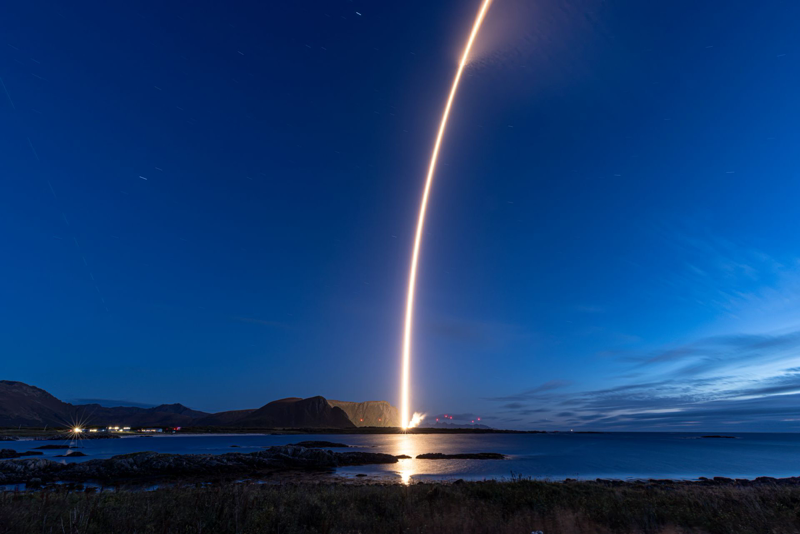
Image source: Isar Aerospace’s mission page. The image is a launch photograph supplied by Isar Aerospace; the official mission page identifies the flight and company source.
On the evening of 5 September, a narrow white line rose from the coast of northern Norway and bent across the darkening sky. It was the exhaust trail of Spectrum, a 28-metre rocket built by German startup Isar Aerospace. The vehicle left Andøya Spaceport at 22:12 CEST on the mission called Onward and Upward, then completed the sequence that a small launcher must get right: clear the pad, survive maximum aerodynamic pressure, separate its stages, restart the upper stage, and build enough horizontal speed to stay above Earth.
This time, it worked. Isar said the mission deployed its payloads into orbit on Spectrum’s second flight, making the company the first commercial space company from Europe to successfully deliver satellites to orbit. The distinction needs a little care. European rockets have launched from sites outside continental Europe for decades, especially from Europe’s Spaceport in French Guiana. This flight was about a privately developed European launcher operating from European soil. Isar Aerospace’s mission release describes the result and the company is still checking the status of the satellites with its customers.
That makes the photograph at the bottom of this post useful in a plain way. It shows the launch as a bright trail reflected in the sea, with the shoreline and mountains reduced to silhouettes. The image does not show the satellites or the rocket in orbit. It shows the first few minutes of a supply chain that ends there, far above the frame.
Launch capacity is the part of the space business that is easiest to underestimate. Designing a satellite is one problem; finding a rocket, a launch slot, the right orbit, and a place in the payload queue is another. A working small launcher gives customers a different schedule and a different set of possible inclinations. It also gives a government another option when access to space is treated as infrastructure rather than a one-off science project.
For Europe, the argument is also about control. The continent has major spacecraft manufacturers and a large scientific programme, but launch services have been concentrated in a small number of systems and locations. A rocket that is designed, assembled, tested, and launched by a European company does not remove every dependence on international supply chains. It does provide another route to orbit, and it lets European institutions buy a service from a newer supplier while the vehicle is still being qualified.
ESA supported the flight through its Boost! programme, while the payload selection came through the German Space Agency at DLR’s Microlauncher Competition. That connection matters because the first customers were not all large commercial operators. They included educational institutions and startups that needed a relatively inexpensive chance to put hardware in orbit. The launch therefore tested two things at once: the rocket’s flight system and the market around it.
The flight followed a difficult first attempt. Spectrum’s first test flight in March 2025 lasted 30 seconds, according to ESA’s pre-launch briefing. The vehicle cleared the launch pad, but it did not proceed to orbit. For a new launcher, that short flight is still useful data, but it leaves the next mission with a very specific burden: the company must demonstrate that it understood what happened and changed enough of the vehicle or its operation to make the next attempt meaningful.
The second flight was designated a qualification mission, not simply a repeat demonstration. ESA described it as an attempt to prove the Spectrum launch system in the context of the European Launcher Challenge, which requires selected launch-service providers to achieve an orbital launch no later than 2027. Isar’s own account says the vehicle passed maximum aerodynamic pressure, completed main-engine cutoff and stage separation, ignited its second stage, crossed the Kármán line at 100 kilometres, jettisoned the fairing, reached orbital velocity, completed its circularization burn, and separated the spacecraft.
Those milestones are a chain, not a checklist of independent tricks. The first stage must produce thrust while steering through a thickening aerodynamic environment. At maximum dynamic pressure, the vehicle feels the combined effect of air density and speed, so the guidance system cannot treat the rocket as if it were moving through a vacuum. Once the first stage has done its work, separation has to happen cleanly, and the second stage must ignite without upsetting the trajectory. A launcher can survive an engine problem and still fail to deploy a payload if the upper stage cannot finish the job.
Spectrum uses liquid oxygen and propane, with a multi-ignition second-stage engine, according to Isar’s vehicle description. The company lists a payload capacity of up to 1,000 kilograms to low Earth orbit. That number is a capability claim for the launch vehicle, not the mass carried on this mission. This flight carried five CubeSats and one non-separable experiment, the six passengers described by ESA before launch.
The physics behind orbital launch is less about reaching a particular altitude than reaching sideways fast enough. A satellite in low Earth orbit is continually falling toward Earth, but its horizontal velocity makes the ground curve away beneath it. The rocket spends much of its flight building that velocity while gravity pulls down and the atmosphere pushes back. The upper stage then uses a precisely timed burn to raise and circularize the trajectory. Crossing 100 kilometres is a useful boundary for describing spaceflight, but it is not the same as achieving an orbit that can carry a satellite for long.
Propellant choice shapes the engineering trade. Liquid oxygen is the oxidizer; propane is the fuel. The combination can be stored as a liquid at temperatures and pressures that fit a practical launch system, while the engine still needs turbomachinery, ignition hardware, cooling passages, valves, and controls capable of handling rapid changes in flow. Isar says the propellants offer a high density-specific impulse among carbon-based fuel options. That is a design advantage, not a promise that the rocket will have lower total environmental impact in every comparison.
The other design choice is industrial. Isar says Spectrum vehicles 3 through 7 are already in production and that a new 40,000-square-metre facility near Munich is intended to support production of up to 40 launch vehicles per year. These are plans and production targets, not a flight cadence already demonstrated. The difference is important. A rocket company can prove a vehicle once and still fail to create a dependable service if manufacturing, testing, range operations, and customer integration cannot keep pace.
Isar is also building a launch complex in Nova Scotia, Canada, for mid- to high-inclination orbits used by Earth-observation and communications missions. That site would complement Andøya rather than replace it. Different launch locations open different orbital geometries, but they also multiply the work: regulations, range safety, ground equipment, weather planning, logistics, and local operations all have to be made routine.
The next test is repetition. One successful orbital flight changes the conversation, but it does not yet establish a launch service with predictable timing and recovery from ordinary problems. Spectrum’s second flight showed that a European startup could move from a 30-second first test to payload deployment on the next attempt. The company now has to show that this was the beginning of a production programme rather than the high point of a long development cycle.
For the customers waiting on small satellites, the practical result is simple: there is now another European launcher with an orbital success on its record. The hard part starts after the photograph. Isar must turn a successful qualification flight into vehicles that can be built, tested, licensed, and launched often enough for customers to plan around them.
 Subscribe to our RSS feed









There are no comments.
Add A Comment