


On 2 September 2026, the German small-launch startup HyImpulse announced that it had closed a Series A extension of more than €50 million, lifting its lifetime equity and grant total to roughly €125 million and growing its commercial order book to over €350 million. The round was jointly led by JOIN Capital, a Berlin-based early-stage venture firm, and Ace Capital Partners, an Israeli aerospace and defence investor, neither of which had participated in the company’s initial €15 million Series A in October 2025. CEO Christian Schmierer framed the raise as Europe’s bid to build an “independent” small launcher: “While providers such as SpaceX offer a scheduled bus service to space, our solutions allow us to develop a flexible taxi service so that our customers can choose individual launch solutions and flexibly plan their schedules” (SpaceNews, European Spaceflight).
The funding matters because HyImpulse is the only European launch startup flying on a hybrid-propulsion architecture, and the first in the world with a published roadmap to put a paraffin-fuelled vehicle into orbit. Its suborbital SR75 has flown once, from the Koonibba Test Range in South Australia on 3 May 2024, and is preparing for a commercial re-flight from SaxaVord Spaceport in Shetland before the end of the year. Its larger orbital rocket, the SL1, has not yet flown but is now scheduled to attempt a maiden launch in 2027, a target the company has consistently described as a stretch goal contingent on further capital. The €50 million buys time on both fronts.
The company’s place in Europe’s launcher debate is awkward. Continent-wide, Ariane 6 and Vega C already provide operational access to space for medium and small payloads, with Ariane 6 capable of carrying over 21 tonnes to low Earth orbit and Vega C rated for up to 2,300 kilograms (European Spaceflight). At the bottom of the mass range, the SL1 is sized for payloads of up to 600 kilograms, small by European standards but large for the kind of responsive, single-customer rides that the global small-launch market has been chasing for a decade. The gap Schmierer is pointing at is real: European providers accounted for less than one per cent of all global launches in 2024, and ArianeGroup’s flagship is optimised for institutional rides, not the weekly cadence a single small-sat operator might want. Whether a hybrid rocket fills that gap, or duplicates it, is the question HyImpulse’s next eighteen months will answer.
HyImpulse was founded in March 2018 as a privately financed spin-off from the German Aerospace Center’s Institute of Space Propulsion at Lampoldshausen, the same facility where the V-2 and early post-war European rocket engines were tested (Wikipedia, DLR). The headquarters sit in Neuenstadt am Kocher in Baden-Württemberg, between Frankfurt and Stuttgart, and the team has grown out of the Lampoldshausen hybrid-motor programme that produced the research the company was built to commercialise. The German government separately committed €95 million in additional funding in late 2024 to support HyImpulse alongside two rival small-launch startups, Isar Aerospace and Rocket Factory Augsburg (European Spaceflight). The new equity raise sits alongside that public funding and brings HyImpulse’s total disclosed war chest close to €125 million in equity and grants combined.
The SR75 is a single-stage suborbital rocket. On its 3 May 2024 flight, named “Light this Candle”, the SR75 launched from the Koonibba Test Range in South Australia, reached an apogee of 50 kilometres, deployed parachutes, and was recovered intact (Southern Launch, ESA Multimedia). The Australian Space Agency called the launch one of the largest commercially launched rockets in Australian history at the time. The mission was supported through ESA’s Boost! programme, which is designed to fund commercial space transportation services in Europe. A second flight from SaxaVord Spaceport in Shetland, planned before the end of 2026, will mark the first launch from European soil under the company’s new agreement with the Scottish spaceport (BBC).
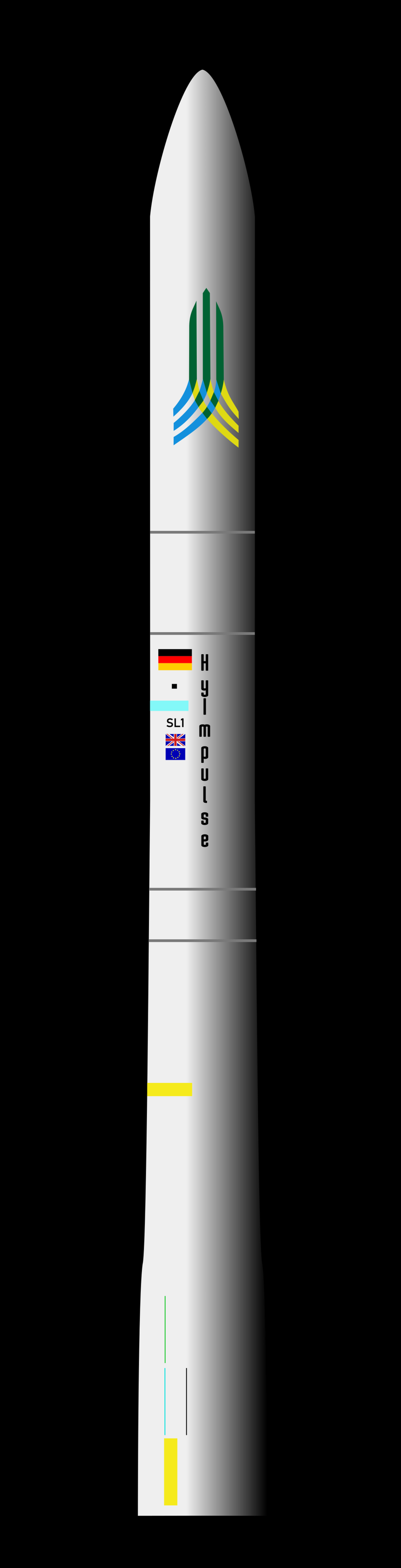
The SL1 is where the technology bet gets serious. The three-stage vehicle stands 33 metres tall, carries a payload fairing 2.2 metres in diameter, and has a lift-off mass of about 54 tonnes (HyImpulse SL1). Each stage burns the same propellant combination as the SR75 (aerospace-grade paraffin wax and liquid oxygen) through clusters of HyPLOX 75 turbopump-fed engines. The first stage carries eight of the engines, the second four, and the third one. According to the company, the SL1’s payload performance was boosted in 2024 to 600 kilograms to low Earth orbit, up from earlier estimates of 500 kilograms to a 400-kilometre sun-synchronous orbit (European Spaceflight – SL1 design update). The vehicle is designed for high flight cadence: the company states it is targeting up to 12 launches per year initially, with a goal of 50 per year by 2030, and turnaround times as short as three weeks between flights.
Hybrid propulsion is the architectural choice that distinguishes the SL1 from every other orbital launcher in development. A hybrid motor stores its fuel as a solid (paraffin in this case, a low-melting-point wax) and pumps its oxidiser as a liquid (cryogenic LOX) into the combustion chamber. The two never mix on the pad, which makes the rocket far safer to handle than a solid or bipropellant liquid stage: a hybrid cannot detonate, can be shut down by closing the oxidiser valve, and stores fuel at ambient temperature. The trade-off has historically been low regression rate and combustion instability, both of which constrain the achievable thrust-to-weight ratio. Paraffin wax partially solves the regression problem because it sublimes and vaporises under heat, exposing fresh surface area more quickly than a rubbery solid fuel like HTPB. The DLR research programme at Lampoldshausen spent more than a decade working on paraffin-LOX combustion, which is the line of work HyImpulse’s founders continued after spinning out (DLR electronic library). The published performance estimates, very high specific impulse comparable to LOX-kerosene bipropellant engines, depend on those gains holding up at full scale. The SR75 proved the motor at suborbital scale; the SL1 will test it at orbital scale.
Whether the SL1 reaches orbit on its first attempt in 2027 is the single question that matters for HyImpulse. The company has booked a €350 million order book, but orders are commitments, not revenue, and small-launch startups have a long history of paper demand evaporating after a failed first flight. The SaxaVord SR75 flight, if it succeeds in the December quarter, will mark the first time a European commercial operator has flown a hybrid rocket from European soil. The SL1 maiden flight, whenever it lands, will be the first attempt to put a paraffin-fuelled orbital launcher on a real flight profile. Both milestones are tractable engineering problems rather than physics ones; whether HyImpulse reaches them on schedule will depend on how fast the new €50 million lets it close the gap between a motor that has flown suborbitally and a launch system that can deliver a payload to orbit. The runway just got longer.
 Subscribe to our RSS feed









There are no comments.
Add A Comment