


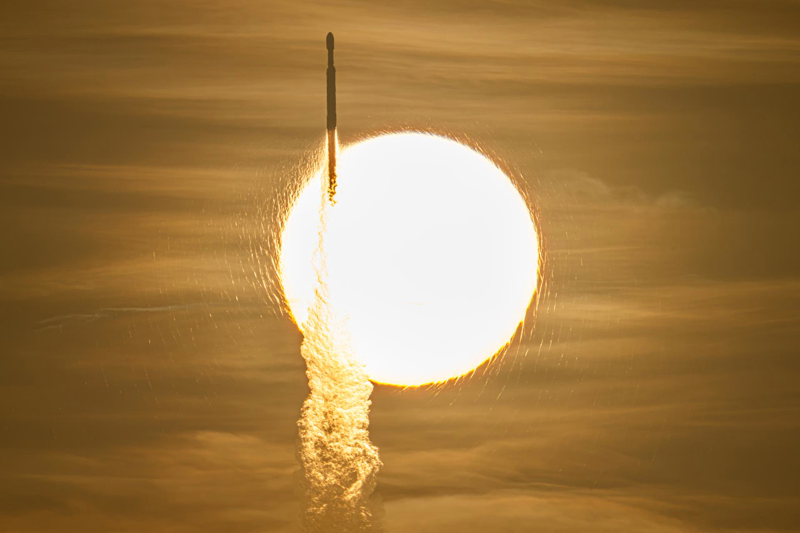
A SpaceX Falcon Heavy climbed off Launch Complex 39A at 7:26 a.m. EDT on Sunday, August 30, 2026, with NASA’s Nancy Grace Roman Space Telescope pinned under its shroud. About seven minutes later, the ground team at Goddard Space Flight Center received the first telemetry, and 31 minutes after liftoff the second stage separated cleanly from the observatory. Photographers caught the moment the rocket transited the rising Sun (Figure 1), the exhaust plume drawing a line straight through the disk as the booster climbed through the morning sky over Kennedy Space Center. Roman is now on a three-month cruise to a halo orbit around the second Sun-Earth Lagrange point, about 1.5 million kilometers from Earth, where it will start a five-year infrared survey of the universe that NASA Administrator Jared Isaacman said was delivered “ahead of schedule and on budget”.
The launch marks the start of an observatory that has been on the astronomy community’s wish list since 2010. Roman will look for the same physics the Nancy Grace Roman mission was conceived to probe: dark energy, dark matter, and planets in other star systems. Three of the things it does best, drawing on a 2.4-meter primary mirror donated by the National Reconnaissance Office in 2012 and an infrared camera that the same NASA press release puts at 300 megapixels, have not been done by any previous space telescope in this combination.
The headline number is the field of view. Roman’s Wide Field Instrument images 0.28 square degrees per pointing, more than a hundred times the sky area Hubble’s cameras can capture in a single exposure. Roman is expected to survey the same area roughly a thousand times faster than Hubble, according to NASA’s press kit, which is what enables a five-year mission that returns 1.4 terabytes of data every day, a rate NASA calls the highest of any astrophysics mission. The WFI also runs 18 4K-scale infrared detectors, each about the size of a saltine cracker, which gives the instrument enough resolution to both find exoplanets via gravitational microlensing and map the same patches of deep field at multiple wavelengths.
The trade-off is one the Wide Field Infrared Survey Telescope (WFIRST) study teams accepted as long ago as 2012, when the National Reconnaissance Office offered two spare 2.4-meter reconnaissance telescopes to NASA. The optics have the same diameter as Hubble but a much shorter focal length, so the optical design supports a wide field of view, per the Wikipedia summary of the AFTA-era concept. That same optical design is what makes the coronagraph possible. The Coronagraph Instrument will demonstrate starlight suppression at the part-per-billion level, the kind of technology that a future Habitable Worlds Observatory would need to actually image Earth-like planets rather than infer them from transits.
The mission sits in a quiet but real moment for cosmology. The original WFIRST concept was the top recommendation of the National Research Council’s 2010 Decadal Survey, and Congress funded it across multiple administrations despite at least one cancellation attempt. The 2026-08-30 launch closes that arc.
Sunday’s countdown ran cleanly. The Falcon Heavy lifted off at 11:26:04 UTC from Pad 39A, per the Wikipedia entry’s launch parameters, separating the observatory 31 minutes into the flight. The ground controllers at Goddard received the first telemetry packet seven minutes after launch, and the booster recovery proceeded normally, with the two side boosters returning to the Cape for refurbishment. About an hour and 23 minutes after liftoff, the spacecraft confirmed that its solar panels and the lower instrument sun shade had deployed.
The Near Space Network’s ground stations and relay satellites carried the first part of the flight, and about 70 minutes in the Deep Space Network took over, picking up Roman’s signal first at the Canberra Deep Space Communication Complex in Australia and then handing off to Madrid and Goldstone, according to NASA’s August 30 press release. Roman’s high-gain antenna, the deployable aperture cover, the first mid-course correction and the Coronagraph Instrument’s power-on are queued up over the next several days. The Wide Field Instrument will activate a few weeks into the mission.
The mission is the fourth primary payload SpaceX has launched for NASA on a Falcon Heavy, according to the same release, and the agency moved the date up to fit the telescope’s early completion. After the in-space commissioning window, NASA expects the first science images in early 2027. The institute partners listed in the press release include the Space Telescope Science Institute (STScI) in Baltimore, NASA’s Jet Propulsion Laboratory, Caltech/IPAC in Pasadena, BAE Systems, L3Harris and Teledyne, with contributions from ESA, JAXA, the French CNES and the Max Planck Institute for Astronomy.
Roman shares most of its optical structure with an older mission. The 2.4-meter primary, the same diameter as Hubble’s, was originally built by Harris Corporation for a reconnaissance satellite and was offered to NASA in 2012 for the WFIRST-AFTA study. The optical design is a three-mirror anastigmat with an f/7.9 focal ratio and a wavelength range of 0.48 to 2.30 micrometers, spanning visible blue into near-infrared, per the Wikipedia infobox on the telescope. That range covers most of the light that escapes from distant galaxies, so a wide-field infrared survey has the same statistical power per square degree that Hubble got with smaller exposures.
The Wide Field Instrument is the instrument that actually does the survey. Its focal plane is a 4×4 array (with two corners intentionally blank) of 18 H4RG-10 mercury-cadmium-telluride detectors built by Teledyne, as described in the mission history. The detectors deliver 300.8 megapixels at 0.11 arcsecond resolution. The filter wheel carries eight science filters plus one wide band and two slitless spectroscopy elements (a grism and a prism), which means the same exposure can be used for photometry or for low-resolution spectra.
The Coronagraph Instrument is the new piece. It operates between 575 and 825 nanometers, with two deformable mirrors and a focal-plane mask to suppress starlight. The instrument targets a 1e-9 contrast ratio, the most aggressive starlight suppression NASA has flown, with the goal of imaging Jupiter-like planets at angular separations as small as 0.15 arcseconds from their host stars. The early-2010s orbit trade study left L2 as the eventual choice for thermal stability and a calmer radiation environment, per the mission history. Communications run over S-band for command and Ka-band for science downlink at 290 Mbit/s.
The first science images arrive in early 2027, after about three months of calibration and instrument commissioning at L2. Astronomers will get their first look at the three Core Community Surveys (the High-Latitude Wide-Area, High-Latitude Time-Domain, and Galactic Bulge Time-Domain Surveys), which were selected by the Roman Observatory Telescope Allocation Committee in April 2025. Citizen scientists and machine-learning pipelines will help triage the 1.4 terabyte per day stream that NASA expects once the mission is operational, since no human team can read that volume in real time.
NASA’s Roman team has set hard follow-up milestones: deployable aperture cover, high-gain antenna and the first mid-course correction are due in the first week; the Coronagraph Instrument’s power-on is the early-September checkpoint; the Wide Field Instrument activates a few weeks into the cruise. Watching those deployments land is the first thing to look for in the coming weeks, with first light as the second.
 Subscribe to our RSS feed









There are no comments.
Add A Comment