


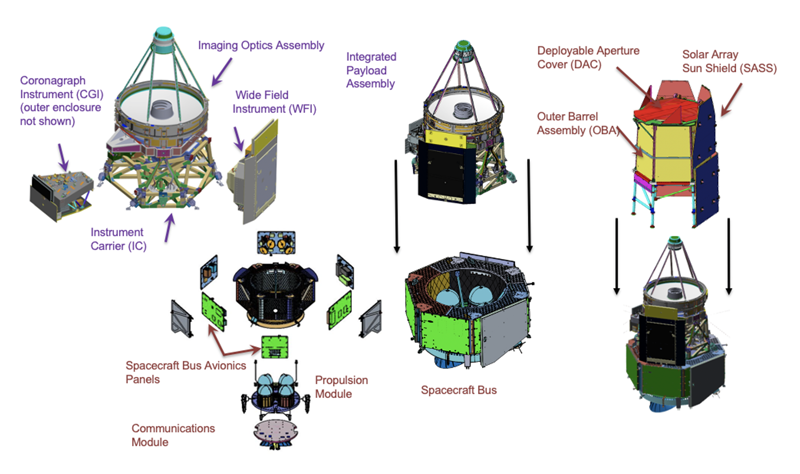
Five weeks after lifting off from Kennedy Space Center on a Falcon Heavy, NASA’s Nancy Grace Roman Space Telescope did the one thing its coronagraph was built to do. On September 22, 2026, the Coronagraph Instrument, a technology demonstrator bolted onto the side of the Wide Field Instrument and shielded from starlight by a system of masks and deformable mirrors, opened to cosmic light for the first time, according to a NASA Roman blog post on September 30 and a contemporaneous Caltech announcement that also noted the milestone on September 27. The team had kept the detectors slightly warmer than they will run during science operations to keep contamination from settling on them, so the first image was a noisy one. Five days later, on September 27, they cooled the detectors and pointed again at a new patch of the Large Magellanic Cloud, and the second frame showed what a star field is supposed to look like. The coronagraph had a focused image, and the team could exhale.
The milestone matters because Roman’s coronagraph is the first active, deformable-mirror coronagraph ever operated in space. Hubble’s coronagraphs were passive: a black spot in the focal plane to physically block starlight, with no way to clean up the diffraction rings and speckles that left a bright star’s halo drowning out any nearby planet. Roman’s coronagraph, designed and built at NASA’s Jet Propulsion Laboratory and operated from Caltech’s IPAC, has two deformable mirrors that reshape themselves about 100 times a second to push the residual starlight into a controlled pattern the team calls a “dark hole.” If the approach works, it will be the technological seed for the Habitable Worlds Observatory, the still-in-formulation flagship NASA wants to launch in the 2040s to image Earth-like planets around Sun-like stars. None of that is possible until a deformable-mirror coronagraph has actually been tested in orbit, which is what made September 22 a quiet but real turning point.
The story behind September 22 starts with launch. Roman left Earth on August 30, 2026 (the mission profile on Wikipedia covers the launch, the cruise to L2, and the planned five-year primary survey), and the Wide Field Instrument and Coronagraph Instrument have been powering on and stretching out one subsystem after another as the observatory cruises toward its halo orbit around the Sun-Earth second Lagrange point. The coronagraph itself woke up on September 1. Mid-month it deployed its mechanical limbs and electronics. The team then spent September 15 through 21 testing the fine-guidance system, a piece of the observatory’s attitude control that has no separate hardware, but instead reads guide-star positions from a small patch of each of the 18 infrared detectors in the Wide Field Instrument. The fine-guidance system reports those positions to the spacecraft’s attitude control about four times per second, and the attitude control nudges the observatory a tiny amount each time to keep it from drifting. Tests confirmed Roman could hold pointing stable to better than one hundred-thousandth of a degree for half an hour at a time with the Wide Field Instrument, and for eight hours at a time with the Coronagraph, a tighter constraint because the coronagraph’s own internal stability loop was also running.
The stability budget for the coronagraph is what makes the second observation more impressive than the first. Even a few nanometers of mirror motion, or a few milliarcseconds of pointing error, would let unwanted starlight leak around the coronagraph’s masks and overwhelm a planet roughly a millionth as bright as its host star. Engineers put the current pointing performance in the same terms they use for any other precision pointing system: keeping a laser focused on a U.S. dime from about 150 miles away, with a goal of stretching that to roughly 230 miles as the commissioning continues. With the fine-guidance loop and the coronagraph’s own internal loop both running, on September 22 the team allowed starlight from a faint star in the Large Magellanic Cloud to fall on the coronagraph’s detectors. The image was blurry by design because the detectors were running warmer than they would in steady-state science, but it confirmed the optical path from the primary mirror, through the coronagraph masks and deformable mirrors, to the focal plane was clear and focused.
Five days later the team ran a second observation, this time after cooling the detectors toward their final operating temperature for better sensitivity, and pointed at a new region of the Large Magellanic Cloud where the team expected many stars in a single frame. The coronagraph saw them. That second observation confirmed the team could reliably move the field of view and keep the coronagraph stable while doing so. Roman’s coronagraph instrument scientist Vanessa Bailey, at JPL, summed up the second observation in plain language: “we’re breathing a sigh of relief.” Alexandra Greenbaum, coronagraph data management lead at IPAC, framed the milestone around what comes next: she’s looking forward to the rest of commissioning on both the operations and the data-processing side.
The technology itself is the science and engineering deep dive here, because that is what makes the milestone a milestone. A coronagraph suppresses starlight so a much fainter planet or disk next to that star becomes detectable. In a passive coronagraph, like the one on Hubble’s STIS instrument or on James Webb’s NIRCam, a physical mask in the focal plane blocks the bright star’s core, but the wave nature of light still spreads some of that starlight into a halo of rings and speckles around the mask edge. Roman’s coronagraph actively corrects the wavefront of the incoming light using two deformable mirrors, surfaces whose shapes can be changed hundreds of times per second by pushing on the back of the mirror with hundreds of small actuators. When the deformable-mirror pattern is right, the speckle pattern from starlight interferes with itself and cancels out across a small region of the image, opening what the team calls the “dark hole.” That dark hole is where a much fainter planet, if there is one, would be visible. The trade is that the dark-hole trick only works for a narrow annulus around the star, and the deformable mirrors must keep running or the dark hole closes within milliseconds. Roman’s coronagraph uses two 64-by-64 actuator mirrors and a set of focal-plane masks that physically block the starlight before the deformable mirrors do their work, and the September 22 observation was a sanity check that all of those pieces are aligned well enough to deliver a focused image at all.
The other piece that makes the coronagraph unusual is the fine-guidance system, which is part of why the September 15-to-21 testing week mattered. Hubble, JWST, and most space telescopes carry a separate guider instrument, basically a small auxiliary telescope that locks onto a guide star and tells the main telescope where it is pointing. Roman does not have one. Instead, the team reuses a few pixels on the edges of the Wide Field Instrument’s 18 infrared detectors to track guide stars, and uses the spectra of those guide stars, not just their positions, to hold pointing steady. That gives Roman a way to point more precisely than a star-image tracker would, because spectra carry more information than a centroid, and it saves mass by removing a separate instrument. Roman’s guiding lead Begoña Vila, at Goddard, said the team is looking forward to validating that spectral-guiding mode in the coming weeks. The September 15-to-21 tests used position-only guiding; spectral guiding is the second tier, and confirming it is one of the remaining milestones of commissioning.
What comes next is a three-month commissioning campaign that will run Roman through a series of progressively harder tests. The coronagraph team will practice keeping the dark hole stable for longer and longer exposures, will test the deformable-mirror control loop under realistic thermal conditions, and will try imaging the dust disks that the coronagraph was originally scoped to study. NASA expects Roman’s first image release in early 2027, with the coronagraph’s first science-quality image landing later in the year once the deformable-mirror dark hole is reliably closing on demand. The September 22 and 27 observations are not those images. They are the “we have a working instrument” sign on the door, and the second one shows that the door is on hinges.
 Subscribe to our RSS feed









There are no comments.
Add A Comment