


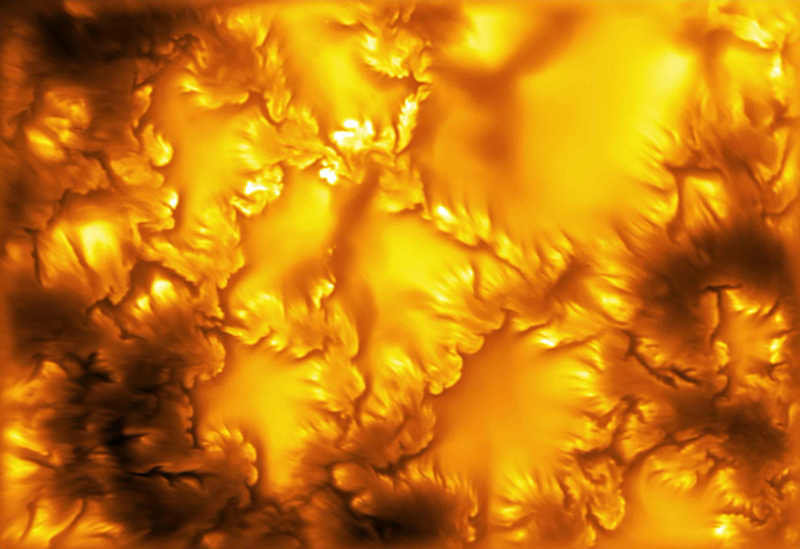
For roughly a century and a half, Kelvin-Helmholtz instability has lived a quiet life in physics. It explained the curls at the crests of ocean waves in a stiff breeze. It showed up in the banded clouds of Jupiter and Saturn. It was theorized to happen on the Sun’s visible surface, where hot plasma bubbles up and slides sideways past magnetic field lines, but no one had ever caught it doing it. That changed on August 5, 2026, when David Kuridze at the U.S. National Science Foundation National Solar Observatory and colleagues published the first unambiguous observation of Kelvin-Helmholtz vortices in the Sun’s photosphere, captured by the 4-meter Daniel K. Inouye Solar Telescope on Maui. The features are tiny: roughly 20 kilometers across, with an instability wavelength between 50 and 65 kilometers. The NSF NSO press release went out the same day, and the result was covered widely afterward.
Solar physicists have spent the better part of two decades arguing about a simple question: what keeps braiding the Sun’s magnetic field? The field is built up by a global dynamo, regenerated on an 11-year cycle, and released in flares and coronal mass ejections that drive space weather at Earth. The release happens through magnetic reconnection, where tangled field lines snap and reset into a lower-energy configuration, but something has to braid the lines in the first place, and existing models have struggled to braid them fast enough. The leading candidate has been “flux braiding” by granular flows (the bubbling of the Sun’s surface as hot plasma rises, cools, and sinks), but no one had directly observed the small-scale mechanism that makes that braiding efficient.
That is what the new result changes. The images show that wherever the photospheric magnetic field is strong enough, the boundary of the magnetic structure becomes sheared by the surrounding granular flow, and that shear rolls up into vortices with the wavelength and shape predicted by classical Kelvin-Helmholtz theory. The vortices are not rare. They are everywhere the field is strong. That gives the braiding mechanism a physical engine: KHI-driven turbulence, persistent and ubiquitous, capable of twisting field lines on the right timescale. It also gives coronal heating, the long-standing puzzle of why the Sun’s outer atmosphere is more than a million degrees Kelvin while the surface is only 5800 K, a candidate answer, since the same shear that braids the field also mixes magnetized and unmagnetized plasma and pumps energy upward.
The Inouye Solar Telescope, also known as DKIST, sits at roughly 3000 meters on Haleakalā, with a 4-meter primary mirror (the largest in any dedicated solar telescope). Science operations started in late 2021 after two decades of construction. The August 5 paper pulls together observations from the telescope’s Visible Broadband Imager (VBI), which captures the photosphere in narrow wavelength bands tuned to specific spectral lines. The KHI data were taken at 416 nanometers, a wavelength sensitive to the photosphere’s quiet magnetic regions.
Kuridze’s team is international: the National Solar Observatory in Boulder; the NSF NCAR High Altitude Observatory (HAO); and the Max Planck Institute for Solar System Research (MPS) in Göttingen. Twelve co-authors include Friedrich Wöger and Thomas Rimmele from NSO; Matthias Rempel from HAO; and Robert Cameron and Sami Solanki from MPS. The paper also validates, at the highest resolution to date, MURaM simulations (Max Planck/University of Chicago Radiative MHD), which simulate the Sun’s surface from first-principles physics. The agreement on vortex structures, wavelength, and fine-scale striations was close enough that the team could rule out alternative explanations.
The vortices appear as small curls at the edges of magnetic field concentrations, where the surrounding plasma flows at one speed and the flux tube moves at another. The curls break down into thin dark stripes a few kilometers wide, the finest-scale dark striations known on the Sun. In the comparison image the team published, the simulated frame and the observed frame are nearly indistinguishable, which convinced the referees that the feature was real and not an artifact. The structures are stable on the timescales of minutes, long enough to rule out noise, but short enough that they could only have been caught with sub-second exposure times.
The timing matters. August 5 lands during the peak of Solar Cycle 25, when the Sun’s magnetic field is most disordered and space-weather events are most likely to affect satellites and power grids. Kuridze told CNN the discovery is “a really efficient way for the Sun to break big plasma flows down into smaller motions,” letting the Sun heat its corona to millions of degrees. Rempel called the agreement between the Inouye observations and the MURaM simulations “the highest resolution validation of solar magnetohydrodynamic simulations to date,” in coverage summarized by Sci.News.
Kelvin-Helmholtz instability, formulated around 1870 by Lord Kelvin and Hermann von Helmholtz, describes how a flat interface between two fluid layers moving at different speeds can spontaneously wrinkle. Any small perturbation along the interface gets amplified by the shear: the high-speed side drags the boundary forward, the low-speed side holds it back, and the differential motion feeds back into the perturbation until the boundary rolls up into a train of spiral vortices. The spacing of the vortices, the instability wavelength, is set by the shear velocity, the density contrast across the interface, and the magnetic tension that resists the rolling.
In the Sun’s photosphere, the relevant interface is between a magnetic flux tube (a vertical column of stronger magnetic field anchored in the Sun’s surface) and the surrounding non-magnetized plasma. The flux tube is buoyant: it has lower density than its surroundings because magnetic pressure partially replaces gas pressure. It also moves more slowly than the surrounding plasma, which is shoved sideways by granulation. That is exactly the configuration for Kelvin-Helmholtz: a denser, slower fluid next to a less-dense, faster fluid, with a magnetic interface that resists being broken. As the team observed, the interface deforms, vortices form, and thin dark stripes are shed downstream, just as classical theory predicts.
The numbers line up. The team measured the instability wavelength between 50 and 65 kilometers in both observations and MURaM simulations, matching the wavelength computed from the measured shear and density contrast within a factor of two. The vortex diameters are smaller, on the order of 20 kilometers, the right size for the boundary layer to wrap around before the vortices detach. A single granulation cell on the Sun’s surface is about 1000 kilometers across, so each granule contains many thousands of vortices when magnetic flux is present. Every granule has magnetic flux threading it, and every flux tube has a sheared boundary.
This matters because the same vortices that braid the magnetic field also mix it. Magnetic flux diffusion, the rate at which the Sun’s field spreads out and reconnects across the photosphere, has been a stubborn parameter in dynamo models: predicted values were too low to explain the 11-year cycle, and observed values were hard to pin down. KHI-driven mixing gives a physical source for that diffusion, on the right spatial and temporal scales. It also pumps energy upward: the vortices shed kinetic energy that cascades to smaller scales, where viscous and resistive dissipation convert it to heat in the chromosphere and corona. Whether that cascade is large enough to be a major contributor to coronal heating is what the team is now pursuing, with automated detection pipelines to count vortices across the full active region.
The August 5 paper is a settled result, not a live event: the Nature paper, the DKIST data, the MURaM simulations, and the imagery are all public and archived. What changes is the resolution of the field. The Inouye Solar Telescope is resolving features at the 20-kilometer scale on the Sun’s surface, and the team has done the comparison work to rule out alternative explanations. The next step is automated detection of these vortices in the existing DKIST archive, which runs into the petabyte range. For space-weather prediction, the practical step is to fold KHI-driven magnetic diffusion into the operational models that drive the next solar cycle’s forecasts. The first such updates, from HAO and MPS, are expected within the year. The Sun has been running its 11-year magnetic cycle for at least the past few hundred cycles. We are only now watching it run.
 Subscribe to our RSS feed









There are no comments.
Add A Comment