


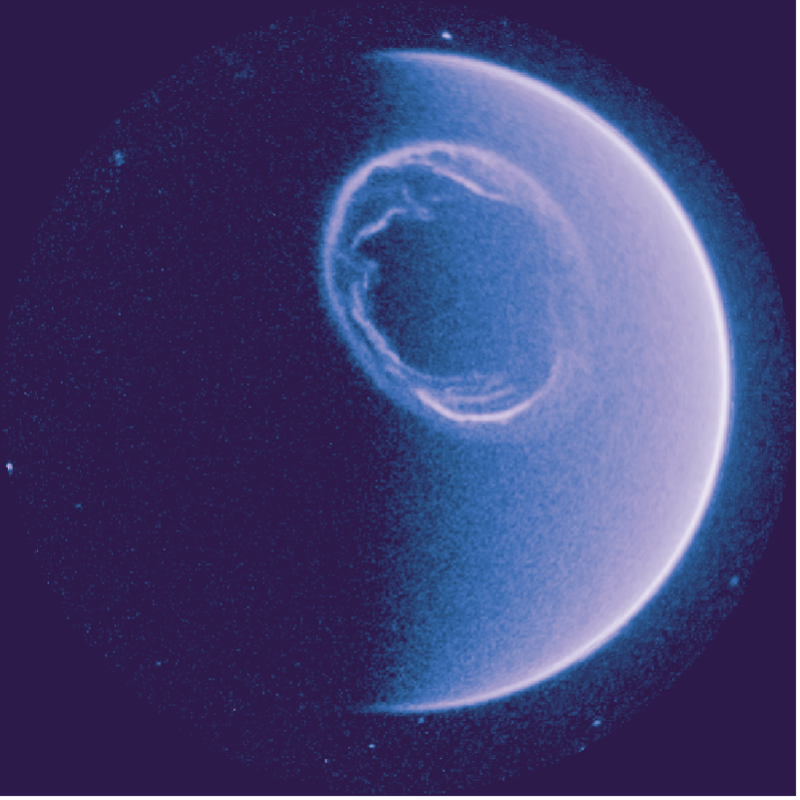
For most of the last eighteen years, anyone wanting to see the whole northern auroral oval at once has had to piece together images from low-Earth orbit, stitching narrow camera swaths into a quilt. The ultraviolet imager on the new SMILE spacecraft ended that gap on 24 July 2026, and on 30 September 2026 the European Space Agency released the result: a 45-hour ultraviolet movie of the entire ring of northern lights, dayside and nightside together, with an auroral substorm frozen mid-ripple. It is the first complete ultraviolet portrait of the oval since NASA’s Polar mission ended in 2008, and the early frames are already changing how researchers think about the boundary between the solar wind and Earth’s magnetic shield.
SMILE, the Solar wind Magnetosphere Ionosphere Link Explorer, is the first space mission jointly selected, funded, built, launched, and operated by ESA and the Chinese Academy of Sciences. It launched on 19 May 2026 aboard a Vega-C from Europe’s Spaceport in French Guiana, reached its science orbit on 20 June, and on 23 September 2026 ESA declared the spacecraft ready to start routine science operations. The mission is built around a question that has lingered since the magnetosphere was first sketched in the 1960s: how does the Sun’s wind of charged particles couple, end to end, to the bright auroras people watch from the ground. Past missions like ESA’s Cluster constellation and NASA’s IMAGE have studied pieces of that problem. SMILE is the first to watch the whole system in one go.
The instrument that produced the released image is UVI, the ultraviolet aurora imager, one of four science payloads aboard the 2,300-kilogram spacecraft (1,580 kilograms of that is propellant used to climb to its operational orbit). UVI was switched on 16 July 2026 and began returning data on 24 July, when the spacecraft caught a substorm in progress. Substorms are short disturbances in the magnetosphere, produced when a pulse of solar wind compresses Earth’s magnetic field lines, fires a burst of energetic particles down toward both poles, and lights up the oval for tens of minutes. The released 58-second clip covers 00:00 to 00:58 Universal Time, with the timestamp ticking in the upper left corner and distant ultraviolet stars drifting in the background. The way the bright ring ripples and brightens across those 58 seconds is the signature of a substorm loading and unloading the magnetotail.
The image at the top of this post is a single frame from that clip. The crescent Earth is light blue, the way it always looks in the ultraviolet Lyman-alpha and far-ultraviolet bands UVI is tuned to. Around the north pole, the white swirl is the auroral oval itself, including the dayside arc that ground cameras cannot see because the Sun drowns it out. The image is square because UVI’s field of view is roughly 10 degrees across, and the spacecraft’s highly inclined, highly elliptical orbit takes it as far as 121,000 km above the North Pole at apogee, nearly a third of the way to the Moon. From that height, the camera can frame the entire oval in a single exposure. The other three instruments contribute context that UVI alone cannot: SXI, a soft X-ray imager led by the University of Leicester, will map the magnetopause, the boundary where the solar wind meets Earth’s magnetic field, by imaging X-rays produced when solar wind ions swap charge with neutral atoms in the geocorona. MAG, a boom-mounted magnetometer, samples the local field strength. LIA, a light ion analyzer on the platform, counts the solar wind particles themselves. The combination is what makes SMILE different: it is a magnetosphere-wide camera, not a single-region probe.
The science the mission is built to chase is space weather. Solar storms can knock out satellites, drag down power grids, and force airlines to reroute polar flights, and the most damaging ones are the hardest to predict because the chain from solar wind to ground-level aurora runs through a magnetosphere that nobody has watched in its entirety. SMILE’s 45-hour continuous ultraviolet sessions are aimed at filling that gap, capturing the oval through enough of a solar rotation to see how the magnetosphere responds as the wind direction and density shift. ESA expects about 300 substorms across the three-year nominal mission, more than usual because the Sun is at the peak of its eleven-year cycle. The mission consortium, reported by India Today, includes more than 250 European and Chinese scientists and 14 contributing countries, with Airbus Defence and Space leading the payload module assembly at ESA’s ESTEC technical centre in the Netherlands. The mission also carries the first instrument ever designed to look at the magnetopause in X-ray light, opening a window that no previous mission has had.
There are open questions that no amount of engineering has answered yet. SXI, the soft X-ray imager, is currently too sensitive to stray light when pointed at Earth, and the team is uploading new settings and software to the spacecraft to bring the background down. The good news is that the unwanted light is dropping on its own as SMILE’s orbit carries it farther from Earth and as the north pole tilts into winter darkness. Mid-October 2026 should bring SXI’s first clean view of the magnetopause or the northern polar cusp, the funnel-shaped hole in the magnetic field above the pole through which solar wind ions rain down. Once SXI lights up, SMILE will be returning simultaneous X-ray and ultraviolet movies of the same events, the first time anyone has correlated the two views frame by frame. The auroral substorm clip itself, covered by Space.com on 2 October, is what put SMILE in front of a public audience that had not heard of the mission before.
What comes out of the next few months is going to be a database, not a single picture. The first ultraviolet still is the proof that the camera and the orbit work, and the GIF of the 24 July substorm is a teaser for the kind of change the camera can resolve. The real work begins in late October 2026, when SXI is expected to deliver its first usable magnetopause image and the four-instrument observation campaign gets underway. Three years from now, the dataset SMILE accumulates should let researchers tie specific solar wind conditions to specific ground-level disturbances in a way that current models, which lean heavily on extrapolation, cannot. That is the kind of data that takes the guesswork out of space weather forecasts, and that is what the mission was conceived to deliver. The first still was the postcard; the science database is what the postcard is advertising.
 Subscribe to our RSS feed









There are no comments.
Add A Comment